
“The Lesser Key of Solomon” does not describe one uniform book. Its parts sort spirits, time, direction, ritual objects, and prayers in different ways. Reading the compilation closely means following those systems as well as the manuscripts that preserve them.
One compilation, five different engines
The familiar five-book table of contents hides a change of method at every boundary. Goetia numbers seventy-two spirits and gives each a rank, appearance, offices, legions, and seal. Theurgia-Goetia replaces that single numbered file with a directional hierarchy of aerial chiefs and ministers. Ars Paulina sorts one series by planetary hours and another by the 360 degrees of the zodiac. Ars Almadel organizes four altitudes around a marked wax device. Ars Notoria joins prayers and graphic notae to promised learning. These are not five chapters applying one classification. They are distinct textual machines gathered under one Solomonic claim of authority.
A partial Lemegeton changes the collection’s logic. Without Ars Paulina, named ranks never yield to celestial time; without Almadel, four-altitude geometry disappears. The fifth position is unstable because medieval Ars Notoria predates the compilation while some appendices depend on Turner’s 1657 print. The five-part sequence exposes compilation rather than a single original plan.
The Goetia turns a catalogue into an operation
Jean-Patrice Boudet describes the older demon-catalogue genre through a recurring set of fields: name, title, physical appearance, functions, and the number of troops counted in legions. Weyer’s Pseudomonarchia Daemonum preserves that logic in a list of sixty-nine spirits. The Goetia keeps the compact profile but expands the list to seventy-two, changes its order, drops Pruflas, and adds Vassago plus the final three entries. The result still behaves like a directory: a reader chooses a named office, then finds the associated rank and description.
The Lemegeton makes that directory depend on apparatus placed around it. Individual entries repeatedly tell the operator to wear a seal as a lamen, hold a ring near the face, or constrain a figure in the triangle. Later sections supply the circle, triangle, pentagonal and hexagonal figures, ring, secret seal, materials, successive conjurations, reception of the appearing spirit, and license to depart. The ritual logic therefore runs in two directions. A profile identifies whom the text says may be addressed and for what purpose; the common apparatus tells the reader how every selected profile is meant to enter the same controlled space. A seal by itself is only one field in that larger sequence.
Worked comparison: Astaroth becomes a ritual record
Astaroth provides a close test because the descriptive core survives while its textual job changes. Weyer lists Astaroth as spirit 28. In the Sloane MS 3825-based transcription, Astaroth is spirit 29: a powerful duke who appears as an unattractive angel riding a dragon-like beast and carrying a viper. The entry attributes answers about past, present, and future, disclosure of secrets, an account of the spirits’ fall, instruction in the liberal sciences, and command of forty legions. Those elements preserve the older catalogue pattern. The changed ordinal shows that the Goetia is reorganizing inherited material rather than simply copying Weyer’s list from top to bottom.
The manuscript-based entry also binds that profile to two objects. It directs the operator to hold the magical ring near the face against the figure’s harmful breath, then says Astaroth’s seal must be worn as a lamen for obedience. The 1904 Mathers–Crowley printing keeps the sequence and nearly every claimed office, but regularizes the prose: the manuscript’s “unbeautifull angel” becomes a “hurtful Angel,” and its awkward dragon phrase becomes an infernal beast like a dragon. This is a small verbal revision with a large visual consequence. In print, the normalized paragraph and a clean seal look like one settled record; the manuscript transcription exposes spelling, syntax, and editorial uncertainty. Both still make the ring and lamen part of how the record is supposed to function, rather than decorative emblems beside a biography.
What a two-book witness preserves and removes
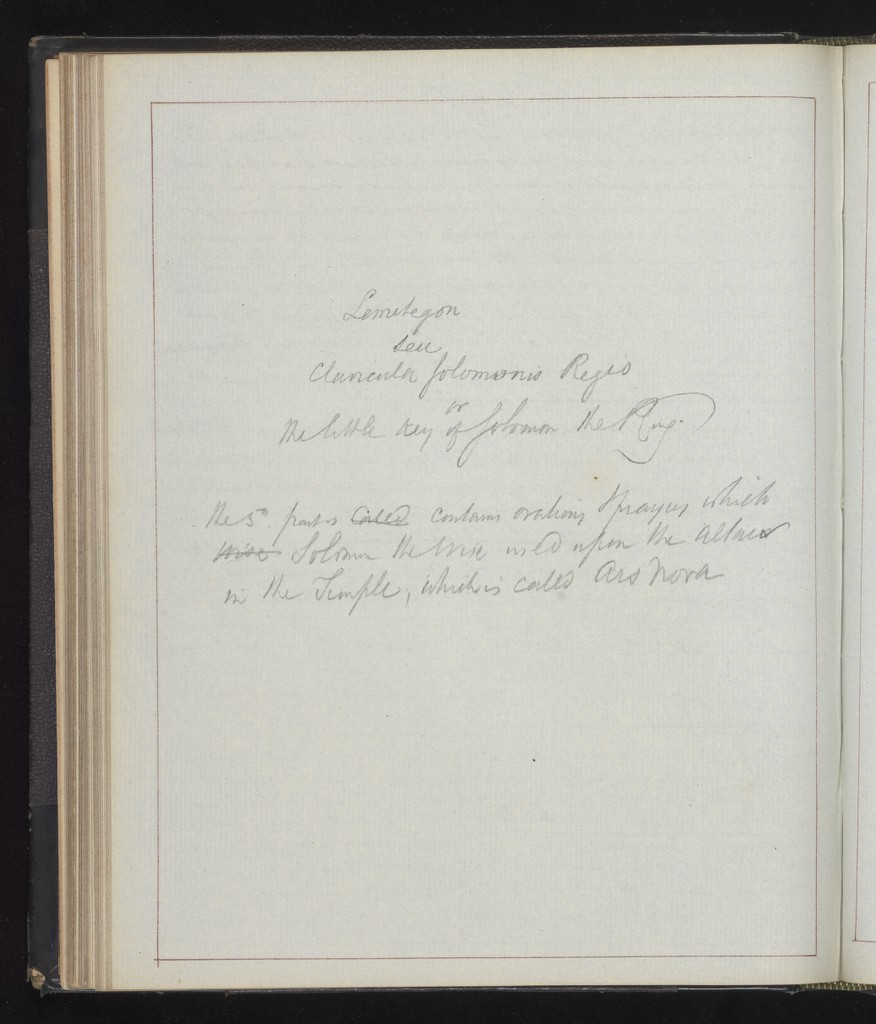
Wellcome MS.3203 makes partial transmission visible. The whole nineteenth-century volume is a miscellany of five treatises. Its fourth treatise is titled as two Solomonic books, Goetia and Theurgia-Goetia, with names, offices, circles, and seals. The surviving section therefore places a numbered spirit catalogue beside a directional aerial hierarchy. It does not continue into the hourly and zodiacal arrays of Ars Paulina, the four-altitude device of Almadel, or the prayers and notae associated with Ars Notoria. Calling this section Lemegeton preserves a broad title while narrowing the operative range of the copy.
Frederick Hockley wrote that he had copied his exemplar from a finely written manuscript he dated around 1680–1700, and Henry Dawson Lea later copied material lent by Hockley. The leaf is evidence for that nineteenth-century copying chain, not a photograph of a seventeenth-century archetype. Its pen-drawn and pasted diagrams also show why textual completeness and visual completeness are separate questions. A copy can preserve a recognizable spirit entry yet redraw, relocate, or lose the sign that accompanies it. It can likewise preserve the title of a larger compilation while transmitting only two of its organizing systems.
What the 1904 edition asks readers to believe
The 1904 volume announces that its introductory description combines four manuscript variants in parallel and argues that their wording agrees closely while later seals deteriorate. That editorial claim prepares the reader to treat the printed prose as a stable composite and the selected diagrams as repairs to transmission. The book then prints Goetia alone, framed by an introduction, preliminary invocation, and commentary. A twentieth-century reader therefore meets one Lemegeton book through an editor’s synthesis and added front matter, not through the order, handwriting, or physical boundaries of a single codex.
This distinction also clarifies the British Library catalogue problem. The current short record for Sloane MS 3648 identifies a Lesser Key at folios 1–47, while the public summary for Sloane MS 3825 names other magical works even though the manuscript-based edition identifies that shelfmark as its principal Lemegeton witness. The disagreement should limit claims about exact folio contents until the records can be reconciled. It does not erase what the texts reveal: manuscript witnesses preserve changing selections and diagrams, while the 1904 print selects Book I and presents one edited reading as a coherent stand-alone Goetia.
References
- British Library, Sloane MS 3648 current catalogue ↗
- British Library, Sloane MS 3825 current catalogue ↗
- Wellcome Collection, MS.3203 catalogue and Public Domain Mark ↗
- Boudet, demon-catalogue structures and the Livre des esperitz ↗
- Project Gutenberg, Reginald Scot’s 1584 Discoverie of Witchcraft ↗
- Peterson, Sloane MS 3825-based Goetia transcription and variants ↗
- Wikisource, indexed 1904 Mathers–Crowley Goetia ↗
- Peterson, Lemegeton manuscript and edition overview ↗