
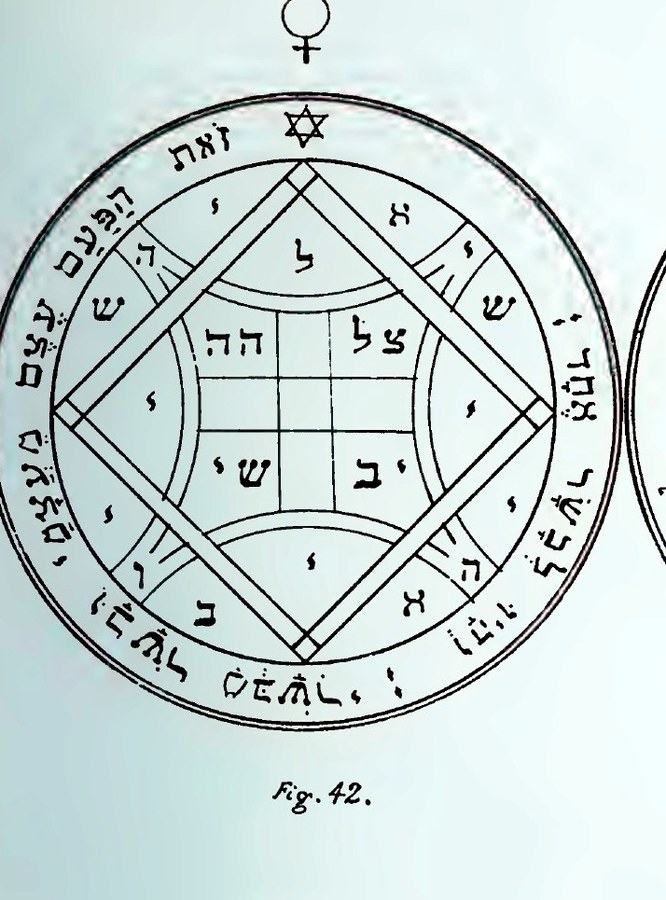
Mathers gives the figure a coercive claim: compelling Venus spirits and forcing a desired person to come.
- Planetary group
- ♀ Venus
- Mathers figure
- 42
- Printed plate
- X
- Text anchor
- Genesis 2:23–24
Mathers assigns green and copper to this planetary group. The crop documents his printed linework; it does not reproduce the color or material described elsewhere in the edition.
What Mathers’s caption claims
Mathers gives the figure a coercive claim: compelling Venus spirits and forcing a desired person to come.
Within the Venus collection, this places figure 42 among themes of Venus spirits, favor, desire, attraction, and compelled presence.
Inscription, names, and script
Genesis 2:23–24: This is bone of my bones, and flesh of my flesh; and they two were one flesh.
IHVH occupies four angles; Schii, Eli, Ayib, and other spirit names fill the interlaced field.
How the diagram is organized
The visible core is a small central crossing. Around it, overlapping triangles and a quadrilateral distribute divine and spirit names. At the edge, the union passage encloses the figure.
Mathers plate and witness differences
The note gives examples rather than a complete transcription of the spirit names. A responsible diagram analysis can identify the four IHVH corners and the cited examples without inventing the unread names.
Plate X is an artifact of Mathers’s 1889 arrangement. His preface and final note say that he compared differing manuscripts and restored difficult Hebrew and magical characters. Sloane 2731 and Lansdowne 1203 remain distinct manuscript objects; this printed crop should not stand in for either one.
WORKED EXAMPLE
A diagram reading of figure 42
Count the four divine-name corners first, then trace the interlaced lines toward the partial spirit-name field. The “one flesh” verse binds an internally divided drawing, making union the outer interpretation of visibly separate parts.
View this figure in sequence
The Venus collection contains 5 figures, numbered 39–43 in the 1889 edition.