
A modern profile can combine an early name, a later number, and a twentieth-century seal. Each element needs its own edition label if the page is to serve as a reference rather than a visual collage.
- Early printed names
- Weyer 1577; Scot 1584
- Goetia edition
- Mathers/Crowley 1904
- Local seal crops
- 1916 illustrated printing
A name is not a seal source
Weyer’s Pseudomonarchia and Scot’s English inventory are early printed witnesses for many names and attributed offices that later appear in the Ars Goetia. Their list positions differ, and neither should be treated as the source of every familiar numbered Goetia emblem. In particular, the Weyer entry for Pruflas supplies a conspicuous test: Pruflas has a place in that Latin catalogue but no numbered entry in the later seventy-two and no corresponding seal in our Goetia gallery.
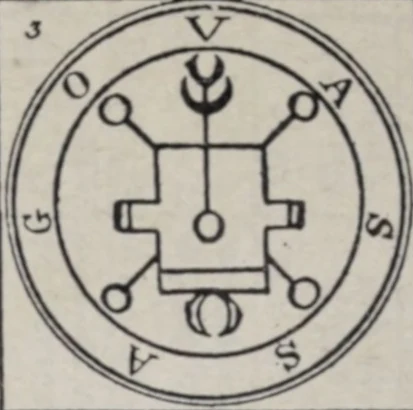
Vassago shows the reverse direction. The name is absent as an entry from Weyer’s 69 and Scot’s inventory, yet is number 3 in the later Goetia. A page that labels a Vassago seal “Weyer, 1577” would therefore join a name and an image across sources without evidence. The more accurate caption identifies the actual printing that supplied the drawn sign.
The 1904 text and the 1916 pictures
The Book of the Goetia of Solomon the King appeared in 1904 with S. L. MacGregor Mathers named as translator and Aleister Crowley as editor and publisher. It is a modern printed presentation of older Lemegeton material, not the original date of the catalogue. The numbered list is a useful comparison target for names such as Bael at 1, Vassago at 3, Paimon at 9, and Belial at 68.
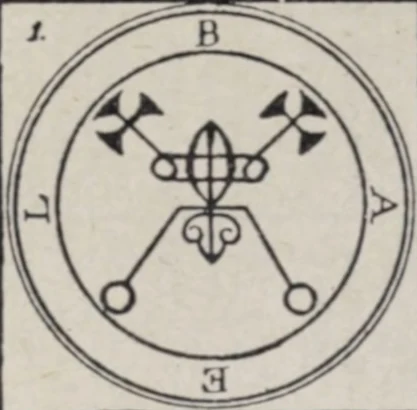
The cropped seal images used in this site’s seventy-two profiles come from the illustrated 1916 de Laurence edition retained by Project Gutenberg as ebook 72679. The site’s local manifest records each plate, crop box, URL, and image hash. The image therefore documents the 1916 edition, while an adjacent account of a numbered entry may draw on the 1904 text or a sixteenth-century spelling. The two printed works are related witnesses, but a cropped plate is evidence for what that plate printed.
What the image can and cannot establish
The two examples below are not a proposed decoding of the lines. Bael’s image shows a seal numbered 1 in the 1916 source plate. Vassago’s shows a seal numbered 3. Those numbers let a reader connect the drawings to entries in that particular visual catalogue. They do not prove that the marks existed in Weyer’s printing, that a manuscript drew them identically, or that any supernatural claim in the text is true.
Edition comparisons reveal changed strokes, missing marks, and different attributions on particular plates and folios. Those variants cannot be replaced by a single supposedly correct drawing. The collection keeps the variants visible and links each historical seal to its image source.
Vassago shows the change in the visual record
Vassago has no entry in Weyer’s 69 or Scot’s English inventory. The later Goetia gives the name number 3, and the 1916 frontispiece prints a numbered seal. Its position and image belong to that later tradition. The early printed lists cannot supply a Vassago seal they never showed.
The 1904 Goetia text, 1916 illustrated edition, and earlier Weyer and Scot lists answer different questions about a name, office, sequence, and image. The linked printings and catalogue records show those differences directly; Peterson’s modern comparison provides further historical context.
Printed texts and images
- Weyer, De praestigiis daemonum, fifth edition (1577), digitized volume ↗
- Scot, The Discoverie of Witchcraft (1584), 1886 annotated reprint, Book XV, chapters 1–2 ↗
- Mathers/Crowley, The Book of the Goetia of Solomon the King (1904), numbered catalogue ↗
- The Lesser Key of Solomon, 1916 edition, Project Gutenberg ebook 72679 ↗
- Joseph H. Peterson, modern Weyer/Scot/Goetia comparison (copyrighted edition; link only) ↗