
Sigil of Furcas
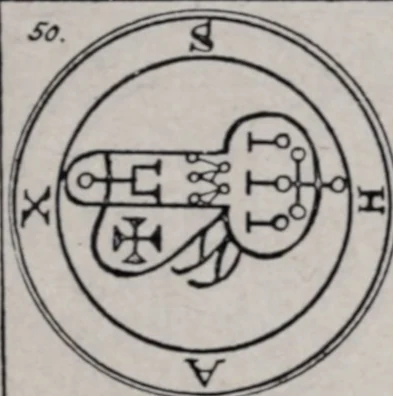
At a glance
- Entry
- 50 of 72
- Rank
- Knight
- Legions
- 20 in the text
Description in the text
Furcas is the catalogue’s knight rather than a king, duke, or president. His office is teaching philosophy, astrology, rhetoric, logic, palmistry, and divination by fire.
Read entry 50 on page 38 of the 1916 edition
Appearance
An elderly, bearded man on a pale horse, carrying a sharp weapon.
Topics attributed to this entry
- Philosophy
- Astrology
- Divinatory arts
Reading this entry
Furcas is the catalogue’s knight rather than a king, duke, or president. He is an old, severe-looking man with a long beard and white hair, riding a pale horse with a sharp weapon. The attributed office is unusually focused on instruction: philosophy, astrology, rhetoric, logic, palm reading, and fire divination. The source claims completeness in those subjects but offers no lesson or system of its own.
His 20 legions and seal follow a straightforward description with no transformation or named superior. The unique rank makes Furcas important in any overview of the Goetia’s hierarchy. It also shows why rank filters should preserve the exact title rather than forcing every entry into the more common royal and ducal categories. The martial picture and scholarly office coexist without a stated explanation.
Read entry 50 on page 38 of the 1916 edition or compare the 1904 transcription.
A closer reading of entry 50
What the numbered text says
Furcas is explicitly a knight, a distinctive title in a catalogue dominated by kings, dukes, and presidents. The older rider’s weapon adds an image of severity, yet his stated office is entirely instructional. Philosophy, astrology, rhetoric, logic, palmistry, and fire divination are listed by name. That specificity makes it possible to describe his syllabus without attributing cures, treasures, or warfare to him merely because of his armed appearance.
About the printed seal
The entry calls its numbered sign a seal or mark; plate 4 supplies image 50. The printed lines do not identify the weapon or the horse, and the source’s two terms provide no symbolic reading of the mark.
Compare another entry
Compare entry 46: Bifrons. Bifrons also teaches astrology and geometry, but his account adds stones, woods, moved bodies, and grave lights. Furcas’s instruction is narrower in kind but more detailed about verbal and divinatory disciplines. Their rank and portrait are also unlike each other.