
The manuscript is an anthology of forty-seven entries, not a single argument or a uniform set of symbols. Its pages move between prose, prayers, names, short directions, circles, and angular signs.
- Extent
- 47 entries in 32 leaves
- Languages
- Icelandic with Latin and encoded material
- Page forms
- Prayers, prose, lists, circles, and staves
An anthology arranged by accumulation
The forty-seven entries vary sharply in length and form. Some occupy several pages; others pair a few lines with a drawn sign. Modern summaries group their stated aims under protection, healing, divination, social influence, finding thieves, controlling weather or animals, and causing harm. Those are categories made after the fact. The manuscript itself does not open with a systematic table that turns them into a coherent school. It looks instead like a working compilation enlarged by successive owners or copyists.
That distinction changes how the book should be read. A protective prayer and a hostile charm can sit near each other without expressing one consistent theology. A calendrical list of unlucky days can interrupt material concerned with seals or psalms. The practical variety is part of the evidence: the compilers gathered items they considered useful, memorable, or authoritative. The entries record historical beliefs and desired outcomes; the manuscript supplies no evidence that the promised effects occurred.
Worked page comparison: scan 17’s word-ring and scan 40’s embedded staves
Scan 17, the manuscript page numbered 8, builds one figure by nesting kinds of writing. A circular band of words is divided by four cross-like marks. Inside it, larger signs sit beside four short rows of vertical strokes; below it, several lines of Icelandic prose continue within the same red-ruled writing frame. The ring therefore is not an isolated logo placed above an unrelated recipe. Written names make its boundary, the repeated strokes organize its interior, and the paragraph beneath supplies the verbal part of the entry. A crop that keeps only the central characters removes the circular reading order and the transition back into ordinary lines.
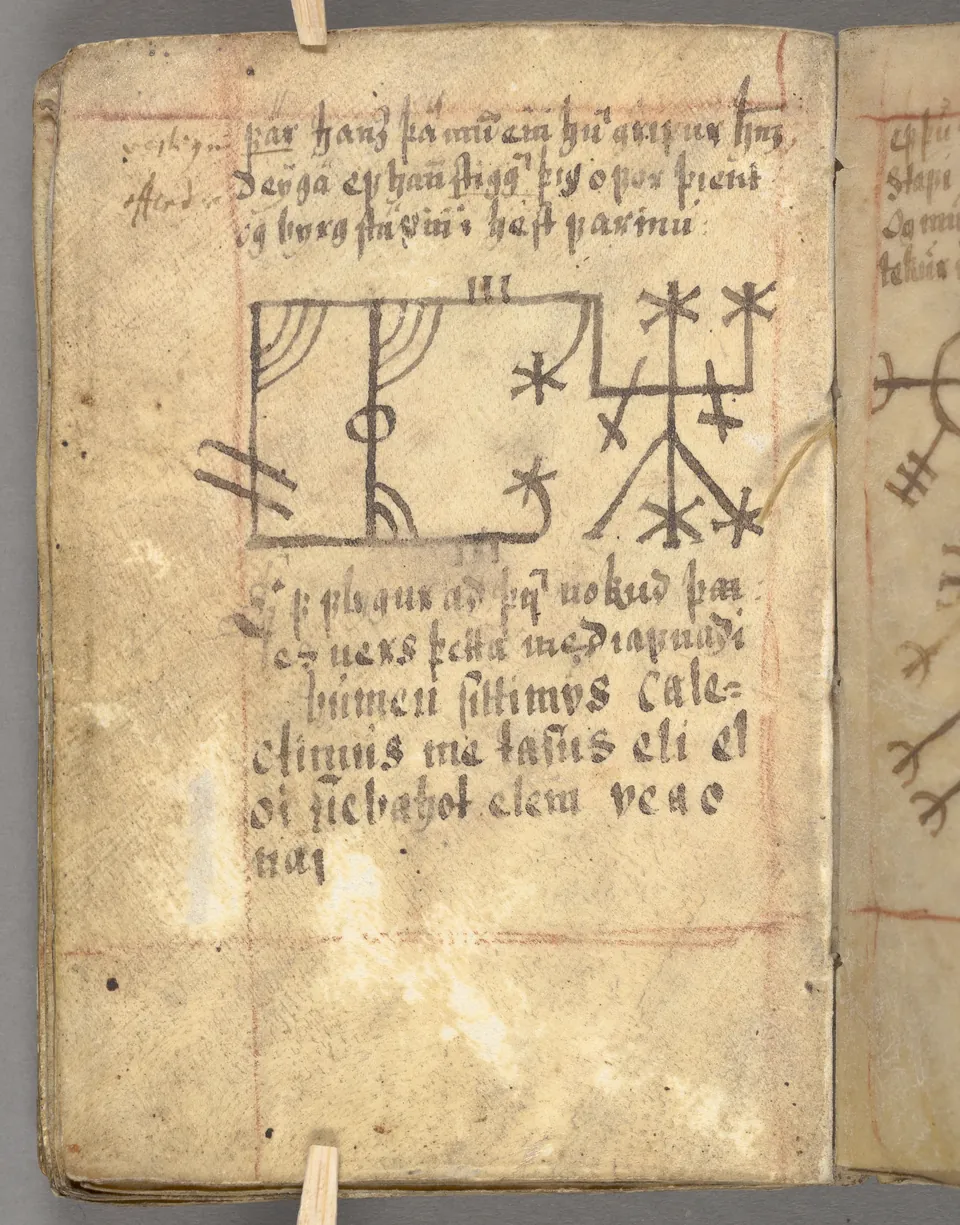
Scan 40 uses the page in almost the opposite way. A short verbal direction comes first, then two bold figures interrupt the prose. The left figure is bounded by a rectangle, with curved bands in two upper corners, a central descending line, and smaller marks at the base and side. The right figure branches from a tall stem into crossbars, forks, and terminal strokes. Another block of prose resumes immediately below, while parts of further signs remain visible on the facing leaf. The drawings function as objects inside the written sequence: text introduces them, space separates them, and text continues after them.
Putting the scans side by side reveals two compositional methods within one anthology. Scan 17 makes words part of a figure’s circumference; scan 40 gives figures their own space between instructions. The first asks the eye to move around and then down. The second asks it to move from prose into two distinct designs and back to prose. Both pages join language and graphic marks, but they do not share one universal stave template. That difference is evidence for compilation: the book preserves operations whose authority could be carried by encircling names, by a bold sign embedded in directions, or by both at once.
Words and figures share the page
The digital images make clear that the famous signs were not originally isolated logos. Scan 17 places a ring of words and crosses above a written passage. Scan 40 embeds two bold figures inside surrounding directions, with another large sign visible on the facing leaf. Red ruling, page numbers, cramped lines, and changes in ink remain visible around them. Cropping a sign away from that material removes clues about sequence, scale, and the hand that drew it.
The figures also resist the idea of a single visual grammar. Some are circular and text-bearing; others are branching, framed, crossed, or assembled from strokes that resemble letters without functioning as ordinary writing. A page can mix several types. The 2025 Gripla study compares these forms with European learned magic and argues for adaptation rather than isolation, while also stressing that Icelandic scribes altered the material for local uses. That is a historical argument based on comparisons, not a claim that every shape has one recoverable source.
Christian, learned, and local vocabularies
Icelandic is the manuscript’s main language, but it is not the only vocabulary on the leaves. Latin phrases, biblical material, sacred names drawn through Greek and Hebrew traditions, cipher-like writing, and signs appear beside vernacular directions. Psalm 109 occupies a substantial run. Elsewhere the names of Norse gods enter lists alongside Christian or demonological names. The result is not a surviving pagan handbook. It is an early modern manuscript assembled after Iceland’s conversion, in contact with Christian prayer, European magic, and local learned traditions.
Stephen Mitchell treats Nordic leechbooks, manuals, and grimoires as overlapping textual forms rather than sealed categories. That approach fits this book: requests for bodily relief, protection from danger, knowledge, coercion, and injury share material space with prayers and signs. Roberto Luigi Pagani’s later study interprets the staves as a vernacular transformation of wider European sigil traditions. Both readings make the mixtures on the page central. Neither requires the modern assumption that an angular form is automatically a Viking Age rune.
Archive records and scholarship
- Alvin, Stockholm Galdrabók catalogue record (ATA Ämb 2, F 16:26) ↗
- Alvin manuscript image, scan 17: circular sign within the text ↗
- Alvin manuscript image, scan 40: signs and surrounding directions ↗
- Natan Lindqvist, En isländsk svartkonstbok från 1500-talet (1921) ↗
- Stephen A. Mitchell, Leechbooks, Manuals, and Grimoires (Arv, 2014) ↗
- Roberto Luigi Pagani, The Mediterranean Origin of the Galdrastafir (Gripla) ↗