
The surviving Angelical material offers several kinds of evidence: a named alphabet, prose received in sessions, immense letter grids, and Calls with English renderings. This collection turns those records into searchable tools while keeping their boundaries visible.
Dictionary, transliterator, grammar, and source comparison
High-level introductions often collapse alphabet, vocabulary, translation, and pronunciation into one promise. The records do not support that shortcut. A letter-name tool can map a modern spelling without translating it. A concordance can locate an attested phrase without proving that every word has a fixed definition. A grammatical observation becomes stronger when a form recurs in comparable positions.
A map of the Angelical language evidence
Alphabet and early conferences
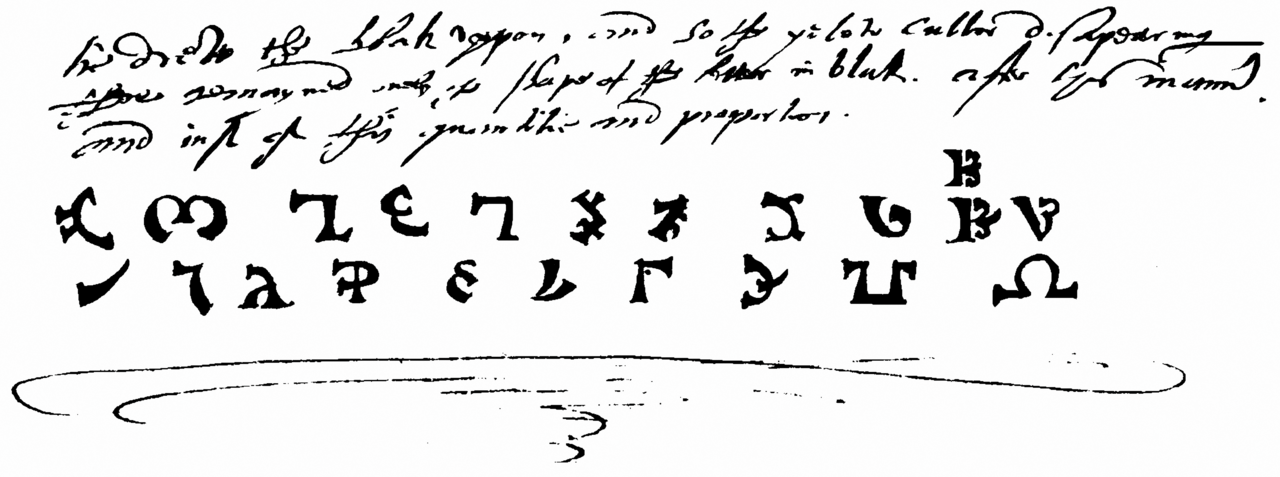
The 26 March action records twenty-one named letters in three groups of seven. A separate 6 May folio supplies the familiar handwritten forms. These entries support a letter register and a controlled transliterator.
Liber Logaeth
Prose material stands beside ninety-five forty-nine-by-forty-nine tables, two empty tables, and four larger arrangements. Grid position and reading direction matter as much as apparent word shape.
The Angelical Keys
Eighteen fixed invocations and one form applied to thirty Aethyrs account for the manuscript count of forty-eight Keys and the familiar count of nineteen Calls. Interlineated English makes this the strongest vocabulary corpus.
Accessible Calls 1–2
The Equinox I:8 printed Angelical and English forms with editorial spellings and hyphenation. Its public-domain text supplies the bounded dataset used by this collection’s concordance.
The manuscripts record a developing body of work rather than one dictionary-ready language manual. The Keys and Logaeth comparison shows why prose, grids, and translated invocations need separate labels before they can be compared.
What these tools can establish
The phrase concordance answers a narrow question well: where does a spelling or English idea occur in the first two printed Calls? It returns forty-nine editorial sense units with Call numbers and order. Because the English rendering is often longer than the Angelical line, the result is deliberately a phrase pair rather than a fabricated one-word gloss.
The alphabet transliterator maps present-day Roman letters to the twenty-one recorded character names. J, K, V, and Y require visible normalizations; W remains unresolved. This transparent result is more historically useful than a decorative font that hides the missing letters.
The grammar analysis tests recurring forms such as the goh- speech family and the repeated imperative sequence around zodacare. It also shows why a small corpus containing many one-off forms cannot support unrestricted automatic sentence generation.
All three tools point back to source objects. That design lets a visitor move from a search result to a manuscript group, date, and textual type. It also separates Dee and Kelley’s recorded material from later pronunciation systems and ceremonial adaptations.
Worked example: from search result to language claim
Search the dictionary for zodacare. The first result appears inside a longer Call 1 unit with eca and zodameranu; the English rendering presents a sequence of commands. The second Call contains the same forms in shorter adjacent units. Recurrence in an imperative setting supports identifying a command family more strongly than a single isolated gloss would.
Now search “justice.” The result reaches gohu IAD Balata in the opening of Call 1. The English phrase names the God of Justice, but the whole Angelical group should not be divided automatically into three English dictionary entries. Other goh- forms support a relation to speech, while IAD and Balata need comparison across further passages.
Finally, enter a modern name in the transliterator. “JOHN KELLY” produces a reproducible character-name sequence and labels J, K, and Y as normalizations. That output is about spelling, not the meaning of the name. The three steps demonstrate the collection’s central rule: a tool should return exactly the kind of evidence its source can support.
References
- British Library · Sloane MS 3188 ↗
- British Library · Sloane MS 3189 ↗
- British Library · Sloane MS 3191 ↗
- Christopher Whitby · John Dee’s Actions with Spirits, University of Birmingham ↗
- The Equinox I:8 (1912) · public-domain scan ↗
- Deborah E. Harkness · John Dee’s Conversations with Angels, Cambridge University Press ↗