
Cotton MS Appendix XLVI is not simply a container for “Enochian lore.” Its principal 1583–87 layer records a changing series of actions: dates, places, named participants, reported sights, questions, objections, prayers, and interpretations. Meric Casaubon’s 1659 A True & Faithful Relation carried much of that record into print, but surrounded it with a contents table and commentary designed to tell readers what the episodes meant. Reading one action closely shows both the diary’s working method and the editor’s intervention.
How an action turns observation into a record
The printed Relation opens its main diary text with a heading for the Liber Mysteriorum parallelus novalisque at “Lesden” on 28 May 1583, followed by a key identifying “D.” as Dee and “E. K.” as Edward Kelley. That apparatus matters. Kelley normally supplies the reported visual scene; Dee asks questions, comments, prays, or explains what he thinks a phrase means. Latin formulas can interrupt English dialogue, while dates and clock times make the encounter read like an experiment log. The page therefore preserves several levels at once: what Kelley says he sees, what a represented voice says, what Dee asks, and what Dee writes afterward. A later doctrine assembled from the diary can erase those levels. Within the record itself, interpretation is negotiated in real time, and uncertainty is part of the mechanism rather than an accidental blemish.
The archive changes subject as well as location
The first printed action does not begin with a finished angelic alphabet. Dee and Kelley are discussing the Polish nobleman Albert Łaski and Dee’s hope that this patron might restore his standing when a childlike figure identified as Madimi appears. The conversation moves through Łaski’s ancestry, scrolls and a book, devotional language, money, and Kelley’s resistance. This sequence joins patronage, family history, household pressure, theology, and reported vision on the same page. Later actions add travel, rulers, tables, calls, contested predictions, and renewed doubts. The Cotton witness is consequently better read as a developing dossier than as a single manual. Its changing subjects reveal how Dee tried to make reported communications answer political and practical questions, while Kelley’s questions and objections keep disrupting any smooth account of revelation.
Worked comparison: the first action and Casaubon’s contents table
Casaubon’s contents table labels the opening episode as Madimi’s first apparition, then immediately describes Łaski as an intended instrument in a supposed plan to overturn kingdoms. The diary entry itself begins more narrowly: Dee records gratitude for Łaski’s favor, reports the sudden figure, and pursues genealogical information. Sequence exposes the difference: Dee moves from circumstance to reported sight to question and response; Casaubon begins with a verdict. The table repeatedly adds judgments such as “pretence,” “illusion,” or “sermon-like stuff,” so a reader reaches the diary after being taught how to condemn it. At the same time, the dialogue preserves moments that resist a simple doctrinal extract: Kelley asks for money, Madimi answers evasively, and Dee supplies his own interpretation. The worked comparison shows why the 1659 print is both a major textual witness and a polemical edition.
The Holy Table plate visualizes a nested system
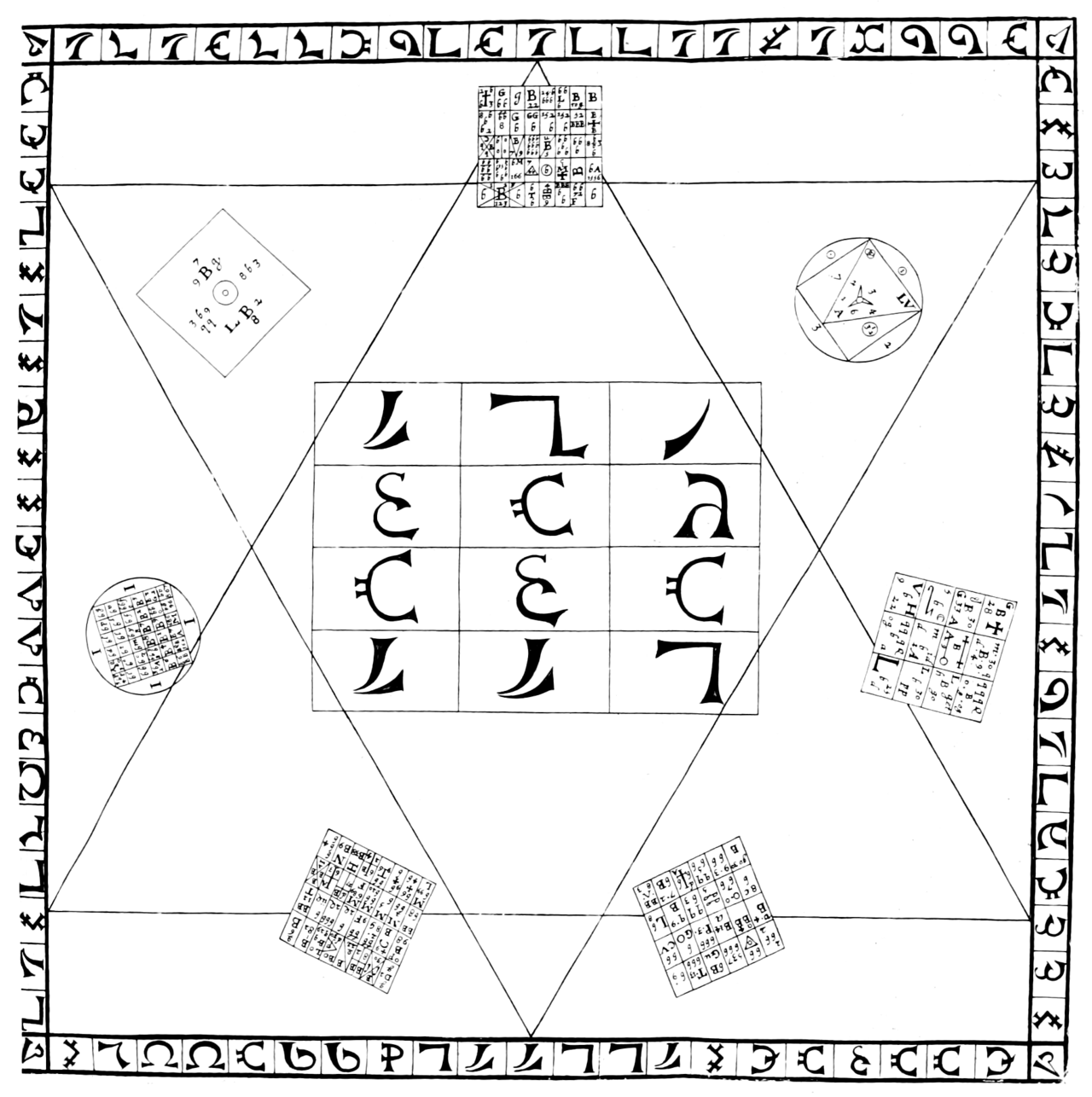
The engraved plate in the 1659 Relation turns one strand of the record into a single view. A lettered border encloses a large geometric field; smaller letter tables occupy peripheral stations; a larger block of characters sits at the center. Its design makes spatial relations visible: boundary, center, corners, and subsidiary tables work together rather than as detachable “sigils.” That visual logic resembles the diary’s method of coordinating names, positions, times, spoken formulas, and a seeing stone during an action. Yet the plate belongs to Casaubon’s publication stage. It is not a photograph of Cotton MS Appendix XLVI or of Dee’s lost painted wooden table. The Oxford museum record identifies the surviving marble table as a later copy. The engraving can therefore illuminate how the apparatus was organized while still showing how print converted a layered practice into a stable diagram.
The Cotton catalogue establishes the collected manuscript’s dates and later layers. The Folger record and the digitized 1659 text establish Casaubon’s printed arrangement, including its table of actions, speaker key, opening action, and engraved plate. The print remains an edited witness rather than a photograph of the manuscript.
Sources and records
- British Library, Cotton MS Appendix XLVI ↗
- Folger Shakespeare Library, 1659 A True & Faithful Relation ↗
- Wikisource transcription of the 1659 Relation, Part I ↗
- British Library, Sloane MS 3188 ↗
- History of Science Museum, marble copy of Dee’s Holy Table ↗
- Wikimedia Commons, public-domain 1659 Holy Table plate ↗