
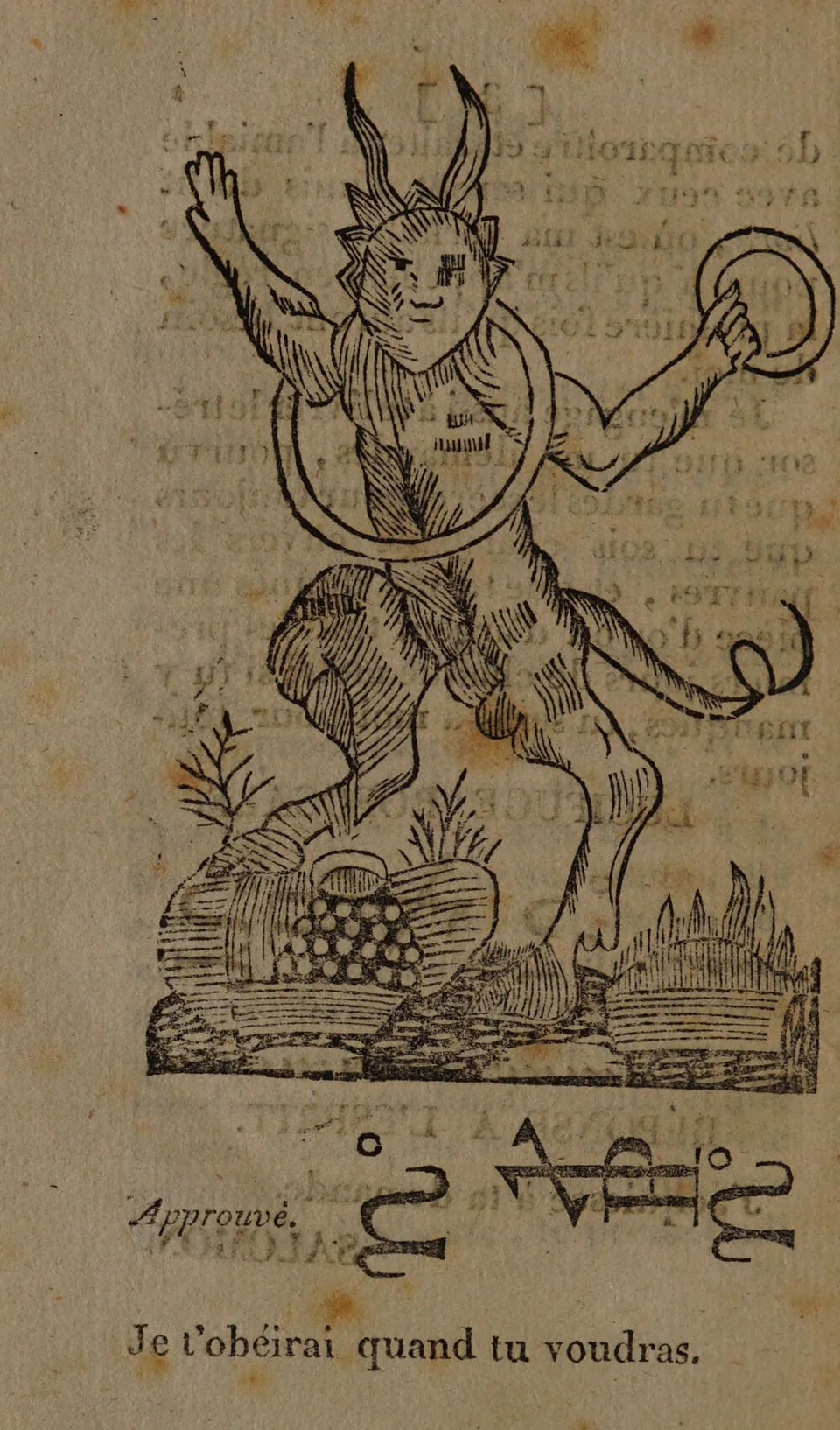
Solomon’s name authorizes very different communication scenes across centuries. The Testament of Solomon turns interrogation into royal wisdom and Temple labor. The Goetia converts names, appearances, offices, and seals into a reusable catalogue and ceremony. The Grand Grimoire stages resistance and written bargain. Similar motifs matter, but they do not make the three works editions of one unbroken manual.
- Late antique narrative
- Testament of Solomon
- Early modern compilation
- Ars Goetia
- Cheap-print drama
- Dragon Rouge
The Testament makes interrogation advance a story
The Testament opens at the Temple works. Ornias steals part of a boy’s food and wages and drains his strength. Solomon prays, receives a ring from Michael, and lets the boy use it to seize the attacker. Capture begins rather than ends the episode. Solomon asks the spirit’s identity, astral association, harmful activity, and countering angel, then assigns the captive to cut stone. Ornias carries the ring onward to Beelzeboul, so one compelled answer produces the mechanism for the next encounter.
This question pattern repeats with variations. Named beings explain attributed harms and opposing angels; groups such as the seven spirits and thirty-six decans extend the scheme; captives are redirected into Temple labor. The narrative argument is political and theological. Solomon’s wisdom classifies hostile forces under divine authority and converts them into building power. The final account of Solomon’s own fall qualifies that control, making royal mastery impressive but morally unstable.
The Goetia detaches profiles from narrative time
The Goetia still invokes Solomon, a ring, seals, a brass vessel, and compelled spirits, but its main list is not a continuous Temple story. Each numbered entry can stand as a compact record with rank, appearance, office, legions, and character. The ceremonial section supplies a common route from summons to answer and dismissal. Knowledge is organized for selection: choose an office, identify a spirit, insert the name, display authority, and ask within the attributed field.
That reorganization does not prove direct copying from the Testament. The named populations differ, and the Goetia catalogue has closer demonstrable relationships to the Offices of Spirits tradition, Weyer, and Scot. The resemblance lies at a broader Solomonic level: a king’s authority, written signs, compelled self-description, and a hierarchy that makes dangerous beings answerable. Genealogy requires verbal and manuscript evidence; motif comparison shows how later compilers could build with a prestigious narrative model without reproducing its plot.
Worked comparison: Ornias is interrogated while Lucifuge negotiates
Ornias’s scene moves through capture, self-identification, attributed harm, countering angel, and assigned labor. The questions progressively reduce uncertainty. Naming an opposing angel places the demon below a heavenly power, and the work order turns that classification into service at the Temple. Ornias can speak and even volunteer to fetch others, but he does not negotiate payment. The ring and Solomon’s judgment define the terms before the interrogation begins.
Lucifuge’s Dragon Rouge scene makes refusal part of the drama. Appeals to Lucifer precede the minister’s appearance; a request for wealth meets a twenty-year condition; the operator rejects it; Lucifuge asks for an offer; counterterms and recurring payment are written; and dismissal follows. Information about hierarchy is supplied before the model dialogue, but classification does not end the exchange. The book derives suspense from whether the agreement can be obtained on acceptable terms.
The contrast marks a change in argumentative logic. The Testament uses demon speech to prove Solomon’s divinely ordered kingship and to advance sacred construction. The Grand Grimoire uses dialogue to explain a private contract for treasure and the conditions attached to it. Both end with asserted control, yet one redirects captured labor while the other records obligation. The intervening Goetia occupies another position: it replaces much narrative negotiation with a reusable catalogue, superior names, and an office-limited demand.
Witnesses keep the history plural
The Testament survives in multiple Greek recensions, excerpts, later manuscripts, and an early papyrus fragment. Conybeare’s 1898 English version follows a particular edited base and divides the work into convenient sections. NASSCAL’s inventory makes the plurality visible. A sentence present in one modern translation cannot automatically define every ancient or medieval form of the work, and the date of an early fragment does not turn the full later narrative into one unchanged late antique book.
The Goetia likewise survives across seventeenth-century manuscripts whose spirit order, words, and diagrams vary; the 1904 edition adds a new printed frame. The Wellcome Dragon Rouge is a nineteenth-century cheap-print witness whose title page falsely advertises 1521 and whose public-domain scan preserves an internal two-book structure plus a Black Pullet appendix. These physical and editorial differences are historical evidence. They replace the fantasy of a single secret text with a traceable series of narrative, catalogue, and contract forms.
Primary texts and records
- F. C. Conybeare, Testament of Solomon (1898 edition) ↗
- NASSCAL, Testament of Solomon manuscript and edition inventory ↗
- Joseph H. Peterson, Sloane MS 3825 Goetia transcription and variants ↗
- Mathers and Crowley, The Book of the Goetia (1904 scan) ↗
- Wellcome Collection, Le véritable dragon rouge, public-domain digitization ↗
- Mélanie Papot-Libéral, Le Dragon Rouge: éditions et réception ↗