
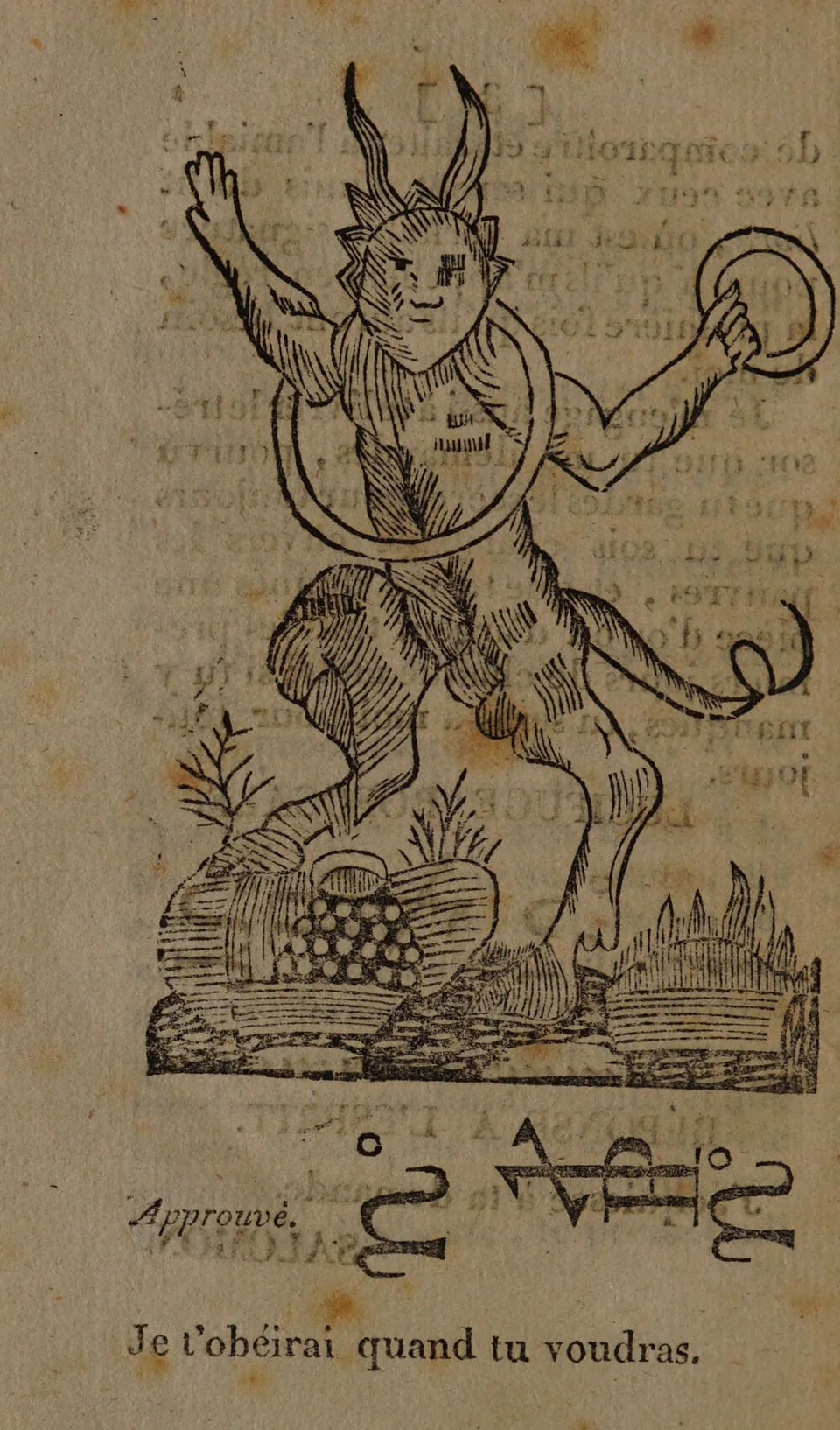
Historical texts do not treat every exchange with a spirit as the same kind of speech. The Goetia demands rational answers and continued presence under superior names. The Grand Grimoire dramatizes a demand, refusal, counteroffer, and written agreement. Other Solomonic texts imagine an oath registered in a book. Comparing these forms separates interrogation, service, and contract instead of flattening all three into “making a pact.”
- Goetia model
- Compelled answer
- Dragon Rouge model
- Negotiated pact
- Shared concern
- Truth and enforceability
The Goetia limits questions by office
The common conjurations demand true and faithful answers, but the catalogue determines what a named spirit is supposed to know or perform. Gusion is assigned past, present, future, and the meaning of questions; Caim gives disputed answers through burning ashes and interprets animal sounds; Murmur compels deceased souls to answer; Flauros discusses past, future, divinity, and the fall but is said to deceive outside the triangle. A question is therefore not imagined as unlimited access to information. It is filtered through an office, a location, and a rule about truthful speech.
The welcome reinforces that model. Once the figure is judged present, it is bound to stay until the operator’s will is performed without fallacy. This is closer to compelled deposition than reciprocal agreement. The spirit’s consent is not negotiated, and the superior divine hierarchy is invoked as enforcement. Even the license at the end assumes that departure requires the operator’s authorization. Calling this entire sequence a “pact” hides the grammatical asymmetry built into the source.
The Grand Grimoire turns resistance into a contract scene
The Wellcome Dragon Rouge witness builds the first book through preparations, repeated appeals to Lucifer, Lucifuge’s appearance, demands and replies, revised terms, a written convention, treasure, dismissal, and thanksgiving. Its second book, headed Sanctum Regum, reorganizes the material as a claimed general method of making pacts. A ruling triad and ministerial hierarchy precede a model dialogue. Lucifuge is not simply another numbered demon entry; he is a first minister associated with riches who can resist, propose a price, and receive counterterms inside the narrative.
The scene’s logic depends on delay. An initial twenty-year demand is refused, the operator answers with different terms and a recurring payment, and the exchange is stabilized in writing. The book presents that negotiation as controlled by appeals to powers above Lucifuge, yet it also gives the minister a speaking position unavailable to the Goetia’s replaceable N. The pact is a literary technology for explaining why promised wealth has a price, why terms must be fixed, and why continued enforcement is imagined after the appearance ends.
Worked comparison: a Goetia demand and Lucifuge’s counteroffer
Take one Goetia clause and one Dragon Rouge turn. The Goetia asks spirit N to make rational answers and perform desires insofar as its office allows. The placeholder and office restriction make the sentence reusable across a catalogue. No counterproposal is expected; failure moves the operator upward to a king or downward into stronger constraints. The communication tree branches according to obedience: answer, escalate, constrain, or dismiss.
Lucifuge’s model exchange branches according to bargaining. The request for riches receives a long-term condition; the operator rejects it; Lucifuge asks what will be offered; and a counteroffer is written. The dialogue turns a claimed infernal hierarchy into contract drama. Both sources worry about deception and enforcement, but they solve the problem differently. One multiplies superior names and spatial bonds; the other records terms and recurring obligation. “Questioning a demon” and “signing a pact” are therefore distinct textual operations.
The physical Wellcome witness sharpens the difference. Page 41 closes the first book, page 42 is blank, and page 43 begins a fresh second book promising the true way of making pacts. The repeated Lucifuge scene crosses that seam: first a character within one narrated operation, then an office within a reusable hierarchy. The Goetia catalogue and ceremonial speeches are likewise separate modules, but their seam joins profiles to a generic command sequence rather than converting a story into contract law.
Oaths can bind memory as well as a spirit
The Key of Solomon includes a different model in which spirits are made to swear upon a prepared book that they will appear when called. Whether or not any practice occurred, the book’s narrative logic is clear: writing turns a past encounter into a standing obligation. The oath is not identical to the Grand Grimoire’s exchange of services and payment. It resembles a registry or warrant that is meant to preserve future availability under sacred signs.
Witness differences caution against treating “the Solomonic pact” as one stable form. The Goetia’s manuscript ceremony, Mathers’s printed Key, and the nineteenth-century Dragon Rouge emerge from different compilations and editorial histories. They share divine names, Solomonic attribution, circles, and concerns about deceit, but those reusable motifs can support command, oath, or bargain. The useful historical question is which speech act a particular page performs and what surrounding structure makes it enforceable within that text.