RUNES · AMULETS · MODERN WARDS
Witchcraft Protection Rune: History, Amulets, and Modern Bindrunes
The search for one ancient protection rune compresses a letter, a written charm, and a modern designed emblem into the same mark. The surviving objects tell a stranger—and far more material—story.

STAR & SIGIL
Cut one boundary into a readable sign
Carry the rune's chosen operation into a cataloged warding rite while keeping history, modern design, and the present protective need distinct.
Set the runic boundary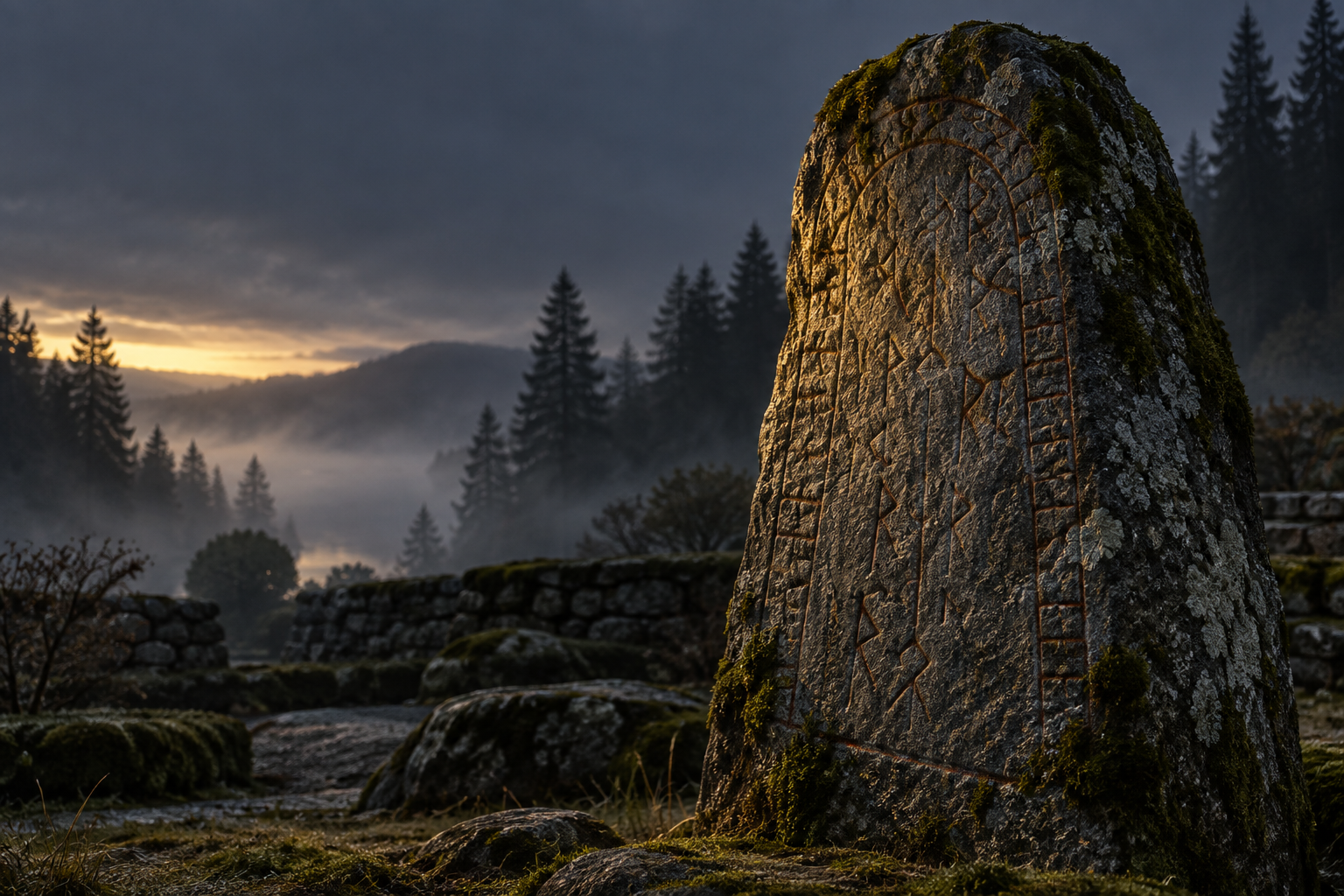
A thin copper sheet has survived with roughly 140 runes pressed across its surfaces. The metal is worn. The opening signs may be bindrunes, or they may not be read that way. The text is commonly understood as protective and appears to call upon Thor, yet parts remain disputed. Nothing about the object resembles a clean chart labeled “the protection rune.”
The Kvinneby amulet is powerful evidence precisely because it refuses that simplification. Protection resides in a written appeal, a divine relationship, a portable material, the arrangement of signs, and the body that likely carried the sheet. Remove one rune from the sequence and assign it a universal keyword, and the amulet’s actual architecture disappears.
A witchcraft protection rune can name three different things. It may mean a historical writing sign later assigned a protective association, a runic inscription operating across an amulet or object, or a modern single-rune or bindrune ward designed within contemporary practice. These categories can speak to one another. They are not the same historical claim.
01 / THREE DIFFERENT OBJECTS
Letter, inscription, and designed ward make different claims
| What is being called a protection rune? | What it actually is | What must be shown |
|---|---|---|
| Historical rune | A sign in a runic writing system, capable of representing sound within an inscription. | Its rune row, date, language, inscriptional context, and what the surviving text supports. |
| Runic amulet text | Several signs written on an object whose words, material, container, wearing, or placement may carry protective force together. | The object, sequence, plausible reading, uncertainties, invoked figures, and intended relation to danger. |
| Modern ward or bindrune | A contemporary magical design that may select, combine, rotate, or reinterpret rune forms. | The modern system and design logic, without presenting it as an unchanged ancient universal. |
The categories are connected by reception and revival, not collapsed by visual resemblance.
02 / RUNES ARE WRITING
The inscription is the first unit of meaning
Runes belong to alphabets used across long periods and changing regions. Surviving inscriptions include names, memorial statements, ownership, makers, short communications, formulas, and texts whose purposes remain uncertain. Many prominent runestones commemorate people; their carved signs do not become protective merely because later viewers find the alphabet magical.
The same rune shape can participate in different words. Its sound value, position, neighboring signs, language, date, and object matter. Treating each character as an isolated oracle card discards the reason writing can carry complex action: sequence permits a name to be distinguished from a warning, an invocation from an owner’s mark, and a charm from an alphabet exercise.
Writing can grant jurisdiction through a mark made by the person being bound. The Unenchanted Signature prevents a chosen person’s signature from binding them while their will is enchanted. Work that refusal where the sign exists but the will behind it is not free.
OBJECT READING THE KVINNEBY COPPER SHEET
Protection appears as an object-text, not a lone glyph
A worn copper sheet bears roughly 140 runes. Its opening may contain bindrunes, its interpretation remains debated, and its often-proposed protective appeal involves Thor. Read the layers separately before naming the whole.
The sheet is small enough to belong near a body rather than announce itself monumentally across a landscape. Copper can bend, wear, catch light, and preserve incisions while recording handling. Portability makes protection accompany a bearer, but surviving wear does not tell us every circumstance of use.
The carrier participates
The inscription exists on copper, whose portability and wear make bodily relation part of the evidence.
Protection unfolds in sequence
Roughly 140 signs provide room for address, action, naming, and relation that no one-character keyword can preserve.
Invoked agency matters
The likely appeal does not treat letter shape as self-sufficient; protection is related to a named powerful figure.
Uncertainty survives
Disputed opening bindrunes and debated readings are part of the object’s meaning, not defects to conceal.
THE CLOSE READING
The Kvinneby sheet supports historical runic protection without producing an ancient universal protection glyph. Its force belongs to an extended inscription on a portable object, plausibly invoking Thor for aid. The opening signs cannot be detached from that architecture and sold as certainty the whole object does not possess.
03 / ANOTHER SHEET, ANOTHER LOGIC
Veddesta adds a container—and another uncertainty
The Veddesta object is also an inscribed metal sheet, this time bronze and found with a leather case. Its text has been discussed as a possible charm against malice, yet the interpretation is not secure. That uncertainty matters because resemblance in object type does not guarantee identical office.
The leather case changes the material proposition. A container can conceal, preserve, carry, enclose, and control access to the inscribed sheet. Protection may therefore involve not only what the bronze says but how text and container meet: the words remain portable while the case mediates touch, visibility, and wear.
Compare the Battersea seax, a weapon bearing a runic alphabet sequence. Its inscription may have carried protective significance, but that possibility remains uncertain. Here iron, weapon, alphabet, naming, display, and skilled making intersect. Calling one character on the blade “the protection rune” would ignore the most conspicuous fact: the signs appear as a sequence on a weapon with its own material agency.
04 / BINDRUNES
Shared staves do not always mean a magical composite
A bindrune joins two or more rune forms through shared or intersecting strokes. Historically, such combinations can save space, solve inscriptional problems, mark names, or serve scribal purposes. Their existence does not establish that every combined stave encoded a magical stack of modern rune meanings.
Modern practitioners may deliberately build bindrunes by selecting characters for attributed powers, combining them, and reading the resulting form as a ward. That is a real modern magical design practice. Its honesty depends on naming its method and era rather than claiming every line descends unchanged from a documented ancient charm.
Visual combination creates new problems worth analyzing. One rune may dominate because its stave remains legible; another may disappear into the composite. Rotation can make additional rune-like shapes appear accidentally. Symmetry may improve emblematic force while obscuring the written sources. The resulting mark is not simply several meanings added together. It is a new visual object with a new hierarchy.
Which rune row?
Rune forms belong to particular writing traditions and periods, not one timeless occult alphabet.
Letter or word?
Ask whether the sign is read alone, inside a name, across an inscription, or as a modern keyword.
What carries it?
Stone, metal, wood, weapon, jewelry, paper, door, and skin create different relations.
What becomes dominant?
Combination, rotation, mirroring, and shared staves change legibility and visual authority.
What is refused?
Protection needs a danger, crossing, condition, or hostile claim more exact than “bad energy.”
How is office released?
A portable amulet, temporary mark, inherited object, and permanent carving do not retire alike.
05 / THE MODERN SINGLE RUNE
A contemporary ward can be meaningful without being universal
Modern rune manuals often associate individual signs with defense, shelter, resilience, divine power, boundary, or the strength to meet adversity. Different systems select different runes because they emphasize different names, poems, myths, visual forms, or magical correspondences. Disagreement is not solved by choosing whichever chart looks oldest.
A single-rune ward is strongest when its interpretive lineage is explicit. Is the practitioner drawing from a rune poem, a teacher’s system, modern divination, a deity relationship, or personal repeated use? Does protection mean repelling danger, enduring it, revealing it, containing it, or preserving choice under pressure?
This makes a modern protection rune an argument, not a fossil. It can be disciplined, beautiful, and consequential while remaining modern. Its legitimacy does not require an invented archaeological guarantee.
The honesty test
“I use this rune for protection within this modern system” is a complete magical claim. “This was the universal ancient Norse protection symbol” demands evidence no isolated chart can supply.
06 / PLACEMENT
A portable amulet and a threshold mark guard different events
A worn rune travels with a body. A carved weapon joins protection to handling and danger. A mark on a door remains when the occupant leaves. A sheet inside a case makes containment and concealment part of the object. Placement changes what can approach, what counts as crossing, and who holds custody.
That distinction becomes exact in The Threshold Rejects the Enchanted Token, which prevents an enchanted token from crossing the threshold of a chosen person’s home. Cast it where carrier, event, boundary, beneficiary, and place can all be named.
Mobility also changes evidence. If an amulet accompanies its wearer through many places, protection may be attributed to a broad span of uneventful time. A threshold ward can be tested only when a relevant approach occurs at that edge. Neither silence nor survival automatically reveals which rune, text, material, or ordinary safeguard contributed.
07 / NAMES AND CLAIMS
Inscribing a name can identify, invoke, commemorate, or bind
Runic inscriptions frequently make naming materially durable. A name can identify a maker or owner, remember a dead person, address a being, locate a target, or place someone within a claim. These offices cannot be inferred from the mere presence of personal letters.
Protection may depend upon recognition: this person is the bearer; this power is invoked; this threat is addressed. But recognition can become jurisdiction. A curse, oath, debt, or hostile claim may seize a name as its point of attachment. The same writing technology that identifies the protected person can expose them to another text’s authority.
The question is therefore not only which sign means protection. It is what the inscription permits the name to do. Does the name summon aid, establish custody, memorialize, command, conceal, or mark the person against whom danger must fail?
08 / THE PROTECTIVE VALUE OF UNCERTAINTY
An unreadable fragment does not become a complete rite
Some rune sheets survive damaged, fragmentary, or resistant to secure reading. A possible protective function may be proposed from partial words, parallels, find context, or object type. Those clues matter. They do not restore every missing line.
Uncertainty protects the object from modern ventriloquism. It prevents a fragment from being made to recite the clean formula a present-day reader hoped to find. It also leaves room for multiple scholarly readings without implying that every interpretation is equally supported.
The discipline carries into modern witchcraft. A practitioner can draw inspiration from amuletic objects while distinguishing reconstruction, adaptation, and invention. The result need not be less magical because its modern decisions are visible. It becomes more legible: the ancient object remains itself, and the contemporary ward takes responsibility for its own design.
The protection rune is a question before it is an answer
Ask whether you are looking at a letter, word, extended inscription, scribal combination, amulet, weapon text, threshold mark, or modern bindrune. Then read material, sequence, invoked power, wearer, container, placement, threat, and ending together.
The historical record gives us runic protection in complex objects and disputed texts. It does not give us one ancient universal glyph that means “protection” wherever it is copied.