BOOKS · EVIDENCE · PRACTICE
The Best Witchcraft Books: A Serious Reading Path
The strongest witchcraft shelf is a conversation among history, living testimony, practical design, and claims precise enough to question.

STAR & SIGIL
Build the shelf that can argue with itself
When the sources stop agreeing, real study begins. Carry one difficult lesson from reading into a cataloged working designed around concentrated learning.
Take one complete lesson into practice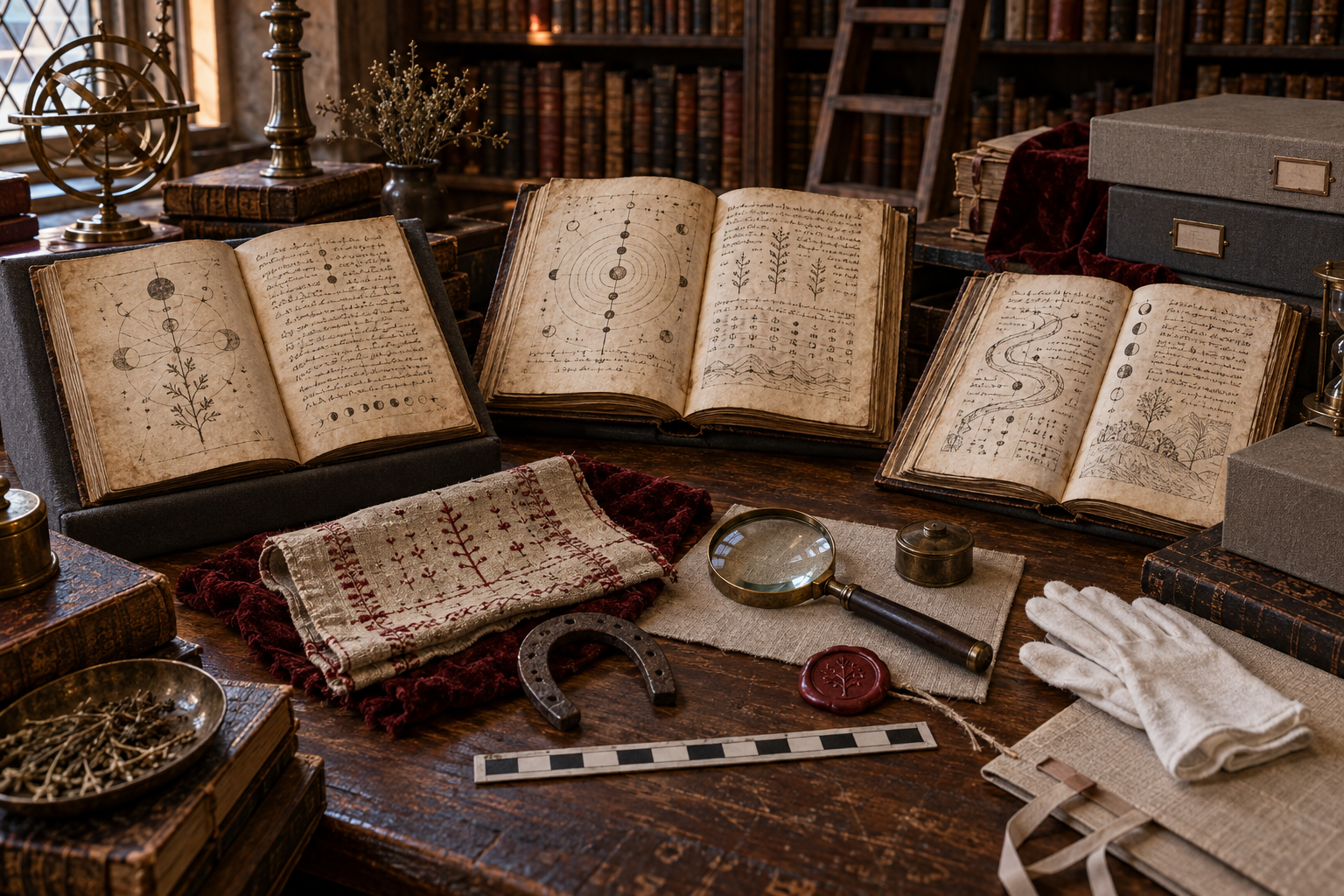
The book opens to a page crowded with instructions, but the first useful question is not “Does this work?” It is “What kind of book am I holding?” A memoir may report experience. A history reconstructs change from evidence. A practical manual arranges actions for reuse. A grimoire may combine prayers, names, diagrams, recipes, and claims of authority. Reading all four as interchangeable “witch books” makes each one less intelligible.
The best witchcraft books are not a single shelf of approved answers. They form a reading path: orientation, history, tradition-specific accounts, practical design, ethics, and comparison. The serious reader learns to identify genre, date claims, follow an operation’s internal logic, and keep a notebook that distinguishes what the author says from what the reader observes.
A book can transmit a practice, advertise a lineage, preserve an argument, or invent a past. Its cover will not tell you which job it is doing.
01 / BUILD THE SHELF
Begin with contrast, not a single authority
Start with one broad history, one close study of a particular movement, one practitioner account from within a tradition, and one practical manual whose operations can be analyzed. Contrast protects the reader from mistaking one author’s vocabulary for the whole field. If two books disagree about the antiquity of a rite, their dates, evidence, intended audiences, and definitions may explain more than choosing a winner immediately.
A useful first pass marks every major claim as historical, theological, experiential, or operative. “This organization began in the twentieth century” requires documentary support. “The goddess is immanent” expresses theology. “I felt a presence” reports experience. “Draw the boundary clockwise” gives an operation. Books often move between these modes without announcing the transition; careful reading makes the seams visible.
02 / READ THE CLAIM
Evidence and enchantment belong on different lines
Occult books frequently build authority through found manuscripts, secret teachers, ancestral inheritance, initiatory restriction, or extraordinary experience. Such frames may matter spiritually and literarily even when their historical claims cannot be verified. The task is not to sneer at the frame, but to ask what it authorizes. Does the hidden source excuse missing evidence? Does initiation prevent criticism? Does the ancestral story establish identity, obligation, or ownership?
A recovered document also arrives through editors, handwriting, damage, selection, and translation. Where the desired power is total recovery, cast The Forbidden Truth Returned to restore a forbidden truth to every mind from which it was erased. Its perfection sharpens the reading problem, because an actual text still has to be distinguished from every later retelling.
Uncertainty changes a claim’s status without making it worthless. A documented date, an author’s theological conviction, an inherited account, and an operative instruction can all matter while carrying different kinds of authority. Trouble begins when an attractive sentence crosses those boundaries and reappears as fact merely because later books repeat it.
READING FILE THE INHERITED MANUAL
One ritual, four layers of authority
A modern manual presents a candle rite as an unbroken village survival. Its method is clear; its history is not.
The introduction names a grandmother but no place or date. The rite uses a mass-produced color chart, a prayer with modern phrasing, and a disposal rule shared by recent correspondence guides.
The grandmother
A family account may be sincere without documenting an unchanged communal custom.
The sequence
Petition, flame, attention, and disposal form a readable modern operation.
The chart
Standardized color meanings suggest print-era exchange and revision.
The result
The rite can be evaluated as a contemporary practice without granting every origin claim.
VERDICT Historical uncertainty does not make the operation meaningless. It changes the honest description of what is being practiced.
03 / FOLLOW THE OPERATION
Read a practical book as a machine made of verbs
When a book teaches a working, list what every action does. A name identifies; a boundary limits; a petition specifies; repetition sustains; burning releases or transforms; burial locates; washing removes; keeping preserves. If an object has no verb, it may be decorative, mnemonic, or unexplained. If two actions contradict each other, the book may combine sources without reconciling their logic.
Worked comparison is more revealing than collecting correspondences. Compare two protection rites by target, boundary, duration, maintenance, and closure. One may fortify a place indefinitely; another may escort a traveler for a defined journey. Both use iron, but iron’s practical job differs. The material does not carry a universal meaning independently of sequence.
04 / KEEP A LIVING INDEX
A reading notebook should record change, not manufacture certainty
Organize notes by question rather than only by author. Pages titled “What closes a rite?” or “Who may consent for a household?” allow traditions to meet without being flattened. Copy a short claim, paraphrase its argument, identify the evidence, then record your response. Leave space for revision. A notebook that cannot show changed judgment is a shrine to the reader’s first impression.
An operative text can also be diagrammed as a sequence of roles. A reader confronting the long consequences of a present choice can work Question the Future Descendant to summon a future descendant to reveal what your choices will do to their world. Descendant, summons, question, revelation, and return form a ritual chain whose verbs reveal more than borrowed imagery ever could.
The best shelf eventually develops productive friction. History challenges inherited legends; practitioner writing reveals what detached description misses; comparative religion questions universal claims; practical manuals expose whether a theory can produce a coherent operation. No single volume needs to carry the whole craft.
05 / COMPARE EDITIONS
The same title can contain materially different books
Occult classics often circulate through abridgment, modernization, silent correction, and compilation. Two covers may announce the same work while offering different diagrams, chapter orders, divine names, footnotes, or translations. Before using a striking passage, inspect the table of contents, translator’s note, publication date, and statement about the source text. A cheap edition can be useful, but usefulness depends on knowing what it reproduces.
Modernized spelling may improve access while concealing technical ambiguity. A redrawn seal may become clear while losing damage, hesitation, or variant lines present in the witness. An editor may combine manuscripts into a readable composite. That composite answers “what might a coherent version look like?” rather than “what appears in this object?” Neither task is illegitimate; trouble begins when the distinction disappears.
Place the same short operation from two editions side by side. Mark every changed verb, omitted condition, renamed spirit, altered duration, and rearranged diagram. Ask which change affects procedure and which affects presentation. This comparison teaches more about textual transmission than a list of preferred editions without examples.
06 / TEST THE AUTHOR'S MODEL
A practical book should explain why its pieces belong together
A recipe can be followed without understanding, but a practice becomes adaptable only when its model is visible. Does the author believe resemblance draws resemblance, contact carries influence, spirits negotiate, divine names authorize, attention conditions perception, or ritual drama reorganizes the self? Many books combine several models. Identify when the explanation changes and whether the steps change with it.
Consider two operations that use a key. In one, the key opens opportunity by resemblance. In another, it belongs to a place and provides a material link. In a third, it is offered to a named power associated with thresholds. Calling all three “key magic” hides the operative difference. Understanding the difference reveals whether substituting an object preserves the argument or breaks it.
Failures are informative. If a book answers every failure by adding cost, secrecy, or dependence on the author, it may protect authority rather than refine method. A responsible manual names ordinary constraints, admits uncertainty, and gives a stopping condition. It does not turn disappointment into proof that a larger purchase or more dangerous act is required.
WORKED COMPARISON TWO PROTECTION BOOKS
The same herb serves two different arguments
Both manuals place rosemary at a doorway, but their operations are not duplicates.
Book A treats scent as periodic household cleansing. Book B treats a named plant as a permanent boundary witness renewed at seasonal intervals.
Air or threshold
One addresses atmosphere; the other addresses entry.
Moment or cycle
One ends after airing; the other remains until renewal.
Removal or alliance
The plant either carries away or stands guard.
Different observations
Freshness and boundary events require different notes.
VERDICT Correspondence lists identify shared material; operative reading identifies what the material is asked to do.
07 / READ ACROSS POWER
Ask who can obey the book safely
Instructions assume bodies, homes, money, privacy, and freedom. A rite requiring uninterrupted midnight access, smoke, expensive tools, private land, or disclosure to a group may be easy for one reader and unsafe for another. Good reading notices those assumptions before treating difficulty as lack of devotion.
Authority also appears in pronouns. Who is permitted to command, initiate, diagnose, or interpret? Who supplies labor and secrecy? Does the book imagine one household form, gender role, physical ability, or cultural inheritance as universal? These questions do not require rejecting an old text. They reveal the social machinery surrounding its ritual machinery.
A serious reading path therefore includes voices positioned differently from the best-known authors. Comparison shows which rules belong to a tradition, which belong to an era, and which reflect one writer’s circumstances. The result is not a neutral shelf—no shelf is neutral—but a library conscious of the doors each book opens and the readers it silently expects to remain outside.
The mature question is not which book can remove uncertainty forever. It is which book makes its claims, methods, debts, and limits visible enough that the reader can think beside it. A trustworthy library leaves discernment in the reader’s hands.