WINDOW · SIGHT · THRESHOLD
Window Protection Spell: Sight, Reflection, and the Terms of Entry
A window is a boundary designed to be penetrated by light. Protecting it means deciding what may pass as sight, attention, air, image, invitation, and entry—without turning the home blind.

STAR & SIGIL
Let the glass admit light without admitting rule
A window ward is strongest when visibility, reflection, and access stay distinct. Enter a protection working that gives each boundary one exact task.
Raise the selective window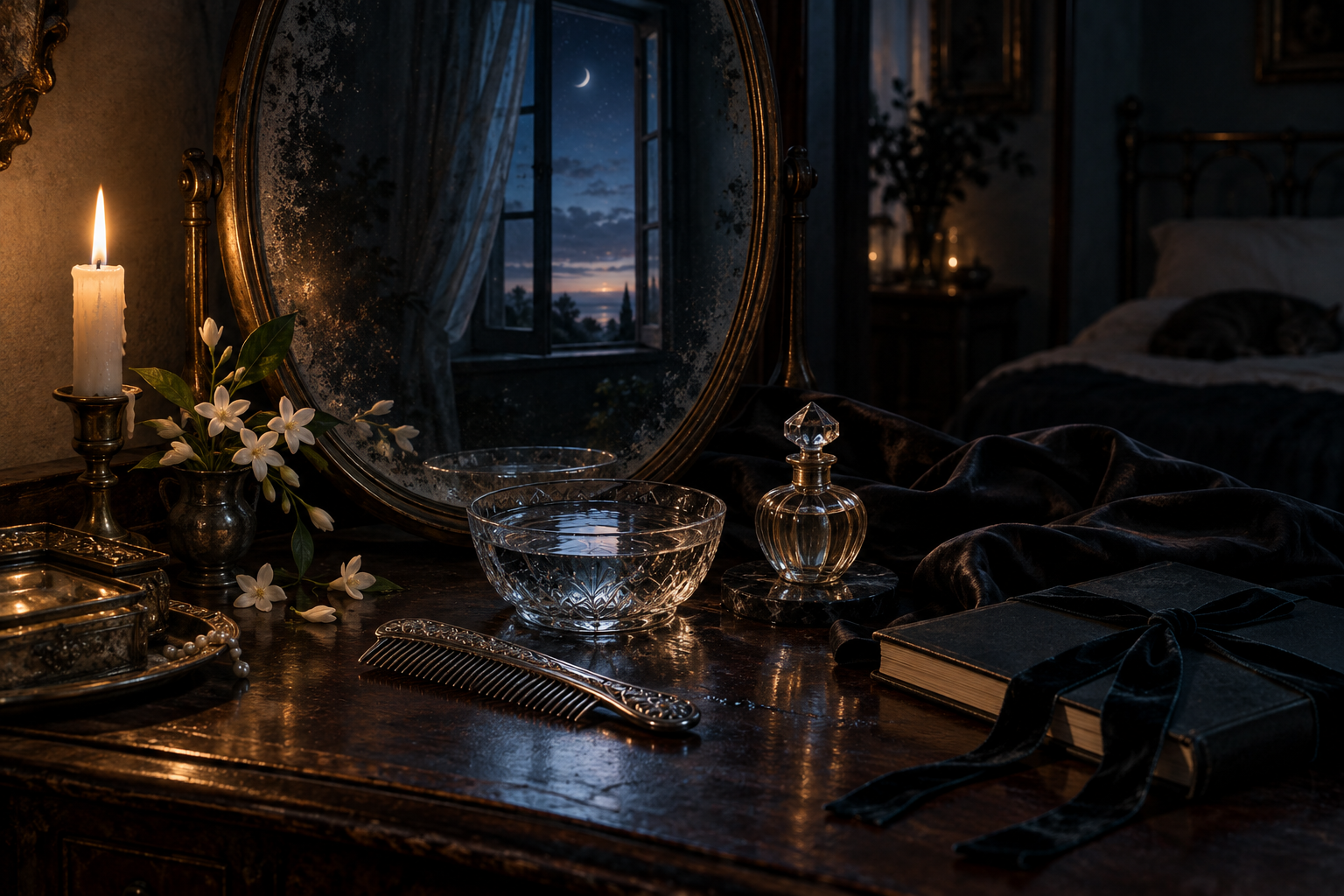
At 11:17 each night, a pale face appears in the kitchen window. Lena sees it above the sink: oval, motionless, too high for anyone standing in the garden. She closes the blind and hangs a reflective charm. The face returns the next night from inside the glass.
A window is not a failed wall. It is a threshold engineered for selective passage. Light enters; sight travels both ways; weather is held back; air may be admitted; reflections appear when illumination changes. Window protection therefore cannot mean “let nothing through.” It must govern which forms of access remain welcome and which kinds of watching lose their claim.
The protected window is not blind. It is a seeing boundary whose terms belong to the people inside.
01 / THE FIVE PASSAGES
A window admits more than light
Light is the window’s first permission. It makes the room usable while exposing parts of the interior after dark. Sight is reciprocal but unequal: the person in a bright room may see only reflection while someone outside sees the room clearly.
Air crosses when the window opens, bringing temperature, scent, sound, insects, and the life of the street. Physical access concerns latch, frame, opening, adjacent ledge, and anything passed through. Image travels differently: the pane reflects the room, frames the world, and can become a screen for projected fears or ritual meaning.
Attention is the least material passage and often the real subject of a window spell. A neighbor’s glance, a stranger’s scrutiny, admiration, envy, imagined surveillance, or the feeling of being visible can all gather at glass. These are not equivalent threats. Protection begins by refusing to call every eye hostile.
LIGHT
Illumination enters
The room becomes visible, and its interior may become visible in return.
SIGHT
Attention crosses
View, scrutiny, witness, admiration, and surveillance follow different permissions.
AIR
The outside circulates
Sound, weather, scent, and atmosphere cross when the boundary opens.
IMAGE
Reflection doubles
Glass overlays inside and outside according to the balance of light.
OBJECT
Matter tests the opening
Latch, frame, screen, sill, and household rules govern physical passage.
02 / SIGHTLINES
Privacy is geometry before it becomes symbolism
A protected sightline begins with position. What can be seen from the pavement, neighboring building, stairwell, garden, or opposite window? What becomes visible after interior lights come on? Which mirror extends the view deeper into the home?
Windows produce asymmetry. During the day, exterior brightness may make the pane appear dark from outside. At night, a lit interior can become a stage while the garden disappears into reflection. A charm designed around daytime experience may feel reversed after sunset.
The desired boundary may concern one zone rather than the whole room. A desk can remain private while plants receive full light. A lower pane can be obscured while the sky remains visible. A household may welcome neighbors’ casual recognition while refusing prolonged observation.
Symbolic protection is strongest when joined to that real geometry. A mark at eye level, a reflective object, or a plant near the pane will be interpreted differently depending on who can see it and which direction it faces. Placement is not decoration after the spell; it is the spell’s politics of vision.
WINDOW FILE
The face that appears at 11:17
Lena sees the same pale face above the kitchen sink each night and assumes someone is watching from the garden.
At 11:17, the neighboring building’s landing light switches on. Its light catches a white ceramic mask displayed on Lena’s hallway shelf, reflects it in the dark window, and overlays the garden at human height.
A real reflected object becomes personlike when detached from its shelf.
The pane relocates the image into apparent outdoor space.
An automatic landing light gives the apparition exact repetition.
The new reflective charm multiplies interior highlights, making the glass feel more inhabited.
THE WINDOW WAS SHOWING THE ROOM
The optical explanation ends the stranger claim, not the symbolic question. Lena had placed a ceremonial face behind herself and then met it as an outside watcher. Protection now means changing the sightline and deciding what the mask is permitted to witness.
03 / WATCHING
A watcher is a stronger claim than a feeling of exposure
Feeling watched can arise from actual observation, architectural exposure, reflection, memory, conflict, or heightened attention. The experience deserves description before it receives an identity. “A face appeared on the glass” preserves evidence; “a spirit watches from the garden” adds agent, location, and motive.
Protective work should match the claim. A privacy boundary addresses unwanted view. A warning addresses repeated approach. A spirit ward addresses an asserted nonhuman presence. A household conversation addresses a family member who keeps opening the blind. One solution cannot substitute for all four.
The desire to reverse the gaze can become its own act of surveillance. The Far-Walking Shadow reverses the watcher’s gaze into remote surveillance; cast it to send your shadow away to watch a distant room and return with everything it saw when remote witness is truly the intended power; its totalizing promise exposes the difference between protecting privacy and claiming exhaustive access to someone else’s room.
A window ward should narrow attention, not make watching the permanent center of domestic life. If the resident spends every night checking whether the protection was breached, the perceived watcher still governs the room.
04 / REFLECTION
A mirror can return, reveal, confuse, or multiply
Reflective protection often promises moral symmetry: harmful attention returns to its source. Yet glass does not identify intent. It reflects light. The magical model must decide whether it is returning malice, revealing a watcher, obscuring the interior, or reminding the resident that the boundary has an outward face.
Return can also escalate a conflict. Neighbors who each treat the other’s glance as aggression may build a corridor of reflective suspicion. A reflection does not settle who began the exchange or whether the original attention was hostile.
In Lena’s kitchen, the pane already functions as a mirror after dark. Adding more reflective surfaces intensifies the condition she fears. A coherent ward might reduce reflection, interrupt the mask’s sightline, or give the pane a different symbolic office. More of the same power is not always more protection.
05 / ACCESS
Windows are material thresholds, not only eyes of the house
A window may be fixed, latched, screened, opened, painted shut, overlooked by a fire escape, or reachable from a roof. Its actual condition defines physical access. Symbolic work that ignores hardware creates a story of security without governing entry.
Objects crossing a window carry a different logic from gaze. A note pushed through a gap, a gift left on a sill, a branch touching glass, or an item passed inside has moved from attention to matter. The protective question becomes what may enter and who has authority to admit it.
That distinction becomes exact when the ward addresses the carried object rather than the gaze. The Threshold Rejects the Enchanted Token moves the defense from glass to the object crossing the house line; perform it to prevent an enchanted token from crossing the threshold of a chosen person’s home. Because the threat is an object bearing influence, not a look through glass, the ward belongs at the passage the token would physically cross.
Household authority matters. A resident may control the blind in their room but not secretly seal a shared window against another resident’s guests, beliefs, or need for air. The boundary belongs to everyone whose life depends on its opening.
06 / THE WINDOW AS WITNESS
Protection can preserve seeing without inviting scrutiny
Windows do not only expose. They connect a person to weather, seasons, street life, neighbors, stars, and the changing hour. A ward that treats the outside as contamination can impoverish the very room it is meant to defend.
The window can instead serve as witness. It marks what happens at the boundary without claiming to control everything beyond it. A resident may notice repeated approach, changing light, a damaged latch, or a feeling that appears only at one hour. Observation becomes useful when it leads to a bounded response rather than an expanding theory of attack.
Lena keeps the mask but moves it where the pane no longer projects its face. At 11:17 the landing light still appears. Now it illuminates the sill rather than creating a watcher. The hour remains uncanny because she knows its history, but the kitchen is no longer organized around an intruder who was never outside.
THE WINDOW AUDIT
Five questions before warding the glass
- Passage: Is the concern light, sight, air, image, attention, or physical entry?
- Direction: What moves inward, outward, or both ways?
- Source: Is the watcher known, inferred, reflected, or imagined?
- Authority: Who shares this window and its right to open?
- Success: What should remain visible and welcome after protection?
07 / THE LIT ROOM
A protected home may still be seen
Privacy is not shame and visibility is not consent. A window can reveal plants, lamplight, movement, and the fact of domestic life without surrendering every interior detail. Protection defines terms rather than demanding erasure.
The most useful magical image is not an impenetrable black pane. It is selective glass: light enters, chosen view remains, hostile scrutiny loses focus, and the people inside decide when the boundary opens.
Lena’s kitchen becomes ordinary again not because all reflection disappears, but because she understands what the pane is doing and has reclaimed authority over its meanings. The window stops being a face from outside and returns to being the house’s deliberate eye.