RELIGION · PRACTICE · IDENTITY
Wicca vs Witchcraft: The Religion, the Craft, and the Overlap
A witch can be Wiccan. A Wiccan can practice witchcraft. Neither word owns the other—and the interesting part begins at the point where they separate.

STAR & SIGIL
Real overlap does not erase meaningful borders
Wicca is one religious current, while witchcraft names a wider and stranger field. Explore a clearly labeled modern beginner spellbook without turning one path into every path.
Cross into the practice without blurring the map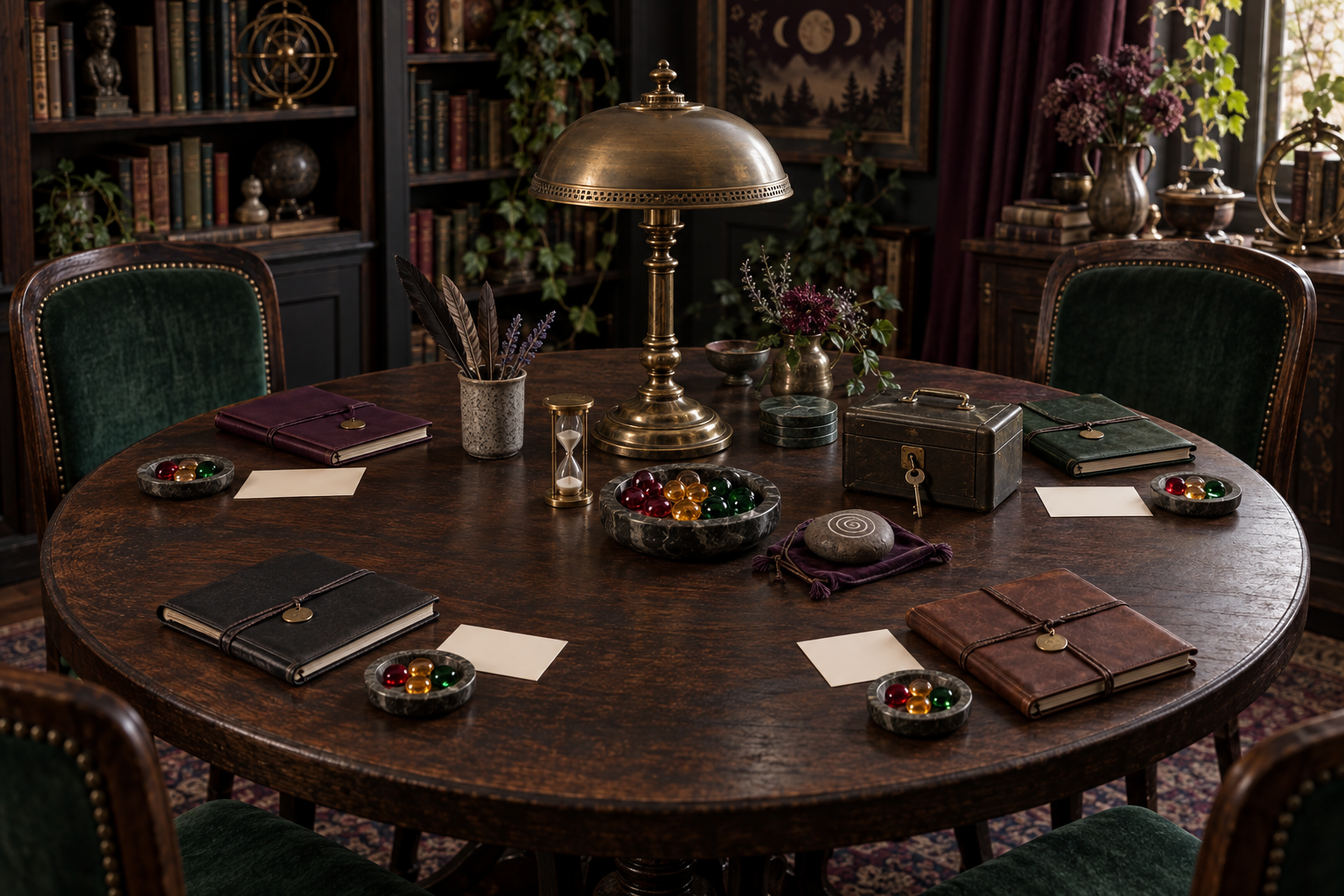
Two people stand before the same bowl of water. One calls the quarters, invokes a Goddess and a God, and understands the rite as part of a religious life. The other makes a private charm for a threatened doorway, names no deity, and returns the bowl to the kitchen. Both might call what they do witchcraft. Only the first scene gives us a reason to ask whether the practitioner is Wiccan. The implements did not answer the question. The relationship around them did.
This is the simplest useful answer to Wicca vs witchcraft: Wicca is a modern Pagan religion with recognizable ritual families, traditions, and communities; witchcraft is a broader, historically unstable name for magical practice, accusation, and chosen identity. They overlap because many Wiccans call themselves witches and perform magic. They separate because people have practiced, been accused of, or reclaimed witchcraft without belonging to Wicca. Neither category is a rank bestowed on the other.
But the neat diagram hides a trap. A practice can look Wiccan because the culture around it borrowed Wiccan language, while its maker follows no Wiccan religion. Another person can belong to a Wiccan tradition and spend far less time casting spells than a solitary non-Wiccan witch. To tell them apart, follow the promises a practice makes beyond one evening.
01 / THE CLEAN DISTINCTION
The religion is a particular house; the craft is not its property
Religions make durable claims about belonging, sacred powers, recurrent observances, and how knowledge moves between people. Wiccan paths often celebrate seasonal festivals and lunar rites, work with deity, and give ritual forms a continuing life in a coven or solitary practice. None of those features has one universal Wiccan setting. Gardnerian initiation is not the same arrangement as an eclectic solitary practice, and a person who says “Wiccan” may need to describe which form they mean before you can picture their calendar or altar.
Witchcraft, meanwhile, is not a single religion waiting for its official creed. The word has been an accusation against alleged malefactors, a label for techniques, and a name people take for themselves. A cunning person hired to find lost goods, a contemporary secular witch making a ward, and a Wiccan priestess raising a circle may all appear under the term. The shared word does not prove shared theology, lineage, or moral rule. It signals that someone sees an unusual kind of agency at work; what that agency means still has to be learned.
Think of architecture, not a family tree. One house has walls, commitments, and recognizable customs. The road outside can lead to many houses, to a workshop, or to a solitary clearing. Practicing a form of magic does not enroll you in a religion by stealth. Nor does a religious identity make every action of its holder a spell.
THE FOUR-QUESTION LANTERN
Ask these before naming the path
The tools may be identical. The answers are not.
A one-night operation, or a recurring religious calendar and community memory?
Gods, spirits, ancestors, a symbolic pattern, or no supernatural person at all?
An initiatory lineage, a named teacher, public books, experiment, or a mix?
A Wiccan identity, a witch identity, both, neither, or only a description applied by someone else?
THE READINGNo answer alone is a secret password. Together they reveal whether you are describing a religion, a method, an identity, or a performance staged to resemble one of them.
02 / A MODERN RELIGION WITH OLDER MATERIALS
Wicca has a twentieth-century history; that does not make it thin
Gerald Gardner’s public books in the 1950s helped present British initiatory witchcraft to a wider audience. Witchcraft Today appeared in 1954, when the idea of a surviving witch religion already had a potent literary and scholarly-looking life. Gardner and people around him assembled, inherited, revised, taught, and argued over ritual material. Doreen Valiente’s work matters in that story too. To call Wicca modern is to locate the institutional form we can actually study, not to deny that its makers used older motifs, magical techniques, and religious imagination.
The alluring claim was stronger: that early modern witch trials had accidentally documented an underground Pagan faith surviving essentially intact. The evidence does not carry that weight. A trial record records allegations shaped by fear and official power; it is not a liturgical manual handed down by the accused. Margaret Murray’s influential reconstruction of a witch-cult helped make an ancient continuity story attractive, but her broad thesis has not survived historical scrutiny. Modern Wicca deserves to be understood as a living, creative religious movement without requiring every strand of it to be ancient.
There is a productive tension here. Ritual can acquire depth because people repeat and transmit it, even when the exact combination is recent. The hymn learned from a priestess, the festival kept with the same companions for twenty years, and the Book carried from one initiate to the next become tradition by being lived. A true date does not drain mystery from a rite. It tells you where its human hands entered the story.
The distinction with teeth
“Modern” describes a traceable formation. “Invented” is often thrown as an insult. All religious forms have histories of making; the serious question is what a community claims about that making.
03 / THE BOOK THAT TRAVELED
A Book of Shadows reveals both continuity and reinvention
The Book of Shadows is a useful fault line between Wicca and the wider craft. Within initiatory Wiccan traditions, it can serve as a transmitted body of ritual: words, arrangements, and ceremonial memory that a member receives in a relationship with teachers and a coven. In wider modern witchcraft, a Book of Shadows may be a personal record of spells, observations, borrowed ideas, failed attempts, art, dreams, and revisions. A book with the same name can be a tradition’s liturgy in one set of hands and a solitary practitioner’s working notebook in another.
The outward resemblance makes bad assumptions easy. Seeing a black-bound notebook on an altar does not establish initiation. Hearing that an initiate copies ritual words does not mean all Wiccans use identical pages. Nor does a solitary book become counterfeit because no high priestess has touched it. The question is what the book is for, who has authority to alter it, and what the practitioner understands it to preserve.
The enchantment of a private book lies in its double life. It is an archive when you need to remember; it is a door when you need to decide. That second office becomes literal in The Midnight Leaf of Answering: perform it to cause your Book of Shadows to open to the spell you most need at midnight. A book that answers its keeper has become an active magical companion, a different relationship from the transmitted liturgy and group authority of an initiatory Wiccan Book of Shadows.
CASE FILE THE SAME CANDLE
One flame, three different promises
Three practitioners light white candles beside shallow bowls of water. From the doorway, their altars could be mistaken for a single tradition.
A Gardnerian initiate begins a recurring coven rite addressed to deity. A solitary witch petitions for a particular household boundary. A third person lights the candle as a contemplative image and claims no supernatural action. The photograph of their hands, candle, and bowl would not reveal which account is true.
Religious form
The first flame belongs to a calendar, a community, and transmitted ritual offices.
Operative aim
The second flame belongs to a desired change at a named threshold.
Symbolic act
The third flame focuses attention without claiming a spell or religious affiliation.
READ THE PROMISE, NOT THE PROP
One can be Wiccan and magical, one can be a witch without being Wiccan, and one can use occult-looking imagery while claiming neither identity. The visible tool is evidence of an action. It is not a reliable census of belief.
04 / COVEN, INITIATION, SOLITARY PATH
Belonging is not a single gate with Wicca written above it
Some Wiccan traditions are initiatory: a community recognizes an entrance, teaches particular rites, and understands its lineage as part of its identity. Other Wiccans work alone or in eclectic groups without claiming that lineage. A non-Wiccan witch may join a coven, learn from relatives, practice privately, or reject formal belonging. None of those arrangements can be inferred from clothing, a pentacle, a Sabbat name, or a post about the moon.
Initiation deserves precision because its language can become an easy instrument of prestige. A lineage can tell you how certain teachings traveled; it does not prove that every holder is wise, harmless, or uniquely powerful. A self-taught practitioner can be deeply skilled without inventing an initiatory history. Conversely, a group may ask for privacy around its own rites without acquiring authority over every person who calls themselves a witch.
And watch the bargain at the entrance. There is a difference between “these are the commitments of our tradition; you may leave” and “you have already agreed to whatever we reveal later.” A religious gate becomes something else when a newcomer cannot learn the cost, refuse a demand, or keep possession of their own name. The distinction matters whether the room belongs to a Wiccan coven, a non-Wiccan magical circle, or a charismatic teacher who avoids both labels.
05 / ETHICS IS NOT A PASSWORD
“Do no harm” cannot carry the whole comparison
People sometimes try to solve this distinction with an ethical slogan: Wiccans follow the Rede; witches do not. It sounds tidy and fails almost immediately. Wiccan traditions interpret ethical teachings differently, and many non-Wiccan witches have serious commitments concerning consent, reciprocity, restraint, or repair. An ethical phrase cannot tell you which religion a person practices, nor does repeating it prove that the person behaves well.
More revealing is the moment two goods conflict. A coven values secrecy, but a member needs to describe an injury. A witch wants a desired outcome, but its imagined path runs through another person’s decision. A teacher says the tradition must be preserved, but someone asks to change a custom. The answer is not hiding behind a shared label. It is seeing whose agency the rule protects and whose it spends.
Religious identity does not settle how a practitioner handles power over another will; the operative structure does. The Crown of the Unignored Voice draws the distinction cleanly: cast it in a council, hearing, or difficult conversation to make your spoken truth carry supernatural authority without silencing another will. Performing the spell seeks an authoritative hearing, not a gag over someone else’s mouth. Authority and domination are not synonyms, and neither “Wiccan” nor “witch” makes that ethical decision on a practitioner’s behalf.
06 / WHERE THE WORDS TOUCH
Why the overlap became so large
Wicca helped shape the public picture of the modern witch. Its covens, ritual circle, seasonal observances, Book of Shadows, and recognizable symbols traveled through publishing and popular culture. People encountered those forms before they learned the history behind them. Some adopted a complete religious path; others adapted a technique or image, and still others used “witchcraft” for quite different family, local, occult, or secular practices. Public visibility made Wicca influential, not exhaustive.
The influence also travels backward in people’s imaginations. A modern practitioner sees an old trial image and recognizes a pentacle from contemporary practice; a reader finds the phrase “Book of Shadows” and assumes every historical witch kept one. This is how a compelling image becomes a false genealogy. The cure is not to strip wonder from the craft. It is to let each period keep its own evidence and let modern communities claim what they actually made.
A practitioner can borrow a Wiccan-shaped calendar while rejecting Wiccan theology; another can honor deity without using that calendar; a third can belong to an initiatory Wiccan lineage and keep private spells unlike anything the public expects. Those crossings are real, and so are the borders. The labels work best when they help people explain a practice in its own terms, not when they become badges of superior authenticity.
The door neither word can close
Wicca is a particular modern religious family, diverse within its own walls. Witchcraft is an older, wider, and more quarrelsome word that can describe practice, accusation, and identity. Many Wiccans are witches; many witches are not Wiccan. The remaining cases are not errors to be tidied away. They are people explaining their lives with more precision than a Venn diagram can hold.
The question worth keeping is not who owns the true word. It is who chooses a path, what it asks of them, and whether another person’s path remains visible from the threshold. A good distinction opens a door. It does not appoint a guard.