WALES · CUNNING PRACTICE · TYLWYTH TEG
Welsh Folk Magic: Cunning People, Charm Texts, and the Tylwyth Teg
The knowing person’s astrological book, a charm folded against the body, and a lake covenant belong to a Welsh history of particular authorities—not an invented generic Celtic system.

STAR & SIGIL
Let dusk reveal the road no rival sees
Continue into a cataloged choice working and search the twilight for a guarded road worth taking.
Open the seven guarded dusk gates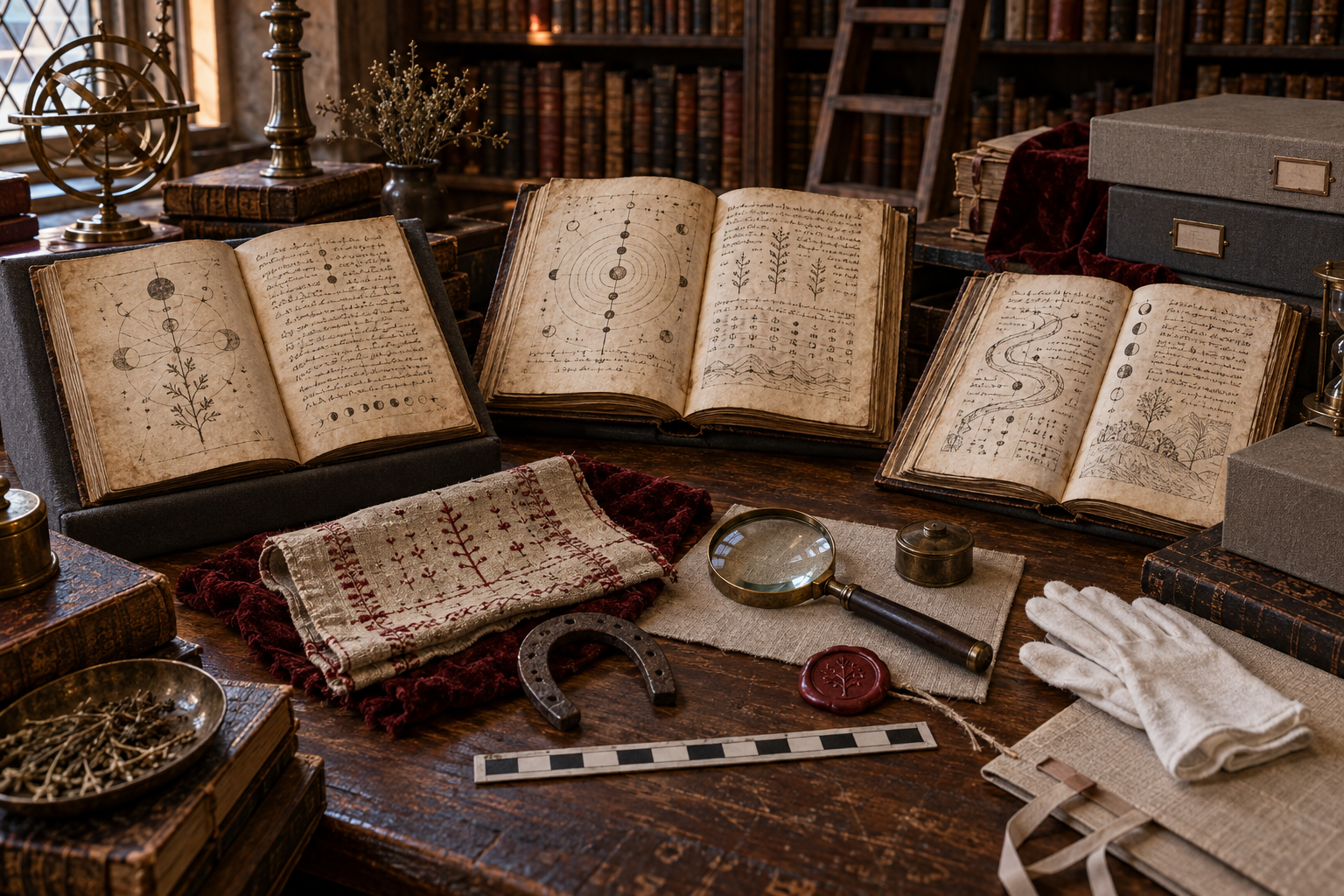
A farmer rides into the hills of Carmarthenshire carrying a question: who stole the animal, why has the butter failed, whether an absent son will return. The man he seeks owns books filled with astrological figures, prayers, seals, and calculations. Elsewhere, a charm is folded and worn against illness; at a lake edge, the Fair Family vanish because a human covenant has been broken. These are Welsh stories, but they do not disclose one generic “Celtic magic.”
Welsh folk magic grew through particular people, manuscripts, devotional languages, healing needs, divination, local landscapes, and traditions of the Tylwyth Teg. Its strongest history is specific: the learned dyn hysbys, or “wise man,” the charm text carried on a body, the fairy bargain attached to a named farm or lake, and the changing authority of Welsh and English words.
The dyn hysbys answered practical questions with mixed arts
Welsh sources use dyn hysbys for a man reputed to possess special knowledge; English accounts often say cunning man or wise man. Women also healed, charmed, divined, and maintained household knowledge, though surviving records and titles make expertise unevenly visible. Clients consulted specialists about theft, lost property, sickness, suspected bewitchment, love, livestock, and the future.
This was not necessarily an inherited Druid priesthood hiding in rural Wales. A practitioner might draw on astrology, printed occult books, biblical and liturgical language, handwritten charms, divinatory techniques, medical lore, reputation, and shrewd knowledge of neighboring lives. Learned and vernacular elements met at the consulting table.
The most remarkable surviving example is John Harries of Cwrt-y-Cadno (about 1785–1839), a Carmarthenshire astrologer and medical practitioner whose family became famous for occult consultation. Manuscripts associated with Harries preserve astrological, magical, and medical material rather than an oral “Celtic” essence. Their pages show calculation, copying, adaptation, and book learning embedded in a Welsh rural clientele.
A Welsh charm could be Christian, textual, and operative at once
Surviving Welsh charms use sacred names, Gospel openings, prayers, crosses, letter strings, numerical designs, and brief commands. They might be spoken over a sufferer, written and carried, placed near an animal, or copied into a household or practitioner’s manuscript. Healing and protection did not become less magical because their authority was Christian; Christianity supplied names, stories, and textual force by which danger could be bounded.
Language adds another layer. A charm might circulate in Welsh, English, Latin, or a mixture whose very obscurity enhanced authority. Copying can preserve a formula while corrupting words no longer understood. A written charm therefore acts twice: as language that can be read or voiced, and as an object whose letters remain present when the speaker leaves.
Welsh medical manuscripts, including collections connected in cultural memory with the Physicians of Myddfai, contain learned remedies and practical medicine rather than a neat manual of witchcraft. Later retellings often fuse herbal knowledge, legendary lake ancestry, and national antiquity. The manuscripts matter, but their actual contents must not be replaced by the romance built around them.
When a hidden history seems sealed inside paper, The Forbidden Truth Returned restores a forbidden truth to every mind from which it was erased. Work that sweeping recovery where erasure is the literal problem; real manuscripts answer the same hope only in fragments.
Tylwyth Teg traditions concern relationship, place, and broken terms
Tylwyth Teg, commonly translated “Fair Family,” names otherworldly beings in Welsh tradition, but stories differ by region, collector, and scene. They dance, reward, punish, exchange children, visit markets, inhabit lakes or hills, and bind human prosperity to difficult conditions. The translation “Welsh fairies” is convenient; it can also make every local being resemble a small Victorian sprite.
The lake-wife narratives associated with Llyn y Fan Fach are a useful example. A human man marries an otherworldly woman under a condition; when he strikes her the prohibited number of times, she returns to the lake, while her sons become linked in tradition to the Physicians of Myddfai. The tale is not simply a spell story. Its mechanism is covenant: wealth and intimacy cross the boundary between worlds, but only while terms are kept.
Other narratives tell of time distortion, music, fairy rings, changelings, and gifts that prosper or vanish according to conduct. These motifs do not form a ritual system automatically. A tale may teach caution around a place, explain unusual fortune, dramatize domestic vulnerability, or entertain. Belief, story, and practice overlap without becoming identical.
Read one lake covenant beside one written charm
Set two Welsh forms next to each other. In the Llyn y Fan Fach narrative, a bride comes from the lake, establishes a prohibition, creates a prosperous household, and departs when the husband exhausts the permitted blows. In a protective written charm, sacred names and signs are copied, folded, and kept with a person or animal so that a specified affliction cannot enter.
| Element | Lake-wife narrative | Written protective charm |
|---|---|---|
| Authority | The otherworldly woman states the terms of crossing | Sacred names and textual signs establish protection |
| Boundary | Lake and farm remain joined while the covenant holds | Folded paper travels with the protected body |
| Failure | Repeated breach ends marriage and prosperity | Loss, damage, miscopying, or unmet conditions can void the object |
| Social lesson | Power cannot be possessed after its terms are violated | Protection depends on authorized form and custody |
The comparison reveals a shared interest in conditional power, but not a shared ceremony. No evidence requires the charm writer to invoke the Lady of the Lake, and the tale does not hide instructions for making an amulet. One is a narrative covenant; the other is a portable textual defense.
Terms
The lake woman speaks hers openly; the charm compresses its terms into words, marks, and manner of keeping.
Custody
The husband fails as partner; the charm bearer must preserve an object whose efficacy may outlast its maker.
Loss
Both forms make broken relationship visible, but only the tale turns that break into departure beneath the water.
This is the discipline Welsh folk magic requires: compare mechanisms closely, then refuse the tempting leap from resemblance to one ancient Celtic system.
A horoscope could become social diagnosis
Consider a plausible consultation grounded in the documented Harries practice. A client reports a stolen mare. Harries records the hour of the question, erects an astrological figure, assesses significators for the client, animal, thief, direction, and recovery, and delivers an answer shaped by both celestial rules and local knowledge. The chart makes uncertainty inspectable: houses distribute roles, planets describe conditions, and aspects narrate whether separated things will meet again.
The procedure is learned, but its stakes are local. Naming a direction can send neighbors onto roads and fields. Describing the thief can intensify suspicion. Predicting recovery can preserve hope or rearrange bargaining. The astrologer’s power lies not only in occult calculation but in converting rumor into an ordered account with a forecast.
Harries’s manuscripts complicate the stereotype of folk practice as purely oral. A rural Welsh expert could be a reader, copyist, compiler, calculator, and healer. His archive also resists the opposite stereotype that books make a practice merely elite. The manuscript page became powerful through consultation with people who arrived carrying ordinary emergencies.
The fantasy beneath many questions about distance is not identification of a culprit but safe return. Every Road Leads Home brings a missing person back by turning every road they take toward the same door. Cast it where homecoming is the exact claim, rather than making divination carry an accusation it cannot prove.
Welsh witchcraft cases followed their own legal and social pattern
Wales did not simply reproduce the scale or institutional pattern of Scotland’s witch hunts. Accusations, prosecutions, defamation disputes, clerical concerns, and neighborhood suspicions certainly existed, but regional legal history matters. A healer could be sought one day and blamed another; a cunning person might diagnose bewitchment while remaining distinct from the alleged witch.
That distinction was unstable because counter-magic creates knowledge about harm. If a wise person identifies an offender through divination, a private misfortune acquires a human cause. Reputation travels faster than legal proof. Records may therefore reveal the social use of magical explanation even where prosecution did not end in execution.
Later folklore collections are equally shaped documents. Wirt Sikes and Elias Owen preserved valuable Welsh narratives in the nineteenth century, but they selected, translated, arranged, and sometimes romanticized material for print audiences. Their books should be read alongside manuscripts, museum collections, linguistic evidence, and later scholarship—not mined as timeless transcripts from an unchanged people.
National identity can preserve difference or paint over it
The label Welsh directs attention to language, places, institutions, and histories that English occult generalization can erase. Yet it becomes misleading when every red dragon, standing stone, Druid, fairy, herb, and medieval manuscript is folded into one continuous religion. Romantic nationalism, tourism, modern Paganism, antiquarian collection, and living local memory all contribute to what readers now expect Welsh magic to look like.
Precision produces a stranger and better landscape. A dyn hysbys calculates from books. A charm survives because paper touched a body. A lake bride’s withdrawal explains the cost of violated terms. A collector’s English sentence may stand where a Welsh cadence was once heard. A family of practitioners turns manuscript learning into rural authority.
None of these needs an invented pan-Celtic system to become significant. Their connections lie in circulation: people moving between farm and consulting room, words moving between languages, manuscripts between generations, and stories between named landscapes and printed collections.