CITY · ECOLOGY · INFRASTRUCTURE
Urban Nature Witchcraft: Seasons in Pavement, Parks, and Infrastructure
The city is not nature’s opposite. It is a living watershed redesigned by roofs, roots, pipes, asphalt, animals, labor, and unequal access to shade.

STAR & SIGIL
Pass through the city without giving every gaze a claim
Carry lawful privacy and urban restraint into a cataloged veiling working while keeping streets, neighbors, wildlife, and infrastructure entirely outside possession.
Open the anonymous-passage veil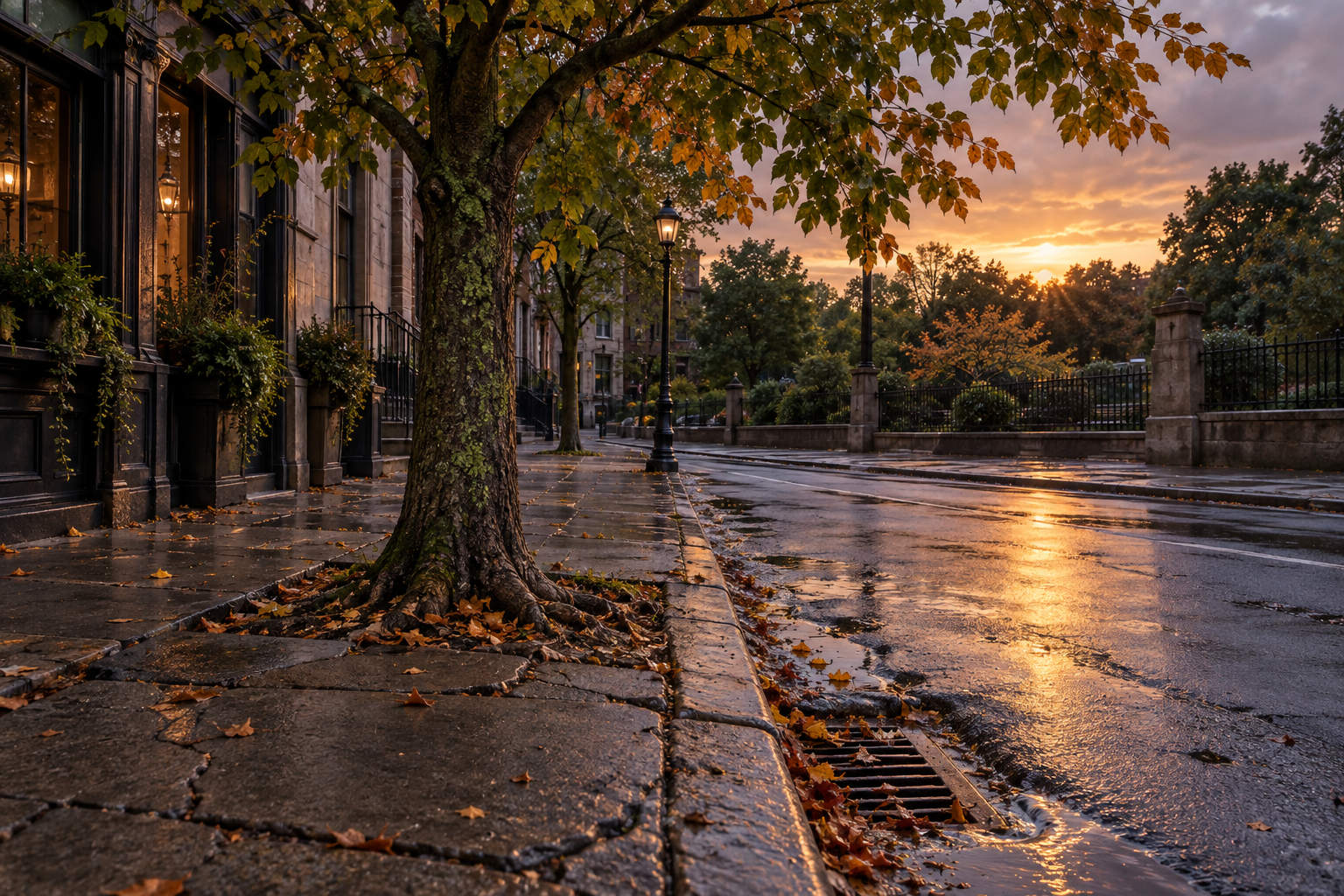
Rain hits a city block and divides. Some enters the square of soil around a street tree. Most strikes roof, pavement, and parked cars, carrying heat and residue toward a grate. A sparrow drinks from the curb. Underground, the drain joins a buried stream whose old course still determines which basement floods.
Urban nature witchcraft begins by refusing the idea that nature stops where pavement begins. The city is an ecosystem intensely shaped by design: roots are confined, water is piped, shade is uneven, species arrive through trade and migration, and heat collects differently from block to block. Infrastructure does not erase nature. It redistributes living opportunity and risk.
The witch’s task is not to imagine the city wild again for one romantic night. It is to read the life already negotiating concrete, ownership, maintenance, pollution, shelter, and access—and decide what repair would actually change.
01 / THE LIVING CITY
Urban nature is relation under pressure
A city supports plants, fungi, insects, birds, mammals, microbes, and people within a dense field of altered soil, artificial light, noise, buildings, traffic, and deliberate planting. Some organisms flourish in disturbed habitats; others lose continuous territory or the seasonal cues they require. “Nature” here is not a surviving decorative layer. It is the whole exchange of water, energy, shelter, food, movement, waste, and care.
This definition changes magical attention. A weed in a wall joint is not automatically a heroic native reclaiming land; it may be introduced, medicinal, invasive, harmless, or all of those labels under different questions. A landscaped park can offer habitat while restricting gathering. A mature canopy can cool a street while being concentrated in wealthier districts.
Urban practice therefore asks two questions at once: what lives here, and what arrangements let it live?
02 / SEASONS IN ASPHALT
The urban calendar is observed tree by tree
Heat retained by buildings and pavement can alter local temperature, yet urban effects on leaf timing are not uniform across every species and city. Water stress, shade, planting choice, maintenance, and microclimate complicate any easy claim that city spring always comes early. One study across multiple places is evidence of variation, not a universal spell correspondence.
Repeated observation offers a firmer practice. Return to the same identified tree or patch and record buds, leaves, flowers, fruit, color, fall, damage, and absence. Compare the same living subject over time. The date printed on a seasonal calendar becomes one witness among others, not the ruler that makes the branch wrong.
| Urban sign | Ecological fact to check | Magical question |
|---|---|---|
| Early bud | Species, sun exposure, heat, and prior dates. | Is this threshold local or merely assumed? |
| Dry tree pit | Soil volume, compaction, rainfall, watering. | What care does endurance conceal? |
| Bird at a grate | Water, food, cover, and traffic risk. | What route joins refuge to hazard? |
| Vacant lot bloom | Ownership, contamination, mowing, species. | Who may tend this abundance? |
03 / THE PIPED WATERSHED
Impervious surfaces make rainfall travel fast
When rain cannot soak into soil, it runs across roofs and pavement toward gutters, grates, pipes, channels, and receiving water. The path carries whatever the surface offers. A storm drain is therefore a threshold between visible street weather and a larger watershed, not a hole where water ceases to matter.
Many cities have buried or straightened streams. Their routes can remain legible through low streets, damp basements, strips of vegetation, place names, and recurring flood patterns. To see those fragments become one watercourse, cast The City’s Buried River Rises in Memory for the blue course between two named addresses. The river’s appearance across every surface it still shapes turns hydrological continuity into something the divided streets can no longer hide.
That magical office is memory with consequence. To reveal a buried river is also to reveal which structures occupy its route, which neighborhoods inherit runoff, and where restoration or protection might begin.
CASE FILE THE TREE AND THE DRAIN
One wet day, one heat wave, and a block that changes meaning
A practitioner follows two ordinary city fixtures through opposite weather.
During hard rain, Nia watches water race past a plane tree whose compacted pit sits above the flow. The grate downstream clogs with litter, and a basement at the lowest corner takes water. Six weeks later, the same tree casts the block’s only afternoon shade during a heat wave, but its leaves curl and the public fountain is broken.
The tree pit
Living soil is present but disconnected from much of the rain.
The grate
Infrastructure joins street neglect to downstream harm.
The shade line
Canopy becomes unevenly distributed refuge.
The curled leaf
A guardian can itself require material care.
READ FUNCTION ACROSS WEATHER
The tree is not simply “earth” and the drain “water.” In rain, soil access and drainage govern flooding. In heat, canopy and public water govern refuge. The same block reveals different dependencies under different stress.
04 / MOVEMENT
Habitat is a route as well as a patch
A park may look abundant while remaining isolated from other feeding, nesting, or shelter sites. Animals and seeds encounter roads, glass, fences, mown gaps, bright night lighting, and stretches without cover. A corridor is not simply a green line on a planning map; it must be usable by the lives it claims to connect.
Where two habitats remain islands, The Green Passage Beneath the Streets lets the reader cast for the missing tissue between them: roots, rainwater, shelter, and bloom in one continuous corridor. The power is not a row of matching planters but a passage living bodies can actually use.
Connectivity also has human dimensions. A green route that excludes disabled people, displaces residents, or makes rest subject to surveillance cannot be praised as uncomplicated healing. Urban nature magic should notice who gains a passage and who is treated as an obstruction.
05 / SHADE, ACCESS, AND POWER
Not every green space is equally public
Trees and parks can cool air and surfaces, offer refuge, absorb some water, and support habitat. Those benefits depend on size, health, placement, maintenance, and actual access. A locked garden seen through a fence is ecologically and socially different from a shaded route to school.
The language of “reclaiming” vacant land can also erase people already using or caring for it. Before naming a lot abandoned, ask who owns it, who crosses it, who grows food there, who is exposed to contamination, and whose labor has kept it from becoming a dumping ground. Magical relationship begins with observation and permission, not imaginative possession.
The urban test
Ask not only whether a place is green, but what work the green performs, for which species and people, under whose authority.
06 / REPAIR AS RITUAL LOGIC
A city working should change a relation, not only its mood
Urban ritual often begins with attention: greeting a street tree, mapping runoff, listening at a fence line, recording first bloom. Attention is meaningful, but repair asks what follows. Does the practice improve soil access, protect a route, reveal buried water, support habitat, or organize care? The material action need not prove supernatural causation to become part of an honest magical relationship.
Maintenance is especially revealing. Young trees need watering; drains need clearing; nest boxes need cleaning; gardens need agreements that survive the founder’s enthusiasm. A single beautiful intervention can fail if nobody inherits its obligations. City magic is strongest when enchantment and stewardship share a calendar.
07 / AN URBAN FIELD PRACTICE
Read one block deeply before claiming the whole city
Choose a repeatable route and note identified living subjects, water movement, sun and shade, shelter, barriers, maintenance, and signs of human use. Return in rain, heat, leaf-out, flowering, fruiting, and dormancy where those phases apply. The goal is not to collect picturesque correspondences but to discover which relations persist and which fail under stress.
Distinguish observation from inference. “Water pooled above the blocked grate” is observation. “The street rejects rain” is interpretation. “The buried stream is angry” is a spiritual reading. These sentences may coexist, but each gains integrity when it is not disguised as the others.
08 / THE CITY THAT ALREADY BREATHES
Urban nature witchcraft is an alliance with consequences
The city does not need to be declared alive by a practitioner. Roots already lift paving. Water remembers slope. Birds learn traffic intervals. Fungi work beneath compacted ground, and people build networks of shade, food, repair, and mutual aid. Magic can reveal, intensify, protect, or transform those relations; it should not take credit for inventing them.
Follow the street tree through rain and heat. Follow the drain to its receiving water. Follow a bird’s route until a wall interrupts it. Then let the spell name the missing relation exactly. Urban practice becomes ecological when wonder leads not to ownership, but to better attention, wider access, and repair that another living body can use.