PORTABILITY · PLACE · RETURN
Travel Altars: How a Sacred Place Learns to Move
A travel altar is not a home altar packed smaller. It is a ritual world engineered to survive closure, transit, strange rooms, and the moment when every familiar direction has changed.

STAR & SIGIL
Carry the practice, not the clutter
Open a beginner spellbook that keeps one complete operation available even when the room, rules, and objects must change.
Enter the portable threshold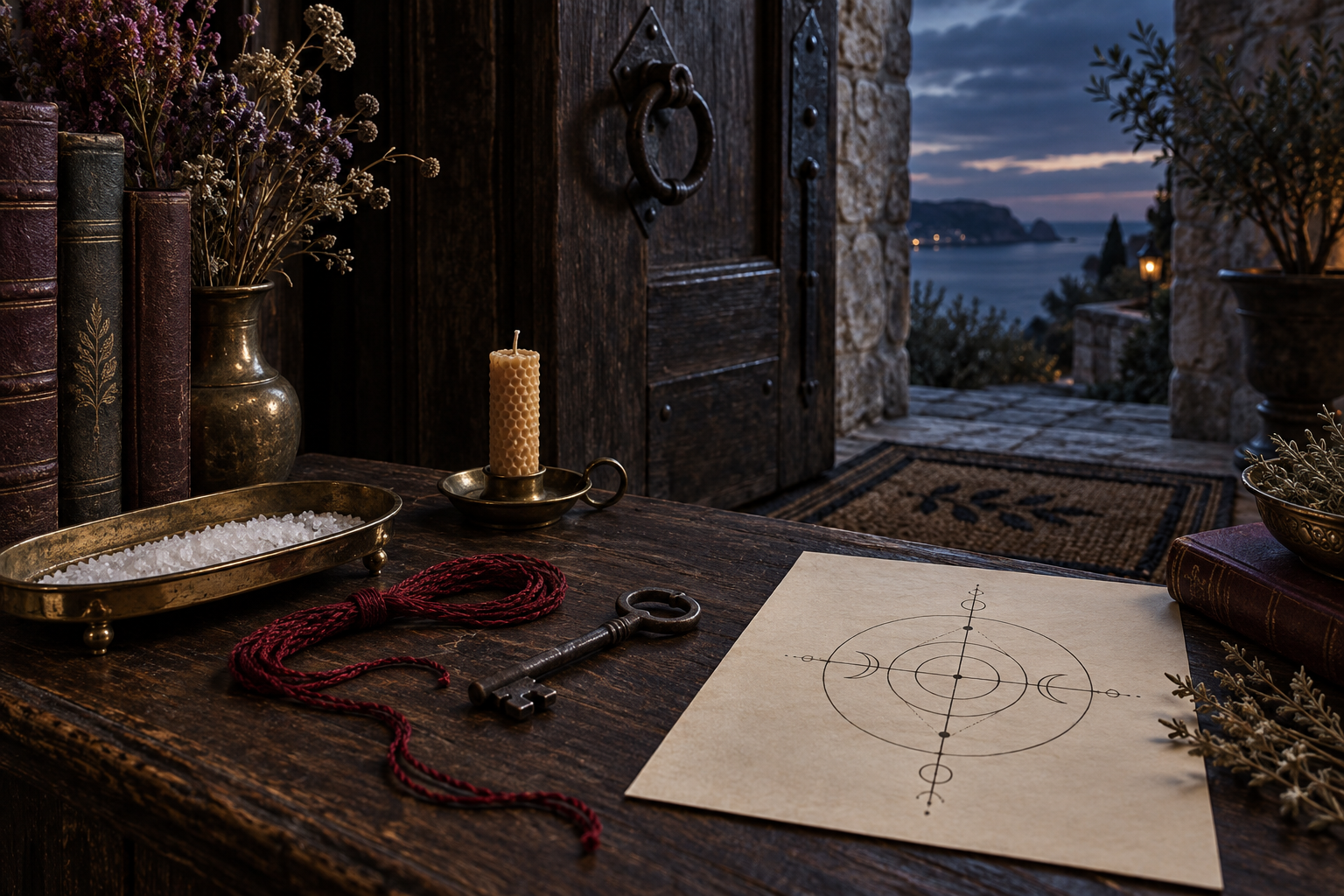
The hotel desk is bolted to the wall. Beyond it, traffic moves in a city whose street names the traveler cannot pronounce. A small case opens. Its lid becomes a backdrop; a coin keeps a square of cloth from sliding; one familiar image stands where a room-service menu stood a moment ago. Nothing here resembles the altar at home, yet the old relationship has found an address.
A travel altar is often described as a miniature collection of tools. Its more interesting function is constitutional. It decides which parts of practice must survive a change of place, which can be translated, and what makes a ritual field recognizable when the usual room, direction, schedule, and scale disappear. Portability is not smallness. It is continuity designed under pressure.
01 / THE PORTABLE OFFICE
A travel altar carries authority, not scenery
Shrinking a home altar object by object usually produces a crowded kit and a disappointing imitation. The home arrangement may depend on a permanent shelf, accumulated offerings, local light, household spirits, or a direction fixed by architecture. None of those conditions fits inside a tin. A successful travel altar begins with verbs: witness, orient, protect, remember, offer, divine, close.
One object can hold several offices, but they should remain legible. A cloth can define the field and wrap the pieces after use. A small image can identify the addressed power and provide visual orientation. A coin can stand for exchange, weight a corner, and mark the place from which a journey began. Multiplicity is not vagueness when every office is appointed.
Closure is as important as opening. Home altars often remain visible, gathering continuity through duration. A travel altar must survive being dismantled, carried through unrelated spaces, and reopened without treating every transit container as sacred. The case protects the altar, but it is not automatically the altar. The room hosts the rite, but it does not necessarily acquire a permanent claim.
Select
Office is separated from everything merely familiar.
Read
The new place is encountered before it is symbolically overwritten.
Establish
Relation, boundary, and orientation become visible.
Release
The borrowed surface returns to its ordinary life.
02 / SACRED THINGS HAVE LONG TRAVELED
Historical portability is evidence of design, not a borrowed pedigree
Portable sacred objects are widespread, but they do not form one universal ancestor of the modern witch’s kit. A medieval Christian portable altar of stone, copper gilt, enamel, and crystal created a consecrated liturgical center that could be carried. Its materials and iconography established conditions for an altar to operate away from fixed architecture.
Japanese portable shrines offer another logic. A double-doored lacquer shrine in the British Museum houses Nichiren, an attendant monk, Buddhist deities, and kami associated with the Lotus Sutra. Closed, the sacred assembly travels protected; opened, the interior becomes a structured devotional world. Another compact Edo-period shrine contains Kannon in painted and gilded wood. Portability belongs here to a specific religious tradition, not to a generic aesthetic of tiny mystical objects.
Domestic devotional prints and portable triptych shrines in modern India likewise show how reproducible images and folding formats made divine presence accessible in households. Portability always forces decisions about enclosure, image, sequence, durability, and encounter.
Contemporary Pagan and witchcraft travel altars may draw on home practice, devotional boxes, pocket shrines, or improvised surfaces. Their legitimacy requires no false attachment to a medieval slab or Buddhist cabinet. Historical objects instead sharpen the questions: what travels, what is addressed, and what changes a closed container into an active sacred place?
03 / THE COMPASS INSIDE THE CASE
Arrival changes every direction except the one you choose to keep
At home, east may be a window, a candle may always stand left of a bowl, and a particular wall may anchor prayer. In transit, east might be a bathroom wall or an airport gate. A travel altar needs an orientation rule that survives without becoming absurd. The rule can be astronomical, geographic, relational, or internal: face sunrise when possible; place the home token nearest the body; turn the addressed image toward the room; align the cloth’s marked edge with the journey ahead.
These systems say different things. Geographic east prioritizes cosmic direction. “Homeward” makes relation the axis. Facing the onward route gives destination authority. Orienting by the body treats the practitioner as the stable point. Expert practice chooses rather than stacking every system until the symbols contradict one another.
Travel also produces disruption: missed connections, wrong turns, canceled rooms, an altar that cannot be opened where planned. A practitioner who chooses The Necessary Wrong Road works the sharper possibility that magic might turn every wrong road and missed connection into a necessary step toward your prize. The power does not pretend the route remained straight. It grants deviation a destination without confusing every inconvenience for an omen.
The orientation test
If the altar is turned ninety degrees, what changes? If the answer is “nothing,” its directions are decoration. If relation, destination, or address changes, the arrangement has a working compass.
FIELD NOTE THREE ROOMS, ONE ALTAR
Continuity survives because the arrangement is allowed to change
A traveler carries an indigo cloth, a brass key from home, a small painted image, one white stone, and a narrow lidded box.
The image names the addressed presence. The key marks home. The stone records the current place. The cloth creates the active field. The empty box receives a written concern temporarily, then must be cleared before departure.
Guest room
The key sits nearest the body; the image faces inward from the lid.
Forest shelter
The stone comes from no disturbed site; the carried stone names place instead.
Airport
The cloth stays folded; key and image meet briefly inside the open case.
Return
The temporary concern leaves the box before home objects rejoin the permanent altar.
WHAT REMAINS CONSTANT
The altar is not the same shape in all three settings. Its grammar remains: presence stands across from the traveler, home stays near the body, current place is acknowledged without being taken, and unfinished concern is contained rather than allowed to spread through the luggage. At the airport, restraint is not failure. The abbreviated opening preserves privacy while keeping the relationship intact.
04 / SUBSTITUTION WITHOUT PRETENSE
A symbol can carry an office without impersonating the absent thing
A vial of home soil is not the homeland. A printed image is not the full shrine. A battery light is not flame. Strong substitution names connection and difference: the soil witnesses home; the image maintains an address; the light marks attention without claiming combustion.
Scale changes meaning too. A tiny cup holds a token offering rather than group hospitality. A miniature blade may signify division but cannot perform a working knife’s physical acts. The question is not whether the miniature is “real enough,” but whether its office depends on capacity, action, mass, visibility, or recognition—and which qualities survived reduction.
Time is another absent material. Transit compresses dawn into boarding and planetary timing into a clock changing zones. At that pressure point, working The Stolen Hour pursues the extreme power to stop an hour for everyone but yourself. It magnifies the travel altar’s quieter desire: a protected interval held intact while the world refuses to pause.
| Portable form | Office retained | Difference that matters |
|---|---|---|
| Photograph of an altar image | Recognition and address | It reproduces appearance, not material biography. |
| Home key | Custody and return | It opens one threshold, not every place called home. |
| Small cloth | Boundary and unfolding | Its field admits fewer relations at once. |
| Electric light | Focus and visible beginning | It does not burn, consume, warm, or leave ash. |
05 / THE PLACE IS NOT EMPTY
Unfolding an altar does not make the traveler sovereign
A borrowed room, family home, campsite, train compartment, and public terminal already contain relationships, rules, labor, and other lives. Declaring a ritual circle does not erase them. A travel altar should encounter the place before assigning it a role. Sometimes the right response is a smaller field, a silent gesture, or no opening at all.
This is especially important when practitioners speak of “taking” local stones, water, plants, or soil so the altar can connect to place. Connection does not require acquisition. The carried white stone in the worked case acknowledges current location precisely by remaining the traveler’s object. It can be placed differently in each setting without removing a piece of land or pretending the visitor has inherited local authority.
Hospitality runs both ways. The traveler may ask whether the practice can occur here, but must also ask what the practice leaves: attention, scent, sound, offerings, marks, fear, or obligation. A good closing returns the surface, room, and temporary arrangement without asserting that nothing happened. The encounter is remembered by the practitioner while the place is released from service.
06 / THE ALTAR COMES HOME DIFFERENT
Return is an integration, not an unpacking
Objects acquire travel biographies. The key has been held during fear; the cloth has crossed borders; the image has faced unfamiliar rooms. Immediately replacing everything on the permanent altar can bury those experiences in routine. A deliberate return lets each temporary office end.
The portable kit may also expose what the home altar accumulated unnecessarily. If one image, one boundary, and one token sustained practice for weeks, the traveler returns with evidence about essentials. Conversely, absence may reveal that a seemingly decorative object carried memory or orientation all along.
The travel altar is the altar under examination. Every component must justify its passage; every gesture must survive a new horizon. What comes home is not a miniature temple but a clearer account of what made the temple possible.