SOLSTICE · CULMINATION · TURNING
Summer Solstice Ritual Meaning: Maximum Light and the Turn Toward Less
The summer solstice is the year's longest daylight interval for a hemisphere—and the instant after which increase changes direction. Its magic belongs equally to maximum light and the first hidden fact of decline.

STAR & SIGIL
Keep the beacon bright and the ground unburned
Peak light becomes a responsible observance through local measurement, cultural context, shared labor, and an absolute fire veto.
Begin the fireless beacon watch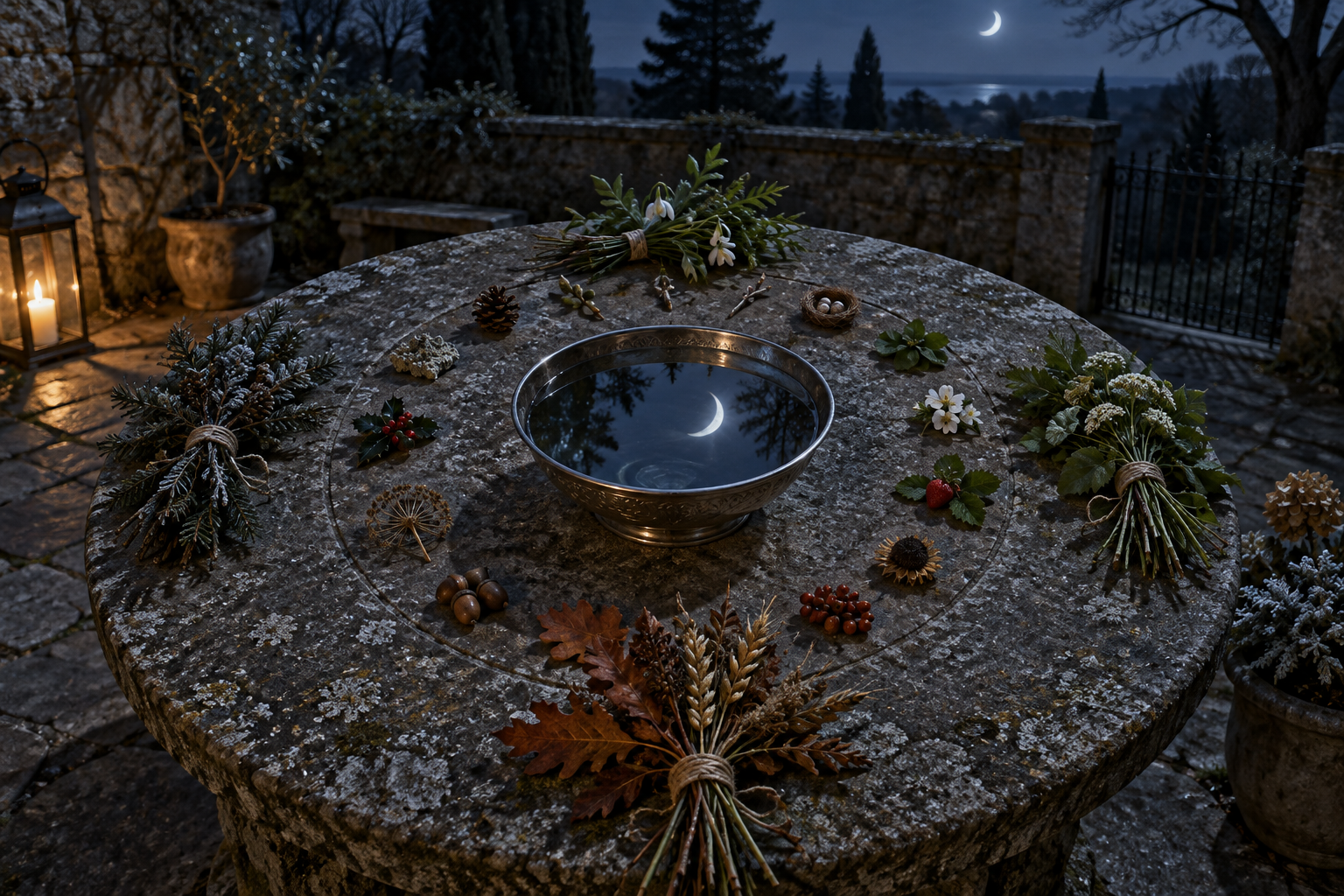
Suppose Arun directs a river-town solstice festival built around the phrase “the Sun at full strength.” At noon the paved square becomes punishingly hot, volunteers retreat into shade, and wildfire smoke turns the light copper. Six months away, a partner town is holding its winter vigil under the same astronomical instant.
The summer solstice occurs when a hemisphere reaches its maximum annual tilt toward the Sun. For observers outside the tropics, the Sun follows its highest daily path and the interval between sunrise and sunset is the longest of the year. June brings summer solstice to the Northern Hemisphere and winter solstice to the Southern; December reverses them.
Solstice magic is therefore not simply “more Sun.” It concerns culmination, apparent standstill, maximum exposure, public authority, abundance at capacity, and the first turn away from increase. The longest day already contains the direction toward shorter ones.
01 / THE SOLAR STANDSTILL
The Sun appears to pause before reversing its drift
The word solstice carries the image of the Sun standing still. Near the turning point, the day-to-day change in the Sun's noon position and rising or setting points becomes subtle before reversing direction. The Sun does not physically stop, and Earth's orbit does not pause. The apparent standstill emerges from the geometry of axial tilt and orbit.
This creates a distinctive ritual interval. An equinox dramatizes crossing through a midpoint; a solstice dramatizes extremity held long enough to be recognized. The work is not merely to gather power but to confront what happens when a cycle reaches its limit.
Local observation matters. Sunrise azimuth, noon altitude, day length, horizon, latitude, and terrain alter what the solstice looks like. Within the tropics, the highest noon Sun may occur on dates other than the solstice; near polar circles, continuous daylight transforms the meaning of “longest day.”
02 / FOUR OFFICES OF MAXIMUM LIGHT
Culmination, exposure, expenditure, and turning demand different rites
| Office | Solar image | Question | Failure |
|---|---|---|---|
| Culmination | The year's longest daylight interval. | What has reached enoughness? | Demanding endless increase. |
| Exposure | High light shortens and sharpens shadows. | What can withstand public sight? | Calling privacy guilt. |
| Expenditure | Heat and long hours sustain intense activity. | What does abundance consume? | Mistaking exhaustion for devotion. |
| Turning | Daylight begins its slow decrease afterward. | What must change before decline becomes crisis? | Treating the summit as permanent. |
The longest day tests whether power knows how to stop increasing.
SOLSTICE FILE THE SQUARE AT NOON
Arun builds a celebration that the light itself rejects
This case is hypothetical: a study of maximum daylight, civic authority, heat, and unequal exposure.
The festival schedule places speeches, dance, and food service in an unshaded square at solar noon. Its imagery promises vitality. Older residents, children, vendors, and performers bear the heat while officials speak beneath a canopy. Smoke from distant fires dims the horizon without shortening the astronomical day.
The high Sun
Maximum visibility distributes physical burden unequally.
The canopy
Authority protects itself from the element it praises.
The river
Local water offers cooling, memory, and a different center.
The turning
The festival needs an ending that admits decrease.
THE READING
Arun moves the gathering toward morning and evening, shifts its center to the river park, and makes noon a short bell-marked pause rather than the main performance. The festival becomes more solar because it answers the actual Sun instead of merely borrowing its prestige.
03 / WEATHER IS NOT THE SOLSTICE
Astronomical summer can arrive cold, wet, smoky, or delayed
The solstice fixes a relation of Earth and Sun, not the day's forecast. Oceans, elevation, cloud, monsoon, wildfire, urban surfaces, and seasonal lag shape lived weather. The warmest period often comes after maximum daylight because land and water continue absorbing more energy than they lose.
Ritual language becomes thin when it demands blazing heat everywhere. A coastal fog, highland chill, rainy season, or smoke-darkened noon is not a failed Sun. It is the local atmosphere through which maximum daylight must speak.
Arun's copper sky changes the festival's claim. “Full strength” can no longer mean unrestricted heat and spectacle. It becomes capacity to shelter, redistribute labor, and acknowledge the wider landscape burning beyond the town.
That distinction also keeps climate and weather from becoming omens on demand. One storm cannot define a region's climate, and one hot festival cannot prove supernatural approval. The rite reads the day honestly while the town reads longer records for changes that will shape future gatherings.
04 / FORTUNE BEFORE THE HORIZON
A long day can still impose a hard limit
Long daylight tempts a festival or working to keep expanding: one more speech, one more task, one more demand upon volunteers. Yet sunset remains a boundary, even on the longest day. The horizon makes abundance measurable.
Fortune Before Sunset gives the solar interval an ethical seed and visible deadline: work it to make a generous deed blossom into visible fortune before the sun sets. Generosity initiates the increase; sunset prevents “eventually” from protecting an empty claim.
For Arun, the corresponding ordinary truth is that celebration must produce something beyond attendance: paid workers, cooled bodies, restored riverbank, or resources returned to the town. Daylight spent without consequence is only duration.
05 / THEFT FROM THE FUTURE
Culmination can arrive before the structure that should support it
A summit is seductive because it converts process into visible proof. Artists want acclaim before craft has matured; institutions want a successful festival before labor systems exist; leaders want authority before accountability has formed.
The audacious compression appears in Tomorrow's Stolen Triumph: cast it to pull the greatest triumph of your future into tomorrow. The spell makes temporal cost unavoidable. A victory removed from its later context may arrive before relationships, skill, or judgment can bear it.
Solstice magic should therefore ask what supports the peak. Arun's beautiful noon program failed because shade, rest, compensation, and atmospheric reality had been treated as background. The turning point revealed the missing structure.
06 / HEMISPHERE AND LOCAL SUN
June is not universally summer
June solstice means maximum annual tilt toward the Sun for the Northern Hemisphere and maximum tilt away for the Southern. December reverses the relation. Publishing one hemisphere's festival language as universal turns geography into spiritual hierarchy.
A locally grounded rite observes the actual solar path and seasonal world: where the Sun rises and sets, how noon shadows change, what weather systems dominate, what is flowering or dormant, and which forms of labor the season demands. Those observations can support inherited festival forms without pretending every landscape shares the same agricultural calendar.
The partner town's winter vigil is not Arun's solstice in reverse as decoration. It answers the same planetary instant through opposite light, season, and social need.
07 / THE VERDICT
Summer solstice magic governs the responsible summit
Use the summer solstice for culmination, public consequence, solar authority, gratitude for abundance, and the deliberate turn toward preservation. Do not treat maximum light as unlimited capacity.
Ask what has ripened, who paid for the triumph, which bodies carry the heat, and what must change as daylight begins to decrease. A summit that cannot imagine descent becomes a trap.
Arun's festival succeeds when noon loses the throne. Dawn, shade, river, bell, wages, and sunset become parts of the solar grammar. Maximum light no longer means maximum extraction.