VESSEL · PRESSURE · RELEASE
Spell Jars: What the Container Changes
A jar does more than hold ingredients. Its walls, mouth, lid, contents, placement, and eventual opening turn a magical intention into a small architecture with consequences.

STAR & SIGIL
A container turns ingredients into a sentence
Once every part has a verb, the jar stops being decoration. Continue with a beginner spellbook organized around complete operations.
Open a spellbook built for complete formulas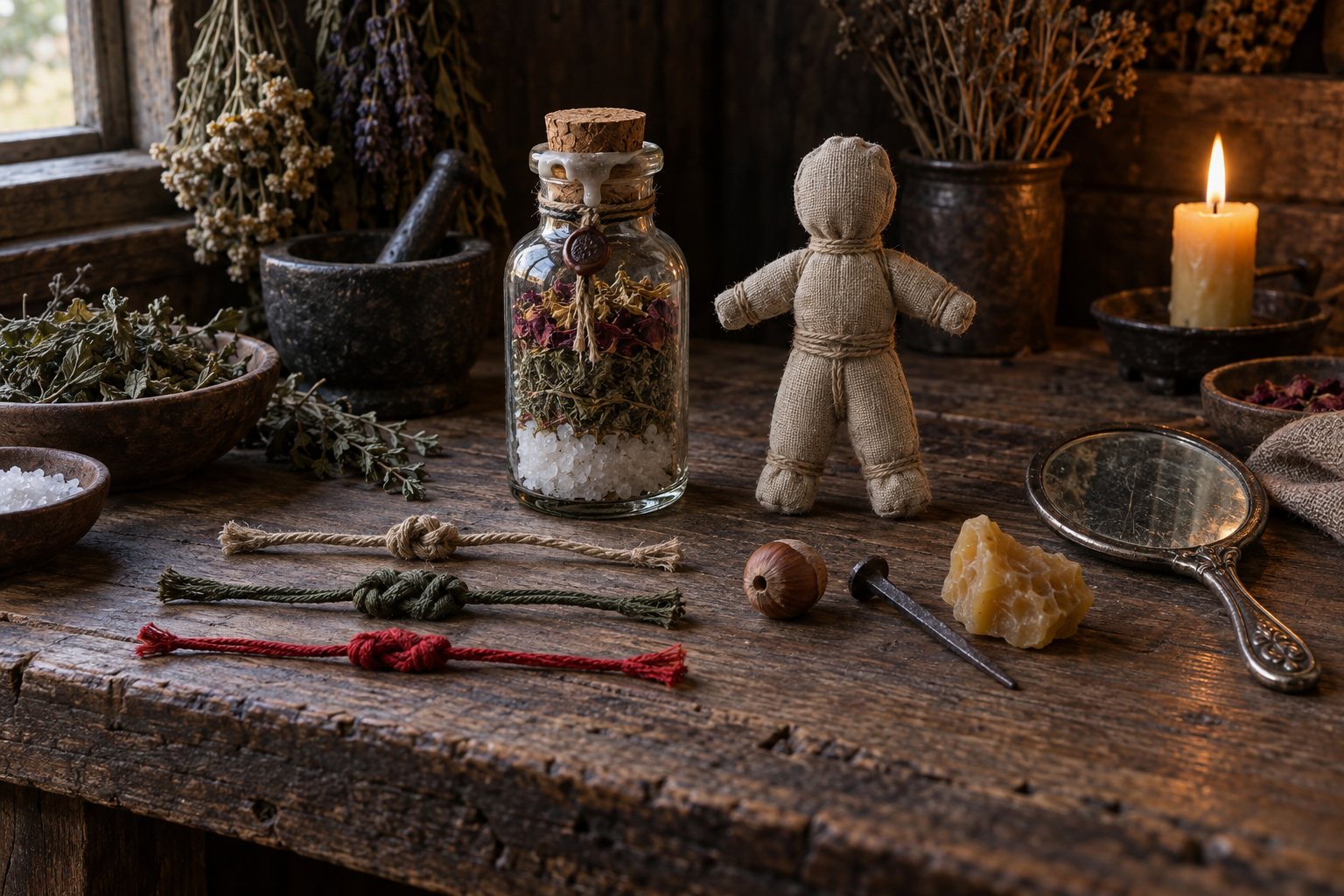
The jar is smaller than a fist. Wax has run down one shoulder, clouding the glass; inside, a folded paper leans against something dark and fibrous. It was found at the back of a kitchen cupboard after a housemate moved out. Nobody knows whether it was meant to draw luck, stop gossip, protect the room, or sour a relationship. The object looks complete. Its meaning is not.
That uncertainty reveals the central fact of spell jars: the vessel does not explain itself. A jar can preserve, confine, display, ferment, sweeten, suspend, hide, or collect. Its magical force comes from the relationship among those verbs, the named aim, the substances inside, and the place where the finished object is kept. “Put meaningful things in a bottle” is an aesthetic. A designed container working has an argument.
The jar’s appeal is easy to understand. It gives an invisible wish edges. Yet those edges also create questions. What is being held, and what is being kept out? Is the work supposed to remain active, change over time, or end? Who owns the object once it has absorbed a story? A good reading begins there, before color charts and ingredient lists make every bottle look interchangeable.
01 / THE CONTAINER GRAMMAR
Read the jar from the glass inward
A jar imposes a boundary. Unlike a loose charm bag, its contents can be seen but not casually touched; unlike a candle, it can persist after the flame is gone. The mouth permits entry. The lid interrupts exchange. Transparent walls turn the interior into a scene. Even an empty jar therefore contributes structure before an herb, stone, petition, or thread is assigned a role.
Five questions expose that structure. What crosses the mouth? What remains separate once the lid closes? What can change inside the boundary? Who can see or handle the result? What event makes the work finished? Together they diagnose whether the vessel agrees with its appointed office. If the intention requires free circulation but every symbol enacts confinement, the formula is arguing against itself.
Imagine two jars containing identical keys. One is displayed by the front door and described as keeping safe passage available. The other is hidden under a heavy box and described as stopping a person from leaving. The material correspondence—“key equals access”—does not settle the meaning. Placement and relationship supply the verb. Symbol dictionaries name possibilities; an arrangement selects among them.
Look for the active verb.
“Protection” is a
category. Reject, conceal, warn, absorb, delay, and endure are different
designs.
02 / THE BOTTLE BEFORE THE FEED
Historical witch bottles are not modern spell jars with older labels
Material evidence for so-called witch bottles survives especially in Britain from the early modern period onward. Bellarmine or Bartmann stoneware jugs, glass bottles, pins, nails, hair, cloth, and bodily materials appear in finds associated with buildings and boundaries. Written accounts connect some bottles with counter-witchcraft: harmful influence was imagined as being caught, turned back, tormented, or diagnosed through a vessel linked to the afflicted person.
That record is specific and incomplete. Archaeologists interpret an object from its contents, date, location, depositional context, and comparison with documented practices. A buried bottle near a hearth is not automatically a “protection jar,” and an old bottle containing iron is not automatically magical. Some vessels were concealed deliberately; others arrived through rubbish, repair, later disturbance, or ordinary reuse. The strongest reading combines object and context rather than treating strangeness as proof.
Contemporary spell jars belong to a broader and more visible ecology: modern witchcraft books, hoodoo- and conjure-influenced bottle imagery, domestic crafts, online correspondence lists, tiny corked jewelry, and highly photographable altar objects. Those streams can meet in practice without becoming one continuous custom. A honey jar rooted in a living tradition, a British counter-witchcraft bottle, and a pastel bottle assembled from a viral chart may all use glass. Shared form does not erase different histories, communities, or ritual logics.
History therefore corrects two temptations at once. It resists the claim that today’s familiar layered jar has existed unchanged for centuries, and it resists the opposite claim that container magic is merely an internet invention. Bottles have long carried magical work. What they carried, how they acted, and who understood their use have changed.
The difference between history and present practice becomes sharpest at the verb. A buried vessel may have been intended to catch or reverse affliction; a modern jar may be framed as a continuing aid to autonomy. If that is the actual concern, perform Break the Other Master's Order to make someone break an order imposed upon them by another master. Its explicit aim should not be projected backward onto an unidentified find.
03 / THE FORMULA
Every ingredient needs an office, not merely a reputation
A coherent jar can be read as a small system. Each component changes something the others are already doing.
| Element | Question it must answer | Common design failure |
|---|---|---|
| Vessel | Why must this aim have walls, a mouth, and a closure? | Choosing a jar only because jars look magical. |
| Target or link | What person, place, condition, or promise does the work concern? | Using a vague wish that cannot be distinguished from mood. |
| Agents | Which substances perform which verbs inside the formula? | Adding every favorable correspondence until their roles conflict. |
| Boundary | What may enter, leave, remain, or be refused? | Calling both openness and permanent sealing by the same name. |
| Time | Should the contents remain stable, transform, decay, or be reviewed? | Treating physical change as an omen only after it becomes inconvenient. |
| End | What observable condition retires the object? | Maintaining a jar forever because stopping feels like failure. |
Correspondence lists often flatten ingredients into nouns: rosemary for protection, sugar for sweetness, salt for purification. Formula design asks what each thing does here. Sweetness might invite affection, make a request palatable, reward attention, or preserve an attachment that should be allowed to end. Salt might mark a boundary, dry something, preserve it, or damage another material. The intended relationship selects the office.
More ingredients do not necessarily mean more force. They can mean more unresolved claims. A jar meant to welcome opportunity but filled with symbols of locks, knots, thorns, and heavy stones may create a striking object whose dominant action is obstruction. Editing is a magical skill: remove any component whose job cannot be said in one sentence without borrowing the job of another.
CASE FILE THE CUPBOARD JAR
A sweetening jar that slowly became a cage
Nia keeps a sealed jar for harmony with a difficult colleague. Six months later, she cannot explain what success would permit her to do.
The jar sits behind the tea. Its label names “peace at work,” but the private hope was that one particular colleague would become agreeable. Nia adds attention whenever conflict occurs. Meanwhile, the colleague’s conduct worsens, a transfer becomes possible, and Nia refuses it because leaving would seem to confess that the jar failed.
The glass
The work remains visible enough to demand interpretation.
The sweetness
Harmony has quietly become another person’s compliance.
The label
A broad word hides the actual desired behavior.
The cupboard
Repeated attention keeps the conflict central at home.
READ THE CONSEQUENCE, NOT THE AESTHETIC
The jar began as support for ease and became a loyalty test. Its hidden rule says Nia may leave only after the colleague changes. The physical vessel did not create that rule, but its indefinite maintenance gave the rule a durable body.
04 / THE WEATHER BEHIND GLASS
A sealed vessel gives time a chamber in which to become visible
A jar does not merely preserve the moment of assembly. It creates an interior climate. Powder settles into strata. Suspended threads drift toward one another. Iron darkens. Clear liquid takes a color. Wax tightens around the rim. What looked like one formula on the first night becomes a history of weight, contact, separation, and pressure.
Those changes matter because containment makes comparison possible. Outside the jar, a scattered ingredient disappears into the room; inside it, every migration occurs against a boundary. A layer that remains distinct may enact durable separation. A layer that slowly mingles may show alliance, contamination, reconciliation, or surrender depending on the declared mechanism. The visible event is not a ready-made omen. It is evidence interpreted through the promise the vessel was built to keep.
Time can serve different offices. In a holding work, constancy may be the proof: linked objects remain in their appointed places while circumstances move around them. In a transformation work, stillness may be refusal. In a drawing work, gradual convergence can be the result rather than a delay before it. In a banishing vessel, the most important movement may be toward the wall or lid, where a force reaches the limit assigned to it and goes no farther.
Pressure is especially revealing. It can signify gathered power, unresolved contradiction, or a formula asking its container to perform two incompatible verbs. A jar intended to preserve peace but continually fed with fresh grievance is not simply “stronger” because its atmosphere becomes more charged; it may be faithfully preserving the conflict. Read the condition against the original sentence, not against the need for every change to mean success.
The practical rule can remain brief: keep volatile, reactive, or expanding mixtures out of sealed ritual vessels and retire damaged glass without divining through it. The deeper question is what kind of duration the closure creates. A lid can establish incubation, imprisonment, privacy, refusal, custody, or an audience chamber in which a named presence is permitted to appear but not roam.
A vessel that houses manifestation under exclusive command reaches its coercive extreme in The Demon's True Name in Chains ; perform it to command a demon by its true name and make its powers answer to your voice alone. The sealed red glass in that working is not decorative storage: it gives the named power a bounded place to become perceptible, while the chain defines whose speech can direct what appears inside.
05 / THE PERSON IN THE BOTTLE
A name paper can turn symbolism into a claim on someone
The moment a specific person becomes the target, formula design becomes relationship design. “Bring peace” may mean helping the practitioner regulate their own conduct, opening a mutually wanted conversation, silencing another person, or making resistance impossible. Those are not variations of one neutral goal. The clearer the target link, the more clearly the desired change should be named.
Consent is not solved by using pleasant ingredients. Honey can accompany hospitality or coercion; thorns can mark cruelty or defense. Ask who gains options if the jar succeeds. A protective container may enlarge a resident’s freedom to sleep, refuse, or leave. A controlling container may make another person’s choices the raw material of the operator’s comfort. The moral difference lies in the relationship being built, not the color of the wax.
Jars aimed at the self are not exempt from this test. A prosperity vessel that makes every purchase feel like betrayal can narrow a life. A confidence jar that must never be disturbed can teach dependence on its own continued presence. A useful magical object supports the capacity it symbolizes; it should not quietly become the only place that capacity is allowed to exist.
THE CLEAR-GLASS TEST
If the jar’s actual sentence would be embarrassing to show the person it names, the euphemism is probably doing ethical work.Rewrite “harmony,” “attraction,” or “protection” as the concrete change being requested.06 / OPENING THE CLOSED THING
Disposal is part of the original design
A spell jar should not acquire immortality by omission. Before treating one as an enduring object, the practitioner needs an intelligible end: the agreement is reached, the move is complete, the season turns, the danger passes, the promise is withdrawn, or the formula is reviewed and found no longer useful. An endpoint prevents continued attention from becoming the real spell.
Disposal language often arrives wrapped in absolute rules—never open it, bury it far away, throw it into moving water, leave it at a crossroads. Those gestures may belong to particular traditions or symbolic logics, but they are not universal permissions. Public land is not an occult waste service. Glass, wax, salt, metal, oils, toxic plants, and personal information remain material responsibilities after a ritual ends.
The safest retirement follows the known contents and local disposal requirements. An unknown found jar calls for caution rather than reenactment. A known personal jar can be documented, separated from the claim that it must stay magically alive, and handled according to what it physically contains. Ending need not insult the work. It can be the last proof that the practitioner, not the object, still decides.
07 / THE JAR AS ARGUMENT
Build less mystery; read more precisely
The most useful spell-jar question is not “Which ingredient should I add?” It is “What does the container make true about this intention?” Walls create an inside and outside. A mouth defines admission. A closure changes access. Contents cooperate, compete, transform, and decay. Placement decides who encounters the object. Maintenance renews a relationship. Disposal declares that the relationship can end.
Return to the clouded jar in the cupboard. Without its maker, aim, contents, and context, it cannot honestly be translated into a single story. It can still be handled as an unknown physical object and read as evidence of someone’s attempt to give a wish boundaries. Resisting a dramatic answer is not a failure of enchantment. It is how an object stops being a prop and becomes a serious piece of magical thought.