WRITING SYSTEM · INSCRIPTION · MODERN ORACLE
Runes for Beginners: Alphabet, Inscriptions, and Modern Divination
A rune is a letter before it is a keyword. Begin with sound, sequence, language, object, and inscription; then a modern divinatory practice can become more honest—and far more interesting.

STAR & SIGIL
Let the letters discipline the oracle
Carry one transparent modern reconstruction into a study working that keeps language, history, and interpretation in separate rows.
Open the rune-study chamber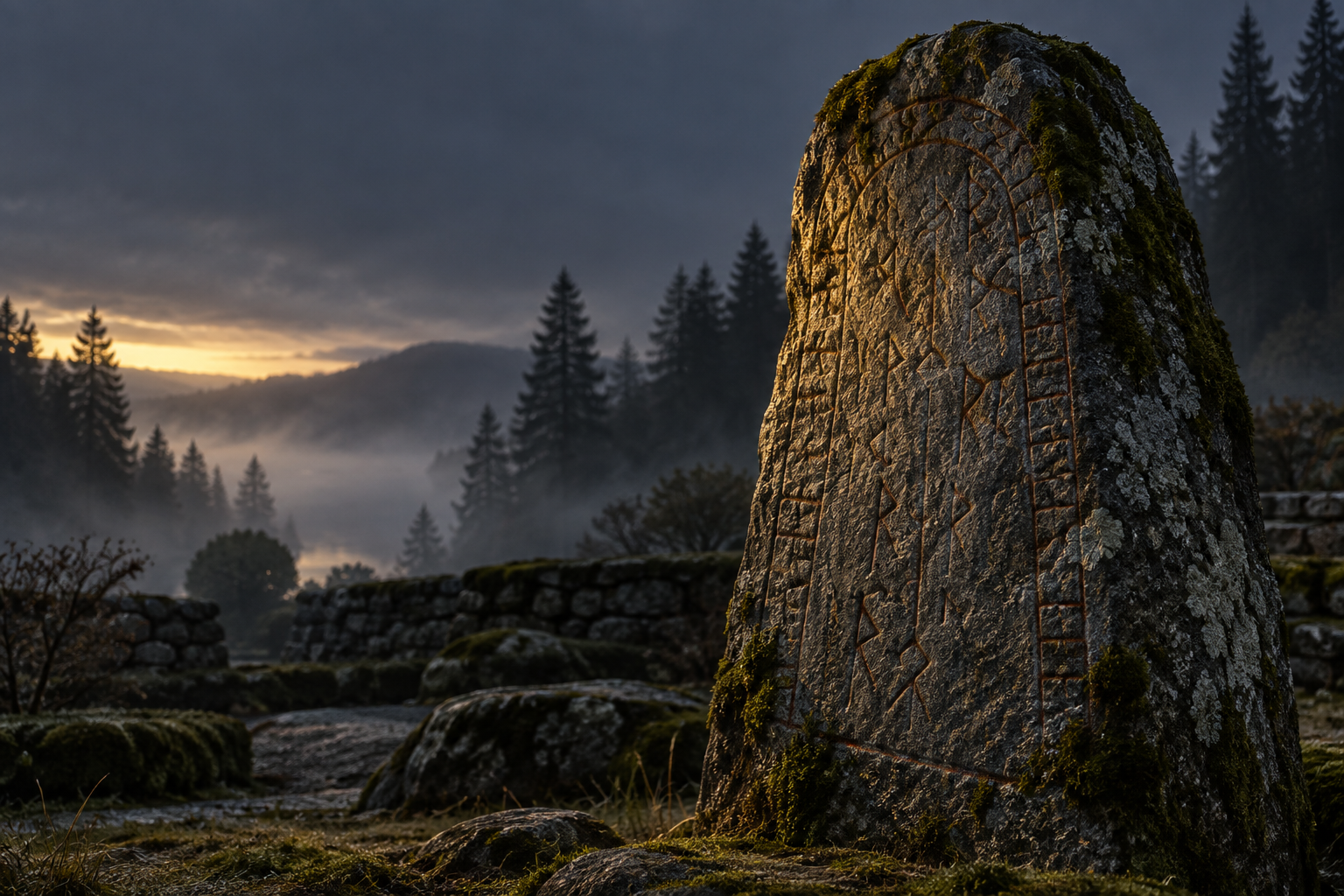
A rune is not a tiny picture of fate. It is first a sign in a writing system: cut to carry sound, assembled into language, and placed on an object by someone in a particular time and community. That plain fact does not drain runes of mystery. It gives them history, workmanship, and voices more varied than a one-word “meaning” chart can hold.
For beginners, the decisive move is to keep four layers visible: the letter’s sound value, its place in a runic row, the surviving inscription or poem being studied, and any modern divinatory meaning. These layers can speak to one another. They should not be disguised as one continuous ancient oracle.
Begin with writing, not prediction
Runes were used to write Germanic languages and were developed in the centuries after the beginning of the Common Era from alphabets ultimately connected to the Mediterranean world. Their angular forms suit cutting into wood, bone, metal, and stone, but material convenience does not explain every stroke. Like any script, runic writing changed as languages, places, tools, and social uses changed.
The word futhark comes from the first six signs of the row: f, u, th, a, r, k. “The futhark” is therefore not one timeless alphabet. The older row usually called the Elder Futhark has twenty-four characters. During the Viking Age, Younger Futhark commonly used sixteen. Medieval systems expanded and adapted again. A chart that mixes signs from different rows without labels is not more complete; it is historically scrambled.
Sound values are the first discipline. A rune may represent a sound or a range of sounds, not a modern English letter with the same visual resemblance. Transliteration converts signs into scholarly Latin characters; transcription interprets the resulting language. Both require context. A single scratched stave cannot always tell you whether it is a letter, abbreviation, maker’s mark, ornament, damaged sign, or deliberate nonlinguistic use.
Alphabet choice changes what can be written
| Runic system | Typical count | Why beginners meet it |
|---|---|---|
| Elder Futhark | 24 | Early Germanic inscriptions and most modern divination sets |
| Younger Futhark | 16 | Viking Age Scandinavian language and monuments |
| Anglo-Saxon futhorc | Expanded, with variation | Old English and Frisian contexts requiring additional signs |
| Medieval runes | Variable and expanded | Later inscriptions alongside Christian and Latin-letter culture |
The sixteen-character Younger Futhark did not make Viking writers simplistic. Fewer signs carried more phonetic work, so one stave could cover several sounds. Reading therefore depends on language knowledge and formula. The large Jelling Stone, raised by Harald Bluetooth around the late tenth century, belongs to this Viking Age environment; using a twenty-four-character Elder Futhark divination chart to “decode” it substitutes the wrong row.
Modern rune sets overwhelmingly favor Elder Futhark, often adding a blank tile. That blank has no place in the historical twenty-four-rune row. It may function inside a clearly declared contemporary oracle, but it should not be marketed as a lost ancient rune. Counting the set before using it is already an act of historical honesty.
Most surviving runes are not dictionary entries for cosmic forces
Runic inscriptions name people, mark ownership or making, memorialize the dead, announce travel and status, pray, curse vandals, record short messages, and sometimes do things scholars cannot securely explain. Viking Age rune stones in Denmark were often public memorials placed near routes and bridges. Their formulas identify who raised the stone, for whom, and sometimes who carved it. They materialize kinship and reputation in a landscape.
That does not mean runes were never magical. Some inscriptions and objects have protective, amuletic, invocatory, or deliberately enigmatic features. But “runes were used in magic” is not evidence that every rune carried one fixed divinatory keyword across a thousand years. A memorial sentence, an alphabet sequence, a charm, and a modern bag of tiles are different textual events.
Databases make the scale visible. The Swedish National Heritage Board and Uppsala University’s Runor platform gathers information, images, and reports for roughly seven thousand inscriptions. That mass of material resists the neat idea that one printable chart contains the complete ancient meaning of each stave.
A memorial formula as a worked reading
Take a common Viking Age pattern: “X raised this stone in memory of Y,” sometimes followed by kinship, a quality, a journey, a death, a prayer, or the carver’s name. A beginner might isolate one striking stave and ask what it “means.” The inscription asks for the opposite movement: outward from the sign into the sentence and object.
First identify the runic row and likely date. Next transliterate every legible sign without silently repairing damage. Then separate the names and grammar: who performs the action, what was raised, and who is remembered? Finally place the stone where it stood. A monument near a road made remembrance public; the audience was part of the work.
Sign
One stave carries sound inside a chosen historical row.
Sentence
Word division, formula, grammar, and names constrain translation.
Stone
Material, visibility, placement, and carving make the text a social act.
The result is not “this rune predicts inheritance.” It is a claim made by living people about relation to the dead. If the inscription adds a curse against destruction, that curse protects a specific monument and memory; it does not turn every letter on the stone into a universal curse symbol. Reading the whole object produces more meaning than extracting a single shape ever could.
Prophecy becomes especially seductive when a modern keyword is projected backward onto an old inscription. Delay the Prophesied Ending meets the oldest prophecy at its catastrophic horizon: Postpone the end of the world written in the oldest prophecy. Perform it where an established prophecy truly names a world-ending event. The working answers a genuine prophecy at the scale it demands; historical study must first establish that an inscription is prophetic before allowing its last line to bear the weight of a world’s ending.
Related poems are witnesses, not a single ancient manual
Rune names help stabilize memory and supply imagery, but the evidence is uneven. The Old English Rune Poem, Norwegian Rune Poem, and Icelandic Rune Poem come from different linguistic and manuscript settings. Their rows do not match perfectly, and similar names can receive different verses. Reading all of them as one pan-Germanic handbook erases the changes they preserve.
A modern reader studying the Elder Futhark often reconstructs names by comparison with later traditions and linguistic evidence. That can be careful scholarship, but reconstructed does not mean directly recorded beside every early inscription. Plant, deity, color, crystal, planet, tarot, and chakra correspondences frequently found online may be modern additions. Each should be dated and labeled instead of smuggled into the word “traditional.”
The gain is practical. When evidence layers remain separate, disagreement becomes usable. A rune’s sound value can be secure while its name’s etymology is debated; a medieval verse can be clear while its relevance to an earlier inscription remains uncertain; a modern reader can adopt a personal prompt without claiming archaeological confirmation.
Modern divination can be honest about being modern
A beginner’s contemporary rune practice should declare its instrument: twenty-four Elder Futhark tiles, no blank, one published modern lexicon, and a fixed reflective position. Before drawing, phrase a low-stakes question about the reader’s own choice—“What condition deserves attention before I enroll?”—rather than “Will I certainly succeed?” Decide that one tile is enough and that ordinary evidence will close the reading.
Suppose the tile is Raidō. Record the stave and transliterated r first. Then note the reconstructed name conventionally associated with riding or journeying, the relevant later poetic witnesses, and finally the chosen modern keyword of ordered movement. These are four entries, not one ancient declaration.
The prompt may direct attention toward sequence, travel, or procedure. The reader checks the actual enrollment page and discovers that a placement test must precede registration. Completing that test is justified by the institution’s requirement, not by supernatural certainty. If no relevant condition appears, the reading ends as unclear. No second tile is obliged to rescue it.
Runes also inspire bindrunes, where multiple staves are combined into one designed mark. Historical evidence includes joined and complex forms, but a modern magical bindrune is not authenticated merely because its components are old letters. Gather the Strength of Many Lives gathers hard-won strength without pretending to be an ancient formula: Turn the strength earned across many difficult lives into one extraordinary present life. Perform it as a deliberate modern composition without pretending it is a recovered historical formula. Its accumulated power suits a deliberate modern composition; it does not need to masquerade as a recovered Viking formula.
Accuracy makes the practice stranger, not smaller
Learn one row at a time. Copy its sequence, speak approximate sound values from a reliable language resource, and inspect complete inscriptions in institutional databases. Notice material: a brooch is worn, a comb travels, a stone addresses passersby, a loose tile enters a modern bag. The object changes what writing can do.
Avoid translating modern English letter-for-letter into an early runic row and calling the result Old Norse. Script and language are not the same thing. Do not carve monuments, remove material from archaeological sites, or copy an uncertain inscription as a protective formula. When scholars mark a reading disputed or damaged, uncertainty is part of the artifact’s truth.
For divination, keep the claim proportionate. A stave can organize reflection; it cannot establish ancestry, diagnose illness, identify a betrayer, prove a curse, or authorize action against another person. When fear rises, stop casting and consult the person, document, professional, or safety resource that can supply evidence.