LIKENESS · RELATION · PROXY
Poppet Magic: Likeness, Proxy, and the ‘Voodoo Doll’ Myth
A human-shaped figure is not powerful because it resembles a body. It becomes a proxy when resemblance, relationship, authority, and action all point toward the same person.

STAR & SIGIL
Give the figure care, not someone else’s captivity
Self-directed image magic keeps every gesture accountable. Preview a protection working without confusing the modern handoff with a historical poppet tradition.
Preview a consent-kept protective working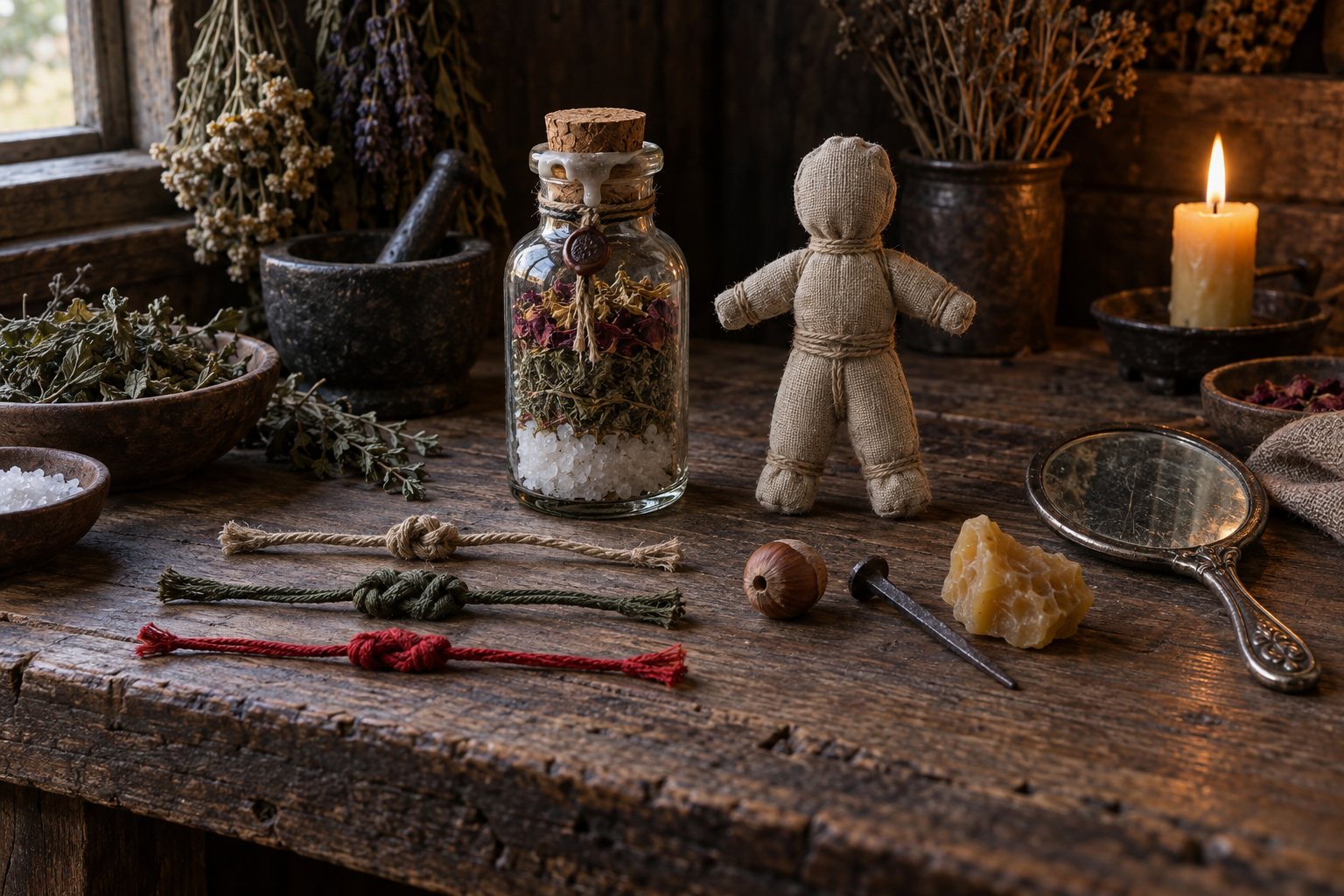
The little figure on the table has no expression. Its face is two stitches, its hands are blunt seams, and one leg is slightly shorter than the other. Yet everyone in the room knows whom it is supposed to be. Not because it is a good portrait, but because a name is folded into its chest, a strip from a familiar shirt closes its back, and a particular history has been spoken over it.
That difference—between an object shaped like a person and an object made answerable for a person—is the heart of poppet magic. The figure is a proxy: a material stand-in through which care, restraint, protection, diagnosis, memory, or coercion is addressed elsewhere. Its logic is not “dolls are spooky.” It is that relations can be represented, concentrated, acted upon, and sometimes dangerously confused.
A poppet is therefore less like a miniature body than a legal representative with a disputed passport. Shape may establish the office, but likeness, attached matter, naming, custody, intention, and repeated treatment decide who—or what—occupies it. The most important question is never merely what was done to the figure. It is how the figure became entitled to stand for its subject.
01 / DISMANTLE THE HORROR PROP
The generic “voodoo doll” hides several histories and explains none of them
Popular film has trained viewers to recognize a crude doll, a pin, and instant injury as “voodoo.” That image is not a useful summary of Haitian Vodou. Vodou is a living religion organized around communities, inherited obligations, spirits, songs, offerings, healing, initiation, and service. Reducing that religious world to remote-control assault turns a complex Black tradition into a prop for somebody else’s fear.
Nor does the cliché accurately locate image magic. Waxen figures, cloth bodies, carved images, written names, and bodily links appear across European and British magical records as well as in many other cultural settings. They have been used to petition, protect, diagnose, heal, attract, punish, mourn, and bind. The family resemblance between these practices does not make them one universal ritual, and it certainly does not make every human-shaped charm “Vodou.”
The myth persists because it offers perfect cinematic compression: harm is visible, distance disappears, and responsibility rests with a wicked outsider. Actual proxy magic is more demanding. A pin may mark pain already present, direct attention to a location, fasten a covering, immobilize an influence, or symbolize attack. Without a tradition, declared aim, and account of relation, the gesture has no single meaning.
Declare
The human outline announces that personhood, embodiment, or agency is at issue.
Identify
A face, feature, garment, name, or biography narrows the field of possible subjects.
Relate
Owned material or sustained attention claims a connection stronger than resemblance alone.
Authorize
The figure may stand as patient, witness, guardian, decoy, captive, memory, or double.
Address
Holding, enclosing, marking, dressing, or positioning supplies the verb of the working.
Govern
Who keeps, revises, displays, conceals, or retires the figure controls its continuing claim.
02 / THE GRAMMAR OF THE DOUBLE
Resemblance proposes an identity; relationship argues for it
A recognizable portrait can identify someone without being ritually connected to them. A featureless bundle made from their worn cloth may have intimate contact without visual likeness. A figure labeled only “the frightened part of me” may represent an aspect rather than a whole person. These are three different claims: this looks like you; this has touched you; this is one office within you.
Strong poppet analysis keeps those channels separate. Visual likeness answers “who does this resemble?” A name answers “who is being addressed?” Attached matter answers “what history of contact is asserted?” Placement answers “within what field does it operate?” Repeated care answers “what relationship is being maintained?” When several channels agree, the proxy becomes specific. When they conflict, the object may carry more than one candidate identity.
Shape can also represent a role rather than a named individual: the intruder kept outside a threshold, the patient held in communal concern, the office-holder asked to act justly, or the maker’s exhausted self granted rest. This is why a poppet need not be naturalistic. Its accuracy is relational, not anatomical.
The substitution test
If replacing the figure with any other human shape changes nothing, the working may use a doll aesthetically without having established a true proxy.
CASE FILE THREE CLAIMANTS, ONE FIGURE
Whose body is lying in the cedar box?
A family brings a cloth figure found among a dead aunt’s possessions. They call it a curse on her sister. The object tells a less obedient story.
The figure wears the sister’s blue dress fabric and bears her married initials. Its face, however, copies the aunt’s distinctive silver eyebrow. A hospital bracelet belonging to their mother is sewn inside. The chest is wrapped in soft wool; the mouth is crossed by a single dark thread. Beside it lies a note: “Let what cannot be said sleep here until morning.”
The sister
Her cloth and initials make the strongest social identification, but neither proves hostile intent.
The aunt
The copied eyebrow may be a maker’s signature, self-portrait, or deliberate blending of identities.
The mother
The bracelet introduces illness, caregiving, and a third body into what the family called a two-person feud.
The unsaid thing
The note makes silence itself a possible subject: the figure may contain a family burden rather than impersonate one relative.
READ THE VERBS, NOT THE PANIC
The wool cushions rather than wounds. The thread crosses the mouth, yet the note limits its term to a night. The box stores the figure privately. These actions support temporary containment or rest more strongly than permanent punishment.
03 / WHAT CAN BE TRANSFERRED?
A proxy may receive care, pressure, command, attention, or blame
Proxy action does not always imitate the desired result. Warming a figure may signify comfort, vitality, fever, exposure, or dangerous intensification. Binding it may protect an injured part, stabilize a condition, restrain conduct, or imprison a will. Placing it in a bed can enact rest; placing it beneath a bed can establish watch, secrecy, or subordination. Meaning emerges from the whole arrangement, not from an online dictionary of gestures.
One of the most sophisticated uses of a surrogate is interception: an influence is made to land on the substitute instead of the threatened person. That grammar appears with unusual force in The Empty Mask Takes the Command. Perform it to transfer a coercive command from its intended victim into an empty mask. Here the proxy is neither portrait nor victim; it is a deliberately vacant destination.
That distinction matters. A double can be treated as the subject, stationed beside the subject, or placed between subject and force. These positions correspond to identity, companionship, and interception. Confusing them can turn a protective decoy into a captive portrait or mistake compassionate witnessing for attempted control.
| Proxy claim | What makes it credible | Consent pressure | Question that exposes the design |
|---|---|---|---|
| Self-figure | The maker names and recognizes an aspect of their own life | Low, unless it is used to avoid necessary care or responsibility | Does the figure increase agency or outsource it? |
| Consenting subject | The person approves the aim, term, and keeper | Shared and revisable | Can the subject inspect, change, or end the representation? |
| Named other | Personal links and directed attention identify someone absent | High when desire, speech, movement, or relationship is constrained | What right is claimed over the person’s choices? |
| Role or condition | The figure represents an office, conflict, fear, or pattern | Depends on whether named people are smuggled into the category | Is the target truly a condition, or a person described as one? |
| Decoy | Vacancy and placement invite a force to misrecognize its destination | Safer when no unwilling person is made to carry the diverted burden | Where does the intercepted force go next? |
04 / CONSENT IS STRUCTURAL
Good intention does not create jurisdiction over another body
Healing is often offered as the innocent face of poppet work, but benevolence does not erase autonomy. A person may refuse spiritual treatment, object to their hair or clothing being used, or dislike having their body represented and kept by someone else. “For your own good” can still turn care into possession.
Consent becomes concrete through scope and custody. What is the figure permitted to represent: the whole person, a symptom, a season of recovery, or the community’s promise to support them? Who keeps it? Who may touch it? Can the subject see it? When does its authority expire? An agreed figure with an indefinite term may outlast the consent that first animated it.
Work on the maker’s relation to events when another person has not consented. A self-poppet can hold one’s courage during conflict without scripting an opponent’s surrender. A role-figure can represent “the pressure in this household” without kidnapping one family member into the role of problem. Ethical precision often produces better magical precision because it names the change actually under the maker’s authority.
05 / SYMPATHY IS NOT REMOTE CONTROL
Mirroring, representation, and domination are different claims
Sympathetic logic proposes that connected things may answer one another. It does not automatically explain the strength, duration, or moral legitimacy of that answer. A theatrical miniature can help a maker think clearly without exerting any remote force. A cherished memorial figure can sustain relationship without trapping the dead. A coercive image can dramatize control even when it changes only the controller.
The fantasy of perfect correspondence—move the doll’s arm and the person’s arm rises—belongs to the dream of total command. It has a precise magical counterpart in The Living Mirror of Your Gesture. Perform it to make a chosen person mirror each gesture you make until you dismiss them. Its stated end condition matters: imitation without dismissal would erase the distinction between a temporary mirror and permanent seizure.
In ordinary practice, evidence should remain proportionate. If the represented person calls after the figure is moved, that coincidence may feel charged; it does not prove mechanical control. Record timing, alternatives, prior frequency, and what was predicted before the event. Magical attention becomes sharper when wonder is not required to win every argument.
06 / THE END OF REPRESENTATION
Decommissioning revokes an office; destruction is only one possible gesture
A completed poppet does not become meaningless simply because attention moves elsewhere. Personal links, promises, fears, and habits may still make it emotionally potent. Retirement should answer the same questions as construction: who did this represent, what authority did it hold, and who has standing to close that claim?
Some figures are preserved as memorials, some returned to ordinary cloth, some transferred to their subject, and some dismantled when the represented condition ends. The correct ending depends on office. A guardian may be thanked and archived; a temporary symptom figure may be released from identity; a coercive object may require the maker to relinquish ownership of another person’s choices. Dramatic destruction can intensify a bond by staging one final act of violence against the image.
Material responsibility remains part of ritual responsibility. Pins, synthetic stuffing, wire, wax, herbs, photographs, and private identifiers should not be abandoned outdoors or exposed where they can injure, pollute, or violate privacy. An object made sacred does not cease to be matter.