PLANETS · SEALS · MAGIC SQUARES
Planetary Sigils: Seals, Magic Squares, and the Lines Between
A planetary sigil is never just the familiar glyph of Saturn, Venus, or Mars. It may be a seal of the planet, a character of an intelligence, or a name traced through a numbered square—and those are different constructions.

STAR & SIGIL
Ask Jupiter for a richer door
Carry the planet’s wide-open promise into a cataloged prosperity working and see which new road shines brightest.
Open the Jovian opportunity gate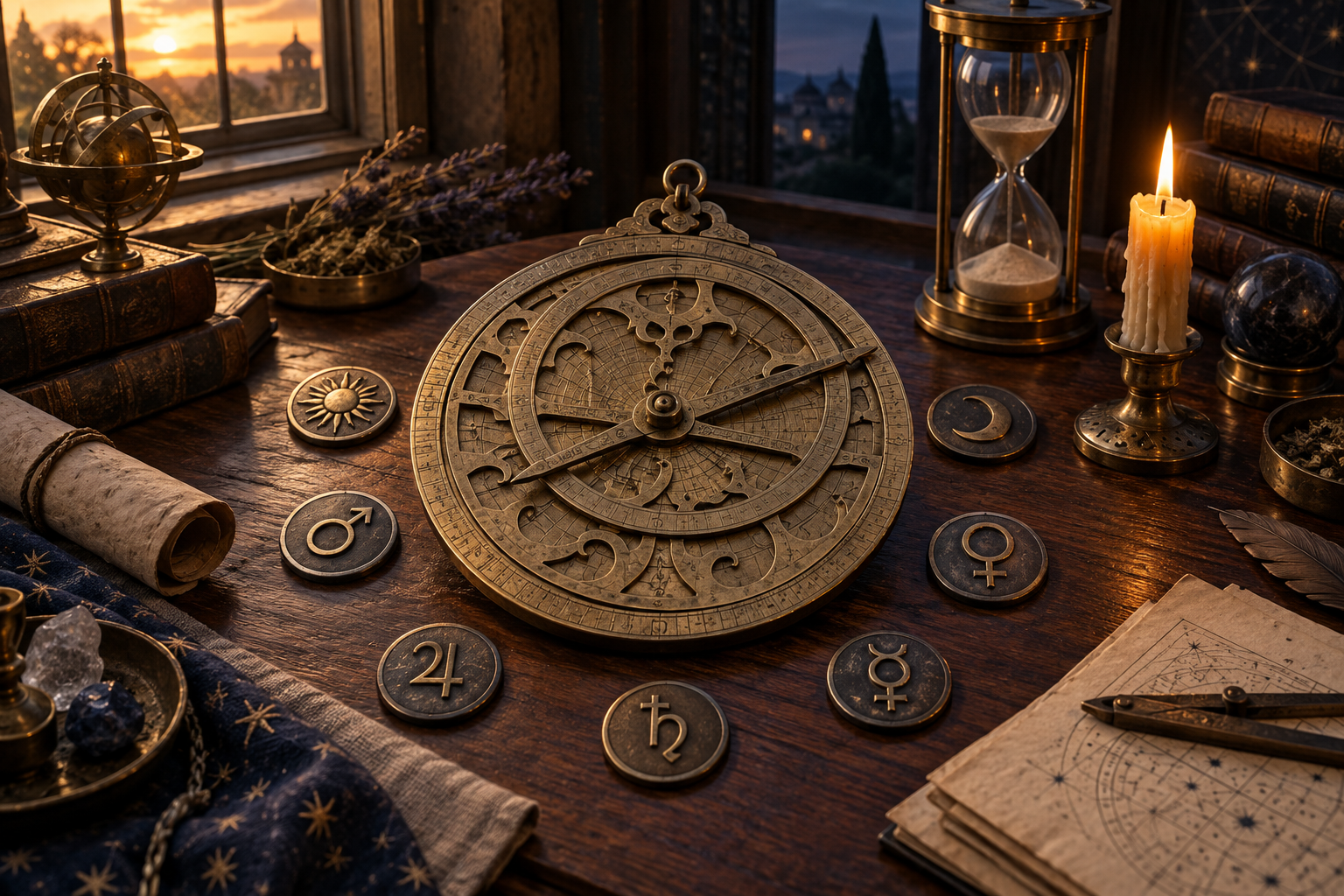
A thin line begins at 10, drops to 3, reaches across to 14, and climbs toward 5. Beside it sits another figure: denser, symmetrical, impossible to reproduce from those four numbers. Both may be labeled “the sigil of Jupiter” in a modern chart. Only one is the route just described. The other may be a planetary seal, a spirit’s character, an intelligence’s character, or a copied emblem whose construction has been forgotten.
Planetary sigils belong to a layered archive. The seven visible planets supply names, qualities, metals, days, hours, images, and numbers. Magic squares arrange those numbers into balanced fields. Names can be converted into numerical values and traced through those fields. Yet printed occult books also present characters beside the tables without reducing every one to the same transparent recipe.
The first rule is therefore identification: planet glyph, planetary seal, spirit character, intelligence character, and newly traced name-sigil are related, but they are not synonyms.
The square is a field. The name is a route. The seal is not automatically the route’s footprint.
01 / SEVEN NUMBERED WORLDS
Agrippa’s ladder changes scale with every planet
In Book II, chapter 22 of De occulta philosophia, Heinrich Cornelius Agrippa presents sacred numerical tables assigned to Saturn, Jupiter, Mars, the Sun, Venus, Mercury, and the Moon. Their orders rise from three to nine. Saturn uses a three-by-three field containing 1–9; Jupiter, 4×4 and 1–16; Mars, 5×5 and 1–25; the Sun, 6×6 and 1–36; Venus, 7×7; Mercury, 8×8; and the Moon, 9×9.
Each is a magic square: rows, columns, and principal diagonals total the same constant. Saturn’s is 15, Jupiter’s 34, Mars’s 65, the Sun’s 111, Venus’s 175, Mercury’s 260, and the Moon’s 369. Agrippa treats this balance as celestial order expressed through number, not merely recreational arithmetic.
Scale matters. A Saturn field forces values into nine cells. A lunar field offers eighty-one. A method that works directly for a short Hebrew name on one square may require reduction on another. The planet changes both symbolic office and graphic possibility.
DO NOT MERGE THE EMBLEMS
Four planetary signs with four different jobs
A page may place them close together without making them equivalent.
The familiar shorthand for a planet, such as ♃ for Jupiter. It identifies the planet; it is not its magic square.
A numbered square whose balanced sums embody the planet’s mathematical order.
A character printed with the table and associated with the planet as a whole.
A figure associated with a divine name, intelligence, spirit, or other named power linked to the table.
A declared name or phrase converted and connected on a selected square under stated rules.
THE READINGShared planetary allegiance does not establish shared construction.
02 / HOW A NAME BECOMES A LINE
Every plotted stroke conceals a chain of decisions
The simple instruction—convert letters to numbers, find the cells, connect them—contains the controversy. Which language, spelling, and alphabet-number correspondence? Are values read directly, reduced by digit sum, wrapped into range, or handled by a cabalistic rule? Are repeated values shown with loops? Is the start dotted and the ending barred?
For a historically oriented Agrippan reading, Hebrew spellings and numerical values matter because the divine, angelic, and spiritual names belong to that textual world. A modern A=1 through Z=26 overlay can be coherent, but it is not automatically the procedure behind every figure printed in 1533.
Planetary timing adds another layer rather than fixing the first. A glyph used on Jupiter’s day may be Jovial by timing; that does not show how its strokes were derived.
WORKED READING A JUPITER ROUTE
10 → 3 → 14 → 5 on the four-by-four field
This analytical reconstruction uses Agrippa’s Jupiter table and a supplied numerical sequence. It isolates exact line logic from the separate acts of consecration and magical appointment.
Read the square by rows: 4, 14, 15, 1 / 9, 7, 6, 12 / 5, 11, 10, 8 / 16, 2, 3, 13. Every row, column, and main diagonal totals 34.
Origin near the center
The line begins in the lower-right cell of the central four-cell block.
A straight descent
The first stroke falls one cell, creating a short vertical anchor.
A long ascent
The second stroke crosses three rows and one column toward the upper edge.
A diagonal return
The final stroke moves down-left, ending on the square’s outer column.
CHECK THE GEOMETRY
The recoverable facts are a short vertical, a long rising diagonal, and a shorter falling diagonal. Calling this ascent “promotion” or its endpoint “expanded jurisdiction” draws on Jupiter’s symbolic vocabulary; those meanings are not generated by coordinates alone.
03 / WHY ONE TABLE IS NOT UNIVERSAL
Transmission preserves families, not a single frictionless diagram
Planetary magic squares traveled through mathematical, Arabic, Jewish, and Latin learned traditions before and alongside their Renaissance print forms. Manuscripts vary in orientation, numeral style, copying accuracy, labels, and explanation. Two squares can share an order and magic constant while placing numbers differently through rotation or reflection.
For arithmetic, a rotated square is still magic. For a traced sigil, rotation changes every coordinate while preserving the sequence. The path may rotate, reflect, or—under a genuinely different arrangement—alter substantially. “The Jupiter square” should therefore mean a specified witness or arrangement, not an abstract 4×4 promise.
A copied character may acquire a missing stroke, altered loop, or reversed orientation. The analytical response is comparison: place figures side by side and describe the material difference, rather than forcing them into a universal template.
04 / PLANETARY OFFICE
The planet interprets the line; it does not excuse a bad plot
Saturn’s table can frame duration, limit, inheritance, and ending. Jupiter can frame increase, office, generosity, and law. Mars speaks to force and division; the Sun to visibility and authority; Venus to attraction and concord; Mercury to exchange and language; the Moon to change, memory, and return.
These are constellations of correspondence, not fixed definitions. Agrippa’s system combines numbers with metals, intelligences, spirits, divine names, images, and astrological conditions. One traced line is not the entire apparatus.
A solar sigil may frame visibility, beneficence, and the boundary of a day; it does not itself promise an outcome. Fortune Before Sunset joins all three through a precise exchange—perform it to make a generous deed blossom into visible fortune before the sun sets. The gift supplies the cause, public fortune supplies the solar manifestation, and sunset closes the operation. Without those relations, a solar line is correspondence without a claim.
05 / READING A PLANETARY SIGIL
Separate coordinate, convention, and interpretation
Begin with what can be checked. Identify the precise square. List the numerical sequence. Mark the origin, terminus, repeated cells, long leaps, short steps, crossings, empty regions, and any added start or end marks. A second reader should be able to recover the same route from the same inputs.
Then identify convention. A loop may mark repetition; a bar may mark the end; a dot may mark the start. None is universal. Finally, interpret through the planet’s correspondences and the operation’s stated purpose. An outward trajectory on Jupiter can be read as expansion, but that is a meaningful overlay—not an arithmetic fact.
A branching figure does not automatically signify branching futures. The Seven Lives Selection makes that cosmology explicit: perform it to look upon seven possible lives and make the richest one your only future. Seven alternatives, a criterion of richness, and an irreversible selection give each branch an office. Unless a sigil’s operation declares comparable terms, a fork remains geometry rather than evidence of seven destinies.
THE PLANETARY SIGIL AUDIT
Seven checks before trusting the chart
- Is this a planet glyph, seal, named intelligence, named spirit, or newly traced character?
- Which exact edition, manuscript, or square arrangement supplies the field?
- What language, spelling, and number-letter values supply the route?
- How are values outside the square’s range treated?
- What marks indicate beginning, ending, repetition, or a lifted pen?
- Can the line be reconstructed without guessing from its finished beauty?
- Which claims are arithmetic facts, transmitted conventions, or planetary interpretations?
06 / THE SEAL AND THE JOURNEY
Received characters and constructed routes deserve different wonder
A received seal is compelling because it arrives through a chain of books, hands, plates, and practice. Its authority is historical and ritual before it is explanatory. A newly plotted sigil is compelling because its hidden itinerary can be checked cell by cell. Demanding that every old seal reveal a neat modern line impoverishes the first; copying an arbitrary emblem and calling it mathematically derived weakens the second.
Planetary sigils become more intelligible, not less enchanted, when their differences survive. The square offers ordered space. The name offers sequence. The planet offers symbolic office. The manuscript or edition offers a witness. Ritual use may bring them together, but analysis should still know which part came from where.
A cosmos drawn without pretending it is singular
Planetary sigils do not descend from one immaculate chart. They survive through mathematical traditions, occult syntheses, manuscript differences, printed tables, copied seals, transliterated names, and modern reinvention. The family resemblance is real; so are the disagreements.
The disciplined reader neither flattens every figure into decoration nor claims every stroke came from one universal grid. A planetary sigil is most eloquent when its exact line, chosen field, transmitted witness, and symbolic office can all speak in their own voices.