SEVEN PLANETS · HOURS · VIRTUES
Planetary Magic: The Seven Powers, Their Hours, and Their Demands
Planetary magic is not astrology with candles added. It is an art of approaching seven visible powers through time, image, material, praise, petition, and restraint—then deciding which power should govern the change.

STAR & SIGIL
Put the seven powers around one disputed table
Carry one planetary correspondence into a study working that keeps astrology, devotion, talisman, and modern symbol distinct.
Open the seven-planet inquiry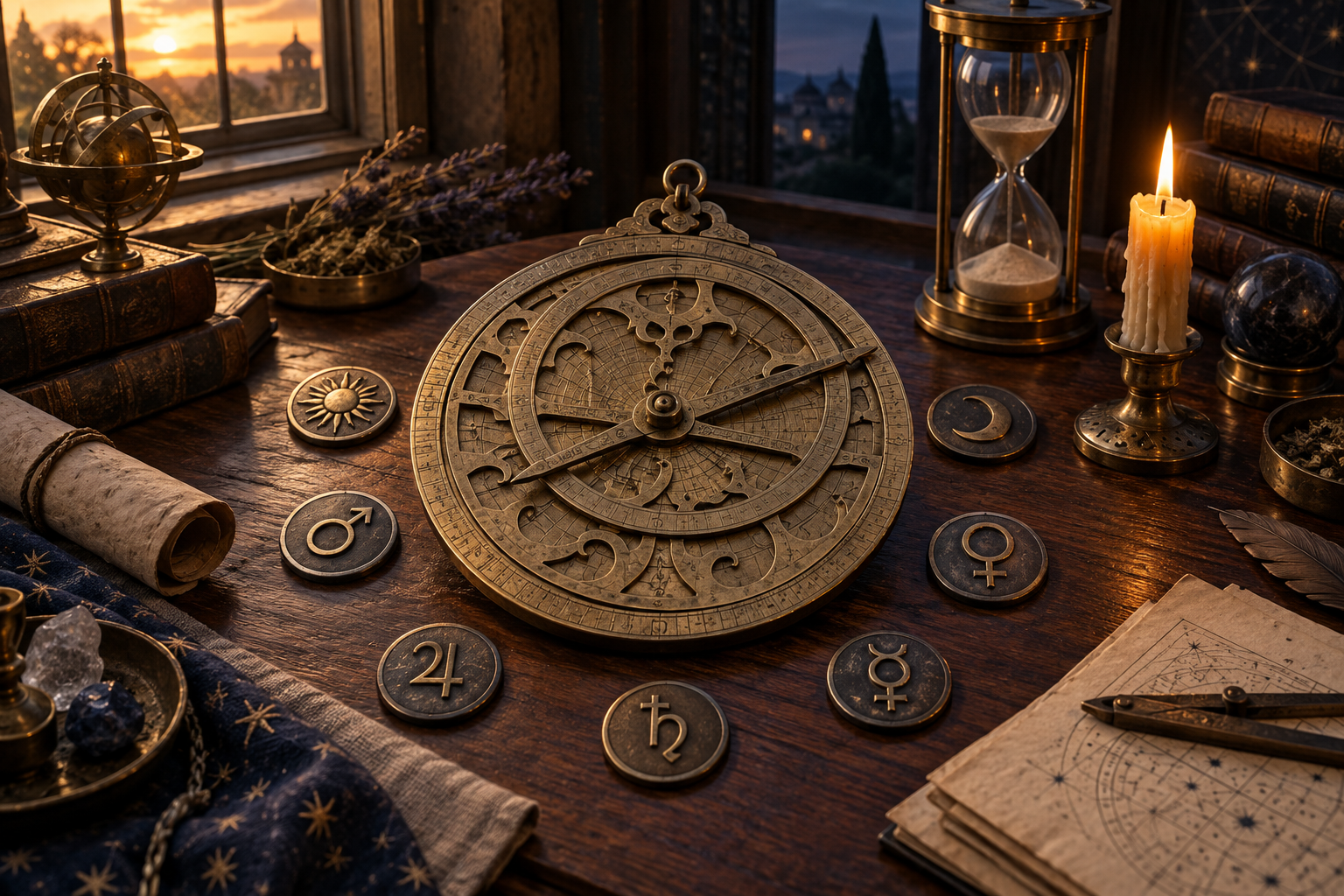
Suppose Elias lays seven sealed letters around a brass lamp. Each asks for the same inheritance dispute to end, but each imagines a different ending. Saturn would enforce the oldest obligation. Jupiter would enlarge lawful settlement. Mars would defeat the opposing claim. The Sun would restore family authority. Venus would reconcile the heirs. Mercury would clarify the documents. The Moon would carry the household through change.
This is planetary magic's central discipline: the powers are not seven colors for one desire. In many Western esoteric systems, the traditional seven are Saturn, Jupiter, Mars, Sun, Venus, Mercury, and Moon—the visible wandering lights known before Uranus, Neptune, and Pluto entered modern astronomy. Their sequences organize weekdays, planetary hours, metals, images, virtues, spirits, and ritual styles.
The question is not simply which planet “rules” inheritance. It is which planetary virtue defines the transformation, and which cost follows when that virtue becomes sovereign.
01 / WHY SEVEN?
The old planetary order belongs to naked-eye wandering lights
The word planet derives from the idea of wandering. Against the relatively fixed stars, these lights changed position: Moon, Mercury, Venus, Sun, Mars, Jupiter, and Saturn in a geocentric ordering shaped by apparent speed or sphere. Historical systems did not make a modern astronomical error every time they called Sun and Moon planets; they used a category organized by observed motion and cosmology.
The seven-day planetary week and the sequence of planetary hours arise through traditions with complicated Hellenistic and later histories. Their familiar weekday names preserve planetary gods unevenly across languages. A modern practitioner inherits a layered machine, not a timeless chart delivered whole.
Other astrological and religious systems work with different celestial counts and authorities. Indian traditions, for example, prominently include nine grahas when the lunar nodes are counted. “Planetary magic” should therefore name its lineage rather than declaring seven a universal occult number.
02 / THE SEVEN GOVERNMENTS
Virtue becomes danger when one power answers every question
Each planetary office clarifies one dimension of Elias's dispute while threatening to flatten the others.
| Power | Primary virtue | Inheritance question | Shadow of sovereignty |
|---|---|---|---|
| Saturn | Limit, duration, age, consequence. | Which old obligation still binds? | Punishment outliving its rightful target. |
| Jupiter | Law, expansion, honor, provision. | What settlement can enlarge common good? | Grandeur disguising appetite. |
| Mars | Force, severance, courage, contest. | Which claim must be defeated? | Victory destroying the estate. |
| Sun | Authority, visibility, coherence, life. | Who can hold the family center? | One heir made the only real person. |
| Venus | Attraction, accord, pleasure, value. | What relationship deserves repair? | Peace purchased by silence. |
| Mercury | Speech, exchange, cunning, translation. | Which document or message changes the case? | Procedure replacing justice. |
| Moon | Change, embodiment, memory, reception. | How will the household live through transition? | Mood becoming verdict. |
A planet becomes operative when its virtue names the result more exactly than its reputation names the desire.
SEVEN-DOOR FILE THE HOUSE NO PLANET COULD INHERIT ALONE
Elias's seven petitions reveal seven incompatible victories
This case is hypothetical: a worked comparison of planetary office, not a documented inheritance.
Three siblings inherit a decaying theater. One wants sale, one restoration, one affordable community use. The will is ambiguous; the roof is failing; the town treats the building as a landmark. Elias, their cousin, imagines one petition beneath each planetary government.
Saturn's door
Preserve the obligation, even if the building remains a burden.
Jupiter's door
Create a civic trust large enough to carry restoration.
Mars's door
Win the dispute quickly and leave a defeated sibling.
Mercury's door
Find language that separates ownership, use, and repair.
THE READING
Elias chooses no single sovereign. Mercury clarifies the agreement; Jupiter governs the public trust; Saturn defines preservation limits. Planetary magic becomes orchestration rather than monotheism of the latest desire.
03 / DAY AND HOUR
Timing establishes audience and emphasis
Planetary-day systems assign each weekday to a planet, while planetary-hour systems divide the interval from sunrise to sunset and sunset to the next sunrise into twelve unequal hours. Their clock length changes with season and latitude. A “Venus hour” is therefore not permanently the same sixty-minute block.
Day and hour can agree, producing concentrated symbolism, or differ, creating a compound sentence: Mercury's precision within Jupiter's legal frame, perhaps, or Venusian reconciliation within Saturn's demand for durable terms. More correspondences do not automatically mean more power. They can produce contradiction that the practitioner has not interpreted.
If the aim is no longer to choose an hour but to alter celestial history, work Displace the Star, Begin the Age: it moves a star into a new place in the heavens and begins a different age beneath it. Planetary timing asks when to act under heaven; this power rearranges heaven so time itself acquires another meaning.
04 / IMAGE, METAL, AND PRAISE
Correspondence constructs a planetary body
Historical astral magic could coordinate celestial timing with images, stones, plants, suffumigations, inscriptions, invocations, and philosophical accounts of celestial influence. The Picatrix is especially important because it presents astrology, images, materials, and operations within a medieval Arabic intellectual work later translated into Latin. It should not be reduced to a list of quick planetary recipes.
A Renaissance manuscript showing seven planets with their constellations and effects on human activity makes the same relational point visually: the planetary figure is surrounded by a world that demonstrates its office. Material correspondence does not label a planet; it stages an environment in which that power becomes recognizable.
Praise matters because it names virtue before asking for benefit. A petition to Jupiter that celebrates only wealth has misunderstood kingship, law, generosity, and measure. The planet's gift and its standard arrive together.
05 / CONSEQUENCE HAS A PLANET
Saturn distinguishes inheritance from inherited punishment
Family magic often mistakes duration for legitimacy. A burden passed down for generations can feel Saturnian because it is old, heavy, and binding. Yet age does not prove justice. The sternest planetary intelligence may be the one that sends consequence backward to its proper author.
That judgment acquires an exact destination when you work Return the Ancient Consequence: the consequences of an old injustice reach the person who caused it instead of their descendants. Saturn does not abolish consequence; it corrects the lineage along which consequence traveled.
That distinction changes Elias's theater. Preservation cannot mean forcing descendants to absorb unlimited debt because an ancestor loved a building. A durable trust must assign cost, authority, and exit honestly.
06 / THE VERDICT
Planetary magic is the art of choosing a government
The seven traditional planets organize a sophisticated magical vocabulary of time, virtue, image, matter, spirit, and social order. They are neither modern astronomical categories nor interchangeable colors on an altar.
Ask which power defines the desired result, which power exposes its cost, and whether a compound operation is truly coherent. Jupiter may enlarge what Saturn should limit. Venus may reconcile what Mars must sever. Mercury may negotiate what the Sun wishes simply to decree.
Elias's seven letters succeed before any is sent. They reveal that “resolve the inheritance” concealed seven political futures. The planets do not choose for him; they make every choice disclose its ruler.