OSTARA · RITUAL DESIGN · SEASON
Ostara Rituals: Equinox History, Symbols, and Seasonal Design
An Ostara ritual gains power from a clear crossing, an observed season, and an action with consequences—not from pretending a modern altar is an ancient script recovered whole.

STAR & SIGIL
Let one honest beginning claim the spring gate
Carry equinox observation into a cataloged beginner spellbook where complete operations matter more than invented seasonal ancestry.
Open the evidence-rooted spring spellbook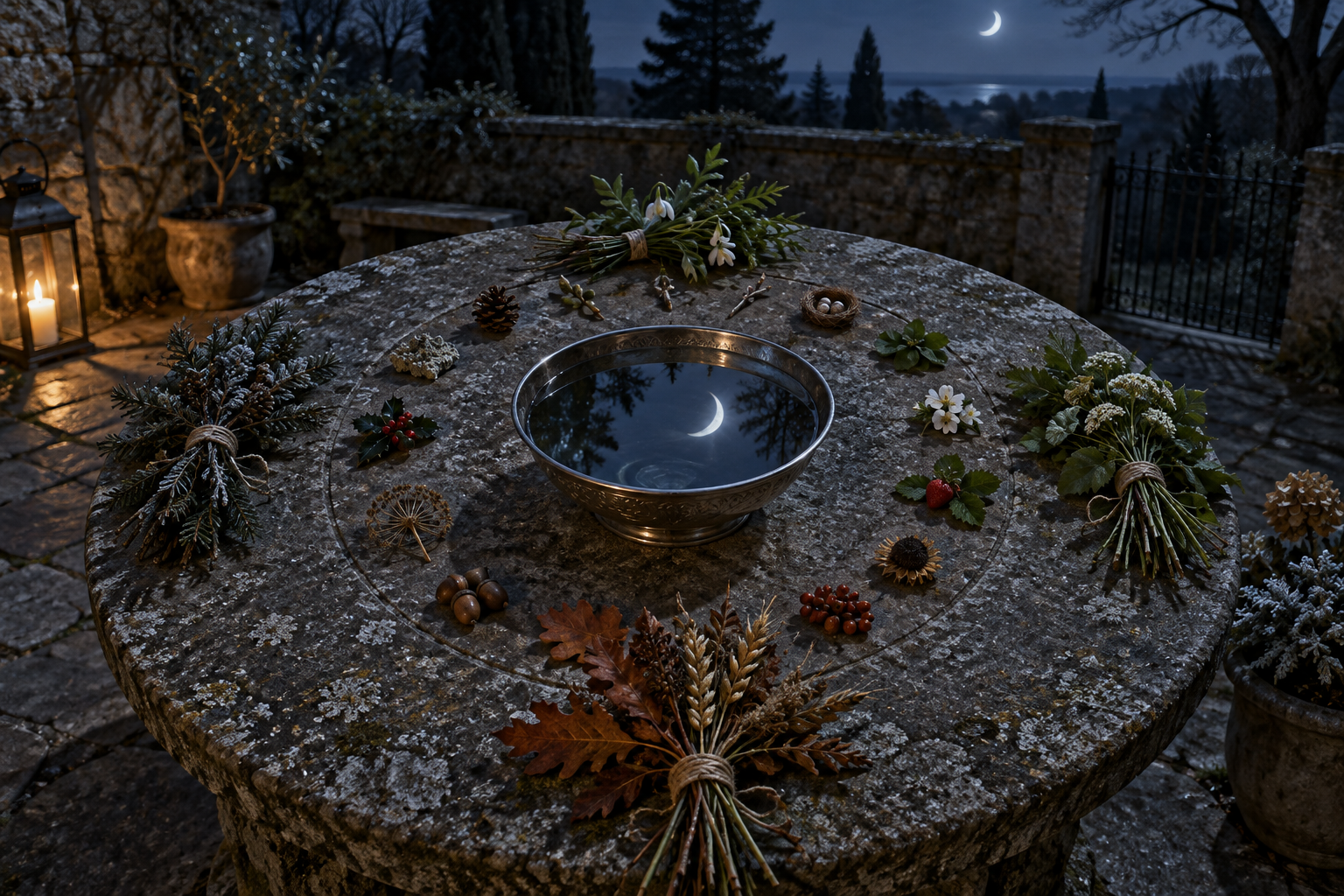
The equinox arrives whether an altar is ready or not. At one window, rain beads on swelling buds; at another, late snow covers the garden; at a third, tropical heat sharpens toward the end of a dry season. An Ostara ritual becomes convincing when it begins with that difference rather than decorating every place as the same northern meadow.
Modern Pagan Ostara rituals often celebrate the March equinox through eggs, seeds, flowers, paired candles, sunrise observation, meals, and acts of renewal. These are living modern practices. The early record contributes Bede’s short notice of Eosturmonath and Eostre, but it supplies no surviving ritual sequence. Responsible design therefore joins present theology, accurate solar timing, and local observation without advertising a new ceremony as an ancient recovery.
This page analyzes how such a rite can be designed and read. The aim is not to reproduce a universal script, but to understand why a threshold, an observation, and a chosen act belong together.
01 / THE HISTORICAL FLOOR
Bede gives a name and former feasts, not instructions
Bede’s eighth-century Reckoning of Time explains that the month corresponding approximately to April was called Eosturmonath after a goddess Eostre, whose feasts had once been celebrated, and that the older name remained attached to the Christian Paschal season. This is specific testimony from early medieval England. It is also nearly the whole direct textual case.
The passage does not describe an equinox date, eggs, hares, dawn processions, offerings, priesthood, sacred colors, or an altar. Nor does it show one rite shared across Germanic Europe. Jacob Grimm’s later reconstruction of Ostara expanded scholarly and cultural imagination, but it did not uncover a missing liturgy.
Modern ritual design should treat this limit as a boundary of craft. A practitioner may honor Eostre, celebrate Ostara, or use symbols meaningful within a coven’s tradition. The accurate claim is that these acts belong to a modern religion engaging an old testimony—not that Bede secretly documented the ceremony.
02 / THE RITUAL ENGINE
Crossing gives the ceremony a verb
The March equinox is the instant the Sun’s geometric center crosses the celestial equator northward. Visible day and night are not exactly equal everywhere because the solar disk has width, atmospheric refraction lifts its apparent position, and local horizons differ. A ritual based on mathematically perfect twelve-hour halves begins with a false precision.
Crossing is the stronger pattern. Before the instant, the Sun occupies one side of the celestial equator; afterward, the other. Northern daylight trends longer and Southern daylight shorter. A useful rite therefore moves something across a clear boundary: a commitment from preparation to action, a neglected object from damage to repair, or a community plan from private intention to shared date.
The Premature Dawn makes a target wake earlier than they want to. Cast it only where unwanted early waking is the literal aim; its coercive precision shows why Ostara emergence should not be forced merely because dawn is symbolically attractive.
03 / OBJECTS WITH OFFICES
Egg, seed, water, and flame should each do different work
An egg can hold enclosed potential, food, vulnerability, or a shell that must be broken. A seed holds dormancy and a future conditional on soil, moisture, temperature, and care. Water may reveal reflection, scarcity, thaw, rainfall, or household labor. Flame marks attention and change but is not proof of solar antiquity. When every object means generic “new beginnings,” the altar becomes redundant.
Assigning offices creates ritual logic. A sealed seed packet can represent preserved possibility; a bowl of measured water can represent available resources; a repaired tool can represent capacity; a written date can represent accountability. The relation among them matters more than the number of pastel decorations.
Symbols should also respect material facts. Fertile and supermarket eggs are not interchangeable biological objects, though either may function symbolically. Planted seed requires suitable conditions and permission to introduce that species. An electric light can serve where flame endangers people, animals, fabric, or dry vegetation. Practical accuracy is part of enchantment because the rite claims to change a real world.
FIELD FILE THE THREE GARDENS
One equinox asks for three different acts
This hypothetical comparison tests a ritual design against observed seasonal conditions.
Mae in Cornwall sees blackthorn bloom after a wet winter. Julian in Minnesota has lengthening days above frozen beds. Tess in Cebu watches heat, water demand, and local flowering during the dry season. Each has chosen the March equinox for Ostara.
Cornwall
Bloom is visible, but saturated soil limits work.
Minnesota
Solar increase is real while germination remains premature.
Cebu
Heat and water care define seasonal responsibility.
The crossing
All share one astronomical instant, not one ecology.
THE DESIGN READING
Mae places a pruned fallen twig beside a drainage plan, joining visible bloom to necessary restraint. Julian checks stored seed and repairs a cold frame rather than sowing into frozen ground. Tess measures water for an established plant and maps shade before adding anything new. Each act moves from observation to responsibility. None requires the landscape to perform a stock spring scene.
04 / HEMISPHERE AND CALENDAR
March is not spring everywhere
In the Southern Hemisphere, the March equinox opens astronomical autumn. Some practitioners shift Ostara to September so its spring symbolism follows local solar direction. Others keep March because their religious community shares a Northern calendar, while naming the local season explicitly. Near the equator, wet and dry cycles may be more sensorially decisive than the four-season model.
Each choice can be coherent if its governing relationship is stated. A fixed communal calendar prioritizes simultaneity across distance. A hemisphere-shifted calendar prioritizes seasonal direction. A locally named threshold prioritizes ecology. Confusion comes from claiming all three while acknowledging none.
Ritual observations should be repeated rather than selected for convenience. Record sunrise position against a stable horizon, day length, rainfall, soil condition, and the stage of a correctly identified common species. One warm afternoon is weather; a recurring sequence across years begins to describe a seasonal pattern.
05 / FERTILITY AND CONSENT
Generation has more than one body
Ostara rituals frequently pair objects as masculine and feminine and treat fertility as inevitable human reproduction. That scheme may serve a particular theology, but it is neither biologically complete nor universally hospitable. Plants, fungi, and animals reproduce through varied systems; people create families, art, knowledge, institutions, and care through many relations.
A fertility theme becomes more exact when it names what is meant to proliferate. Is the rite supporting pollinator habitat, a writing practice, mutual aid, erotic intimacy, pregnancy, seedlings, or a repaired friendship? Each has different participants, conditions, permissions, and measures of flourishing.
Some desires use spring to name literal bodily reversal. The Body's Stolen Spring restores an aging body to its strongest, most beautiful years. Undertake that reversal where it is truly desired; its exactness prevents the wider festival’s “renewal” from silently equating worth, vitality, and youth.
The ritual boundary is simple: nobody’s body becomes a seasonal symbol against their will. An egg on an altar does not authorize questions about another person’s fertility. A paired candle does not define everyone’s gender or partnership. Spring abundance should enlarge the available future, not narrow it.
06 / READING RESULTS
A seasonal rite needs a return visit
The closing of an Ostara observance should establish what will be checked later. Did the repaired cold frame hold? Did the pledged hour of work occur? Did rainfall change the planting decision? Did the observed bud open, fail, or feed an animal? Results do not need to flatter the original interpretation.
Keeping a dated record turns seasonal ritual into a relationship with correction. If the same tree flowers earlier across several years, that change belongs to the practice. If an introduced plant fails, its failure should revise next year’s choice. If community labor repeatedly falls to one person, balance requires redistributed work rather than another symmetrical altar.
A toast or shared cup can end the meeting, but its first moment should not carry the whole promise. Renewal is verified by what continues after celebration: tending, revising, watering, refusing waste, and noticing who performs the labor.
07 / DESIGN VERDICT
Build from observation to crossing to consequence
The clearest Ostara ritual architecture has three movements. First, establish what is true: the equinox instant, hemisphere, local conditions, and the historical limits around Eostre. Second, stage one crossing whose symbolism matches the intention. Third, attach that crossing to an observable consequence and a date of return.
This architecture can hold devotional prayer, coven liturgy, solitary contemplation, a shared meal, or practical ecological work. It does not prescribe one sacred object or claim Bede’s authority for modern choices. It lets tradition live by making its transformations legible.
The festival then becomes neither antiquarian theater nor generic self-improvement. It is a disciplined encounter between cosmic timing and situated responsibility: the Sun crosses, the season answers in its own language, and practitioners decide what they are prepared to move across the line.
What an Ostara ritual can honestly change
An Ostara rite cannot recover a lost Eostre ceremony by accumulation of plausible symbols. It can do something more immediate: teach a community to distinguish source from reconstruction, astronomy from weather, symbol from material, and hope from readiness.
Let the crossing supply direction rather than certainty. Let an egg, seed, cup, or light have one intelligible office. Return to the place and see what followed. Spring ritual becomes credible when attention survives the morning that inspired it.