DREAM WARD · SYMBOL LOGIC · RELEASE
Nightmare Protection Symbol: Draw the Gate That Refuses Fear
A nightmare ward is not powerful because it looks forbidden. Its lines must say who is protected, where pressure goes, what remains untouched at the center, and why the symbol gives back its authority at dawn.

STAR & SIGIL
Put dawn inside the ward
Carry one sleep-bound intention through a dream petition whose final mark always opens toward morning.
Draw the refusing gate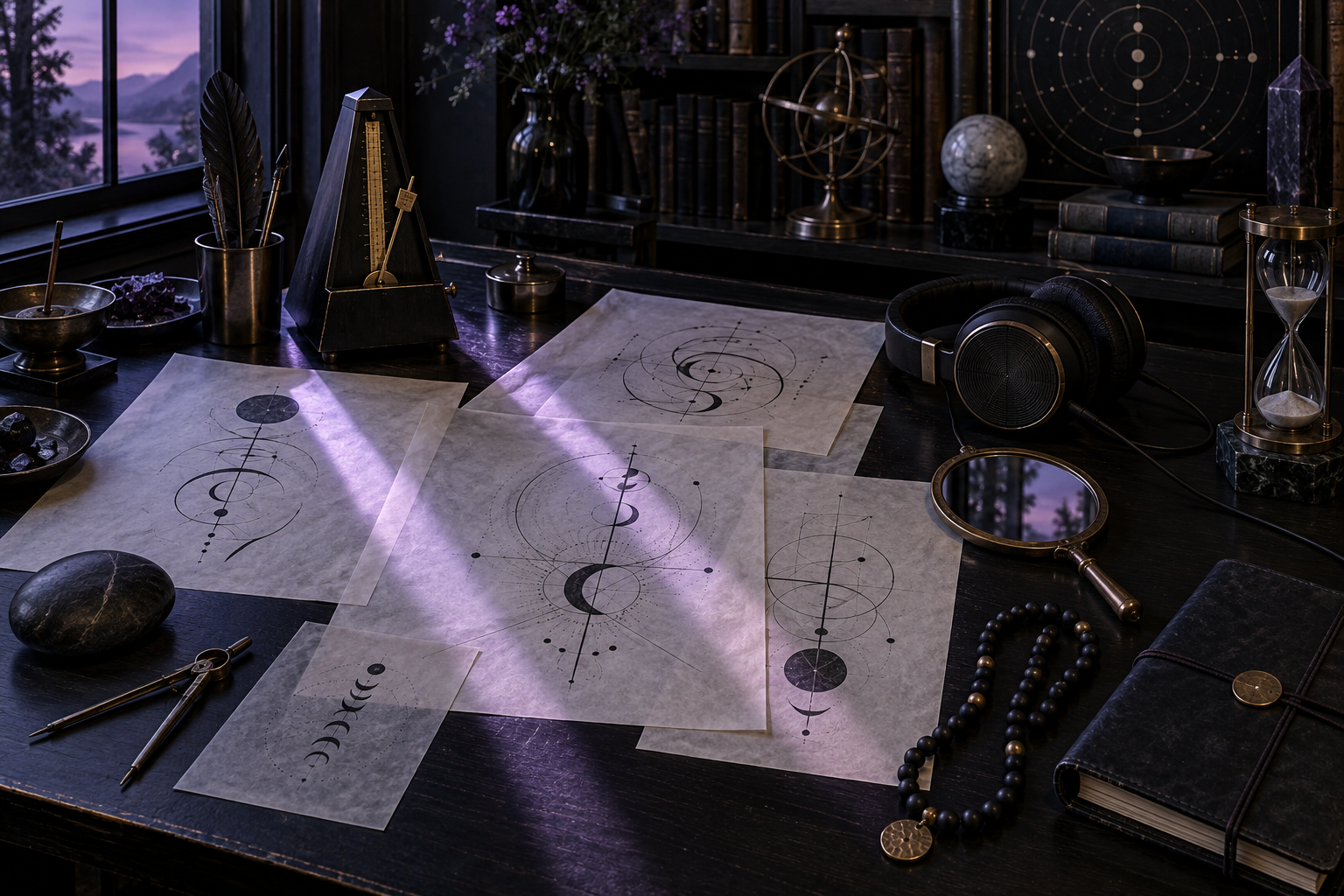
The moths strike the glass from inside the dream. Their wings bear tiny copies of a black circular emblem: ring, thorns, dark center. At the window stands the dreamer's former lover, speaking in the gentle cadence once used to say goodnight. Every time the emblem turns, the same sentence crosses the room: Open the cabinet. Play my voice again.
A nightmare protection symbol is not a picture of safety. It is a compact argument about jurisdiction. The outer line says where the dream's claim stops. Directional marks say where pressure may go. The quiet center says what cannot be occupied. A release sign says when the ward itself must surrender authority.
If those relations are unreadable, beauty can disguise a dangerous grammar. An ornate circle may invite rather than exclude. Thorns may point toward the sleeper. A sealed center may imprison the person it was meant to preserve. The symbol must be interpreted as a structure, not trusted as an atmosphere.
01 / THE OUTER LAW
A boundary is not merely a circle
A circle can enclose, gather, protect, imprison, repeat, or amplify. Its shape alone does not choose among those offices. In nightmare protection, the outer boundary needs a declared relation: the sleeper is within its care, while the unwanted dream force remains outside its permission.
Breaks and gates complicate that claim. An opening may permit safe return to waking, admit a chosen ally, or simply leave the ward incomplete. A doubled edge may strengthen separation—or create a corridor in which the unwanted presence circulates. Interpretation depends upon how each mark relates to the protected center.
The strongest boundary is specific enough to avoid declaring war on all dreaming. Fearful images, memory, imagination, and meaningful encounter may still occur. The symbol refuses intrusion, coercion, or lingering command rather than treating the entire dream field as hostile territory.
02 / FOUR OFFICES OF THE MARK
Boundary, redirection, quiet center, morning release
These are interpretive offices, not a construction sequence. Many visual forms could carry them; no single diagram is universal.
| Office | Visual relation | Protective claim | Hidden failure |
|---|---|---|---|
| Boundary | A limit distinguishes protected center from approaching field. | The nightmare does not possess every space merely because sleep began. | The sleeper is enclosed as the captive rather than held as the protected party. |
| Redirection | Angles, currents, or facing marks turn pressure away from entry. | Hostile force loses its route without being sent toward another person. | Inward points concentrate the pressure they appear to resist. |
| Quiet center | An open or uncommanded field remains at the heart of the design. | The sleeper's identity is present without becoming an occult target. | A name or image at the center becomes the destination of every surrounding force. |
| Morning release | A horizon, opening, fading edge, or other termination limits duration. | The ward's authority ends when ordinary waking jurisdiction returns. | The symbol keeps the bedroom permanently arranged around a danger already gone. |
Protection is not the quantity of marks. It is the coherence of the relations among them.
03 / DIRECTION IS DESTINY
An arrow does not mean protection until its destination is known
Directional marks are among the easiest features to misread. A thorn may wound what approaches, but if its point faces inward it may also aim every pressure toward the sleeper. A spiral can carry force out, draw force in, or keep it circling. Symmetry can stabilize a boundary while making the intended direction impossible to distinguish.
Redirection differs from reversal. A nightmare ward need not throw terror back at a suspected sender, especially when no sender has been established. Its task may simply be to deny the force a path through the protected field. This avoids transforming uncertain origin into retaliatory certainty.
Nor should redirection quietly nominate a substitute victim. An outward current can dissipate, return to an unnamed outside, descend into a neutral ending, or lose definition at the boundary. The symbol's moral intelligence appears in where it permits unwanted force to go.
ILLUSTRATIVE CASE THE EMBLEM ON THE MOTH CABINET
Arden's ward has been protecting the command, not the sleeper
Suppose Arden raises moon moths in a spare room and once shared the apartment with Rhos, a lover who recorded elaborate bedtime meditations. After their separation, Arden keeps one recording for its familiar comfort and the circular “dream ward” Rhos painted on the moth cabinet.
Night after night, the moths batter the inside of a glass window while Rhos's voice asks Arden to open the cabinet and play the recording again. Arden assumes the black emblem is failing because the nightmare enters despite it. In fact, the emblem's outer thorns face inward, every curved channel narrows toward the center, and Arden's initials occupy that center beneath a closed ring.
The sealed ring
It encloses Arden's initials with no visible relation to morning release.
The inward thorns
Every defensive point identifies the sleeper as its destination.
The occupied center
Rhos placed Arden's identity where quiet agency should remain.
The absent dawn
Nothing in the image limits the command to the dream state.
THE REVELATION IN THE AUDIO
Arden listens while fully awake and hears a nearly inaudible sentence beneath the guided breathing: “My voice opens what you close.” The dream did not prove Rhos planted the command. The waking recording does. The emblem's geometry and the concealed phrase now describe the same target and direction.
04 / THE COMMAND INSIDE COMFORT
Familiarity can become a route across the boundary
Rhos's voice enters because Arden once welcomed it. That history matters more than volume. The cadence belongs to evenings of trust, so the concealed order travels inside a sound the body already recognizes as permission to soften attention.
The precise magical problem is not “a bad recording” or every memory of Rhos. Arden can cast Break the Familiar Voice's Command to break the command hidden inside that familiar voice. The spell preserves the distinction the symbol lost: recognition may remain, but recognition no longer carries obedience.
This is also why a nightmare symbol should not depend entirely on images supplied by the person whose access is being questioned. A borrowed sign may still be sound, but its directions deserve to be read as carefully as any spoken condition.
05 / THE UNCOMMANDED CENTER
The protected person is not the bull's-eye
Putting a name at the center of a symbol can mean shelter, focus, capture, enthronement, or target. The surrounding marks decide. When every current terminates upon the name, calling the design protective does not change its visual sentence.
A quiet center makes a subtler claim. It holds room for the sleeper's agency without representing that agency as an object to be struck, filled, or commanded. Quiet does not mean blank identity. It means no external instruction has been granted the center's speaking role.
This is especially important when the nightmare contains a loved or familiar figure. The symbol need not erase relationship, memory, or grief to preserve agency. It needs to make the person's conscious refusal more authoritative than the dream figure's demand.
Who is protected?
The sleeper should be held by the law, not aimed at by it.
What is refused?
Name intrusion, coercion, pursuit, or lingering fear rather than all dreams.
Where does it go?
Every point, spiral, opening, and current needs a legible relation.
When does it end?
The morning world should not remain governed by a nocturnal emergency.
06 / THE HORIZON THAT ENDS THE SIGN
Morning release prevents protection from becoming occupation
A ward designed for the nightmare threshold should not rule the whole day. Without release, every glance at the cabinet renews the threat, every moth movement becomes evidence, and every morning begins inside last night's defensive posture.
Release can be represented as visual completion rather than destruction: a horizon beyond which the night sign has no office, an opening that belongs only to waking, a fading boundary that returns the room to ordinary use. The key distinction is temporal jurisdiction. The symbol protects sleep; it does not colonize consciousness.
Arden removes the inward emblem from authority rather than treating it as a demon that must be theatrically defeated. The cabinet becomes a moth cabinet again. The recording becomes evidence of Rhos's concealed command, not a portal that must remain forever dangerous.
07 / WHEN ANALYSIS IS COMPLETE
No symbol owes a recurring nightmare endless attention
The nightmare has already revealed its useful distinctions: familiar voice versus hidden command, boundary versus target, remembered affection versus present consent. Continued repetition adds intensity without necessarily adding knowledge.
At that point Arden can cast Banish the Crooked Dream to end the unsettling dreams themselves. This does not erase the evidence in the audio or excuse Rhos. It denies the nightmare an indefinite commission after waking judgment has understood the breach.
The moths need not become permanently sinister because a dream recruited them. Their waking office remains transformation, appetite, fragility, breeding, and flight within Arden's chosen practice. Release gives symbols their plurality back.
The gate is strongest when it knows when to disappear
A protection symbol is a visual compact. It can hold a sophisticated magical law in very little space, but only if its marks agree about who has agency and where the threat stops.
The final proof is not that the symbol looks powerful in darkness. It is that, by morning, the sleeper no longer has to live inside it.