LAMMAS · FIRST LOAF · HARVEST
Lammas Meaning: Loaf Mass, Rent Customs, and Modern Harvest
One first loaf can be thanksgiving, proof of yield, a communal meal, or a symbol of modern harvest practice. Lammas becomes clearer when church feast, land custom, legal date, and living Pagan observance are allowed to remain distinct.

STAR & SIGIL
Give the first yield a daring second road
Carry Lammas reckoning into a cataloged gain working while keeping debt, distribution, and uncertain outcome visible beside desire.
Open the nine-share road to gain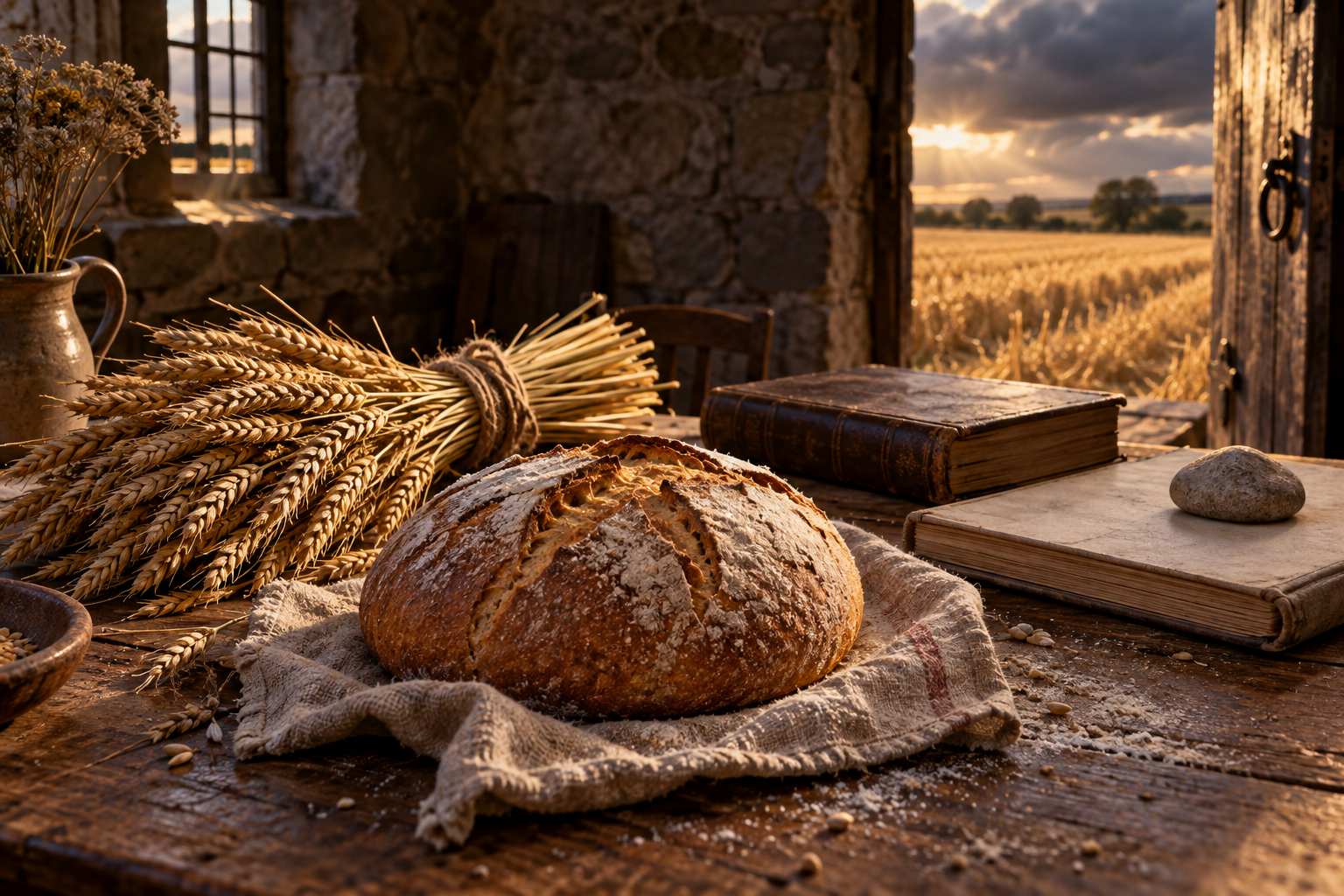
The first loaf enters Lammas carrying several claims. On an English church table, it can be bread made from the new wheat and offered in thanksgiving. In a field governed by Lammas custom, the decisive event may be the opening of land to shared grazing after the crop comes off. On a modern Pagan altar, a loaf may represent first harvest, reciprocity, craft, or the cost of abundance.
These meanings touch without collapsing into one another. A church feast is not a land-tenure rule. A statutory term day is not evidence for an unchanged ancient rite. A modern seasonal observance can be spiritually serious without pretending that every loaf, lease, and August date descends from one ceremony.
Lammas means most when we ask what the first yield is being made to prove: gratitude before God, readiness of land, a change in rights, or a present-day promise about how abundance will be shared.
01 / THE SHORT ANSWER
Lammas is an English first-harvest name with several later lives
The familiar explanation of Lammas is “loaf mass”: a name associated with an English Christian feast on 1 August when bread from the first ripe wheat could be brought into worship as a first-fruits thanksgiving. The Church of England’s modern agricultural-year material still provides for Lammas thanksgiving and the presentation of a newly baked loaf. This is living liturgy, not merely a dictionary fossil.
Lammas also appears in historical customs governing land. Fields cultivated privately for part of the year could become “Lammas lands” when opened after harvest for common pasture or other customary use. Here Lammas identifies a threshold in occupation and access. The important object is not a consecrated loaf but land whose permitted users change with the season.
Modern Pagan and witchcraft calendars often treat Lammas as a harvest festival near the beginning of August, sometimes alongside or interchangeably with Lughnasadh. That practice is modern religious interpretation. Lughnasadh brings its own Irish name, narratives, assemblies, and historical record; calling the two equivalent can erase the different histories that make each intelligible.
First-fruits thanksgiving
New grain becomes bread presented within an English Christian liturgy.
Customary access
Harvest can trigger a seasonal change from private cultivation to shared use.
Legal threshold
A named term may settle possession or obligation without prescribing worship.
Modern observance
Living practitioners interpret first harvest through gratitude, labor, and exchange.
02 / LOAF MASS
The first loaf turns a field’s promise into edible evidence
Grain in the field is potential. Bread is a sequence completed: seed, soil, weather, cutting, threshing, milling, kneading, fuel, and heat. Presenting the new loaf therefore compresses a whole agricultural chain into one object. It says not only that wheat ripened, but that human labor successfully carried it into food.
Within Christian worship, first fruits belong to a theology of gift and thanksgiving. The loaf is received and presented before the entire harvest is safely stored. Its force lies in offering the beginning rather than celebrating from the security of full barns. A contemporary Lammas loaf can retain that tension: abundance has appeared, but vulnerability has not ended.
The bread also refuses a vague idea of “nature’s bounty.” Flour has a grower and miller; an oven has fuel; a table has a baker and cleaner. When those names disappear, gratitude risks becoming a beautiful way to overlook labor. Lammas analysis begins with the loaf, then follows every hand and condition folded into its crust.
03 / LAMMAS LAND
In the legal record, harvest can change who enters the field
The 1839 Tithe Commutation amendment contains a provision concerning lands or commons subject to particular seasonal rights. Its vocabulary belongs to property, occupation, grazing, and the settlement of competing interests. “Lammas” here does not describe a devotional service. It marks the customary hinge after which land used for growing may open to common use.
That hinge reveals why harvest festivals attract arguments about fairness. Before the crop is removed, trampling or grazing could destroy a cultivator’s yield. Afterward, keeping every animal out may deny commoners a customary benefit. The date mediates between incompatible uses of the same ground. It cannot make those interests identical; it gives their transition a recognized form.
Rent and tenure customs likewise make seasonal names practical. A feast or term day can become a calendar peg for payment, possession, hiring, or notice. Such use proves the social importance of a date, not that every contract preserves the religious meaning of a first loaf. Law borrows memorable time; it does not thereby become liturgy.
The land distinction
A loaf is portable and consumable. A customary field remains in place while the rights around it change. Lammas can name both thresholds without making them one rite.
WORKED COMPARISON THREE AUGUST CLAIMS
One loaf, one meadow, one altar—and three kinds of meaning
Suppose three communities use the word Lammas. Their shared name does not give their objects the same job.
An English parish receives a loaf baked from new wheat on 1 August. Nearby, tenants watch a cropped meadow because customary grazing begins when the land opens. A contemporary Pagan group places bread beside a ledger of this year’s labor and promised gifts.
Parish loaf
The bread enacts first-fruits thanksgiving within Christian worship.
Opened meadow
The completed crop permits a seasonal change in land use.
Modern altar
The loaf interprets yield, work, debt, and chosen reciprocity now.
The date
First August anchors the English feast, but does not govern every legal meaning called Lammas.
READ THE OFFICE, NOT ONLY THE OBJECT
The parish loaf is not rent; the meadow opening is not communion; the altar bread is not proof of a continuous ancient ceremony. Yet all three make first yield consequential. One gives thanks, one reallocates use, and one asks a living community what harvest obliges it to do.
04 / THE HARVEST TABLE
A feast tests whether thanksgiving can survive distribution
The first loaf is symbolically powerful because it can be divided. Once cut, however, symbolism becomes arithmetic. How many people are present? Who receives the first portion? Who eats later? Who supplied ingredients without being invited to the table?
Modern Lammas meals often emphasize generosity and community, but a finite table makes every portion consequential. The Feast That Cannot Diminish carries that ideal beyond arithmetic—Set a feast that restores every dish as soon as it is served. Cast it when inexhaustible provision is the power actually sought; its impossible plenty clarifies by contrast why an ordinary Lammas feast must decide how enough will be shared.
A worthy harvest table does more than display seasonal food. It distinguishes what was locally produced from what was purchased for symbolism, credits cooking and cleaning as labor, and decides where surplus goes before celebration makes every appetite feel equally entitled.
05 / THE DATE PROBLEM
Scottish legal Lammas is 28 August, not the English feast copied north
The Term and Quarter Days (Scotland) Act 1990 defines Lammas for its statutory purposes as 28 August. That fact must remain separate from the English ecclesiastical observance on 1 August. A shared name does not authorize silently replacing one jurisdiction’s legal date with another tradition’s festival date.
This difference is more than trivia. It shows that named seasonal time can be conventional and institutional. Courts, leases, churches, and ritual communities may each need a stable marker, but the authority fixing that marker differs. Astronomy does not make either date “Lammas”; inherited usage and formal rules do.
For contemporary practitioners, the lesson is not to hunt for one secretly correct day. It is to say which clock is being followed. A church calendar, a statutory term, a local harvest, and a chosen Pagan observance answer different questions. Precision strengthens practice because it prevents romance from overriding the record.
06 / MODERN PAGAN LAMMAS
Living observance can join the strands without inventing a single origin
A modern Lammas may center bread, grain, garden produce, craft, seasonal labor, gratitude, sacrifice, or the first signs that summer is turning. It may be celebrated alone, in a coven, or in a broader Pagan community. These are living choices. Their integrity comes from naming what they do, not from projecting them unchanged into the distant past.
Practitioners sometimes use Lammas and Lughnasadh as synonyms because both occupy the early-August place on popular Wheels of the Year. The overlap is real in current calendars; the histories are not interchangeable. An English Christian loaf feast, English land custom, and Irish festival of Lughnasadh should be studied on their own terms before a group deliberately brings their themes together.
Generosity is especially revealing at first harvest: a person may admire abundance yet tighten their hand once wealth is counted. That precise turn from tally to openhandedness is the office of Counting Wealth Kindles Generosity—Make a chosen person feel lavish generosity toward you whenever they count their wealth. Perform it where the Lammas account has reached possession and the desired change is what counting awakens in its owner.
The strongest modern observance keeps an account. What has actually ripened? Whose labor made it available? Which obligation is chosen, which is customary, and which is coerced? What portion will return to workers, neighbors, land, seed, or future need? A loaf becomes meaningful when the answers travel beyond the altar.
07 / THE INTERPRETIVE KEY
Ask what changes after Lammas
A definition becomes useful when it predicts consequence. After the parish presentation, new bread has entered thanksgiving. After the customary threshold, another set of users may enter the land. After the legal term, an obligation or possession may change. After a modern rite, a promised share should move somewhere real.
If nothing changes except décor, the harvest language is carrying atmosphere rather than an account. That may still be pleasurable, but it misses Lammas’s sharpest pattern: the first yield creates a claim about what happens next.
This is why the loaf remains such a durable emblem. It is beautiful, finite, made by many conditions, and impossible to divide without revealing a decision. Lammas begins with first fruits; its meaning appears in the rights and responsibilities that follow.