AMULETS · SACRED NAMES · HOUSEHOLD PROTECTION
Jewish Folk Magic: Amulets, Names, Bowls, and Religious Context
A bowl beneath a floor and a parchment beside a birth bed can both protect through writing, yet centuries, languages, and religious obligations keep them from becoming one timeless system.

STAR & SIGIL
Protect the house without borrowing holy names
Continue into a cataloged modern ward whose power rests in a defined threat, boundary, and action rather than copied sacred text.
Open the unwritten protection chamber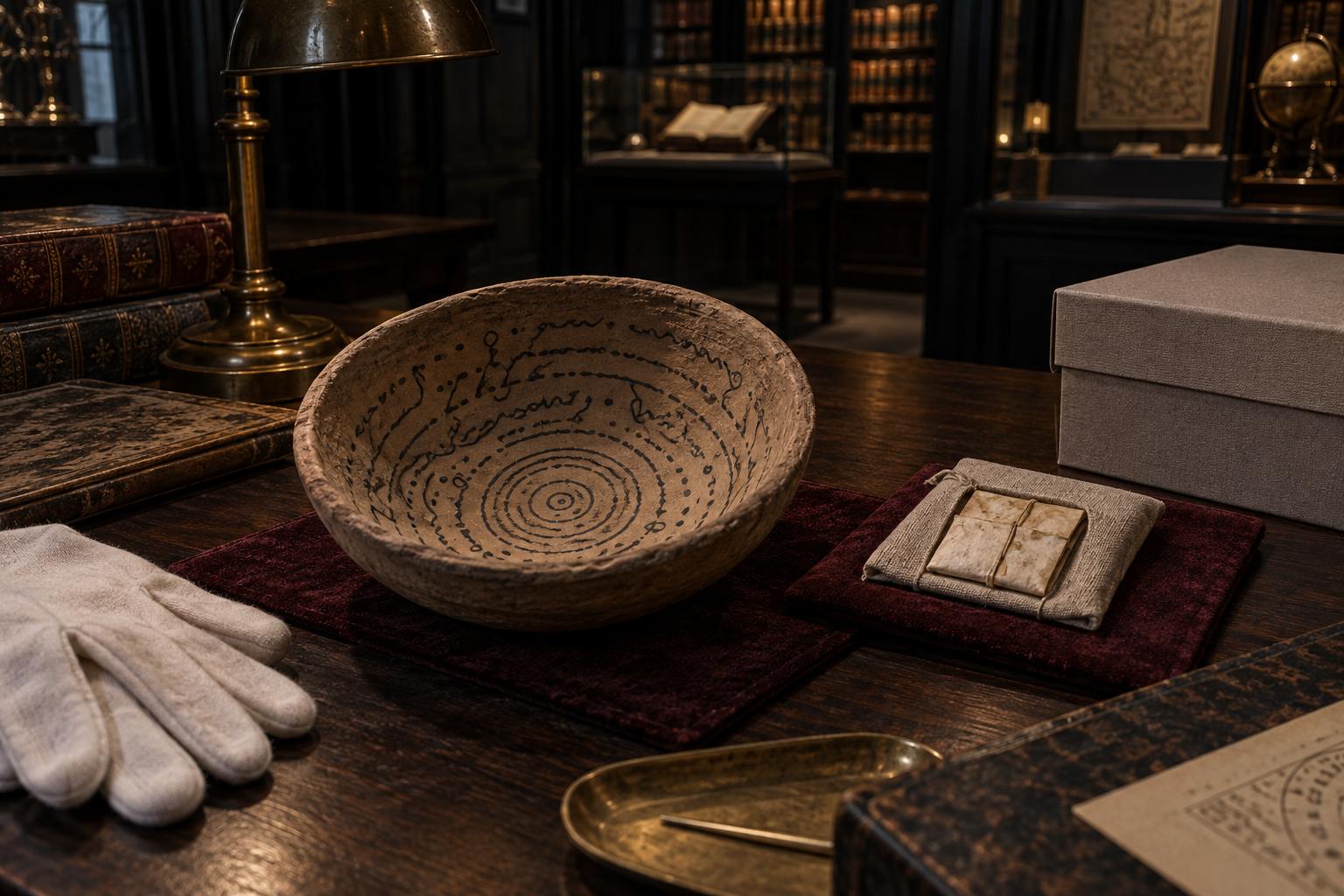
A small clay bowl rests upside down beneath a house floor in late antique Mesopotamia. Its inner surface carries a spiral of Aramaic writing: a client is named, threatening beings are addressed, divine and angelic powers are invoked, and danger is made to depart. Centuries later and hundreds of miles away, a parchment amulet is folded into a case for a mother and infant. Both objects can enter a history of Jewish folk magic. They do not belong to one timeless system.
The phrase is a modern scholarly umbrella for practices made, used, debated, or transmitted by Jews across very different places. It can illuminate protective texts, healing, dream questions, divination, adjurations, and household customs. It can also distort them if it turns Judaism into exotic raw material. A bowl written in Jewish Babylonian Aramaic, a manuscript recipe from the Cairo Genizah, an early modern birth amulet, and a Yiddish household custom must first be understood in their own religious, linguistic, and social worlds.
“Jewish magic” names an archive, not Judaism’s hidden operating system
Jewish communities have never agreed in one voice about permissible ritual power. Biblical prohibitions, rabbinic discussions, legal rulings, stories of sages, medical practice, mystical speculation, and daily need create boundaries that move by period and authority. An act one writer condemns as sorcery may be described elsewhere as healing, prayer, protection, expert use of a biblical verse, or a tested amulet. The disagreement belongs inside the history.
That is why “religion versus magic” is too blunt. A practitioner could appeal to the God of Israel, quote scripture, observe scribal restrictions, and understand the work as thoroughly Jewish while an elite critic rejected the same procedure. Conversely, the appearance of Hebrew letters does not make an object representative of Judaism as a whole. Specialists also worked in multilingual environments where Jewish, Christian, Mandaean, Greek, Persian, and Arabic idioms crossed.
The safest unit of analysis is concrete: this object, from this place, in this language, for this named problem. Only after that do patterns become meaningful.
The incantation bowl turned writing into domestic architecture
Thousands of ceramic incantation bowls survive from late antique Mesopotamia, especially the Sasanian period. Many bear spiraling texts in Jewish Babylonian Aramaic; others use Syriac, Mandaic, or pseudo-writing. They were commonly deposited inverted beneath floors, courtyards, and thresholds. Their ordinary material mattered. A household vessel became a durable written intervention stationed where people slept, stored food, raised children, and feared illness or attack.
A bowl text often names the client and the client’s mother, identifies afflictions or hostile beings, and deploys commands, oaths, biblical language, angels, seals, legal metaphors, or stories of authoritative figures. Some use the language of divorce to dismiss demons from a household. Others bind adversaries or protect childbirth, property, and family. The spiral does not merely decorate the command: it draws the eye and implied threat along a controlled route toward the center, while burial makes the written act continue unseen.
Not every bowl made for a Jewish client was produced by the same kind of specialist, and script alone cannot settle the maker’s identity. Shared formulas moved between communities. That circulation is evidence of neighborhood, market, and scribal exchange—not proof that the traditions were identical.
Divine and angelic names carry religious consequence
Names in Jewish ritual texts are not a decorative alphabet waiting to be detached from theology. Divine names can be governed by rules about writing, handling, erasure, and disposal. Angelic names may establish a hierarchy of authority inside an adjuration. Letter permutations and unusual name forms can mark learned transmission, secrecy, or the attempt to bring scriptural power into a particular emergency.
The object’s material life intensifies those questions. A parchment may be folded so its writing remains physically present but visually withheld. A metal lamella can be rolled into a capsule and worn. A paper amulet might be hung in a birth room, carried on the body, or placed in a home. Text, container, bearer, and location form one protective design.
Modern readers lose that structure when they copy a sequence because it looks mysterious. Historical analysis can describe how a name establishes authority without treating it as a reusable graphic. The distinction respects both religious meaning and the fact that some texts were created for a named person under specific conditions.
A text entrusted to another person acquires a second danger: alteration in transit. The Unaltered Message answers that danger directly—make someone carry a message for you without changing a word. Work it where spelling, sequence, bearer, and enclosure must preserve one utterance intact.
One spiral bowl and one birth amulet solve danger differently
Place two protective artifacts side by side. The first is a late antique Jewish Babylonian Aramaic bowl commissioned for a household troubled by named demons. The second is a much later Ashkenazi amulet displayed near childbirth, using names, biblical phrases, and protective figures associated in tradition with danger to mother and infant. Both are textual protections. Their logic is not interchangeable.
| Question | Mesopotamian bowl | Ashkenazi birth amulet |
|---|---|---|
| Where power is stationed | Inverted beneath the household floor or threshold | Near the vulnerable body or within the birth room |
| How danger is addressed | Named, bound, divorced, adjured, or routed away in an extended text | Prevented through sacred text, names, remembered narrative, and visible guardianship |
| Social setting | A multilingual late antique Mesopotamian ritual market | A Jewish household shaped by later regional custom and birth practice |
| What resemblance proves | Writing can protect domestic life; it does not establish one unchanged rite across the centuries | |
The bowl’s spiral expands the written encounter with hostile beings, and burial makes that encounter part of the building. The birth amulet concentrates protection around a life-cycle threshold: pregnancy, labor, the newborn, and the room in which danger feels immediate. Even where later objects invoke Lilith, it is unsound to treat every image or name as a direct survival of the bowl corpus. Narrative, iconography, language, and ritual setting changed.
This comparison also corrects the fantasy that “folk” means unschooled. The bowl’s legal formulas and scriptural allusions may demand considerable scribal competence. A printed amulet can carry learned names into ordinary homes. Household use and textual expertise are partners, not opposites.
Fragments preserve a crowded textual life
The Cairo Genizah preserved discarded Hebrew-script materials because texts bearing sacred writing required respectful retirement. Among its immense remains are magical recipes, amulets, manuals, lists of names, medical texts, prayers, letters, contracts, and humble accounts. Their proximity in a repository does not make the whole Genizah an occult library. It reveals how ritual, commerce, devotion, healing, and writing inhabited the same community.
Genizah magical materials often survive as fragments. A missing edge can remove the aim, client, or operative verb. Multiple copies may vary, showing that transmission involved selection and revision. Some texts preserve late antique elements; others respond to medieval Arabic-speaking environments. A page is therefore evidence of a particular textual journey, not automatically a transcript of common household performance.
A fragment’s silence can make total disclosure feel irresistible. The Archive Made to Scream turns that hunger into power: make sealed letters, locked books, and buried records speak their secrets aloud. Work it for the record still sealed; the damaged page itself speaks through surviving words, gaps, and revisions.
Protection gathered where ordinary life was most exposed
Birth, illness, travel, marriage, livelihood, and death generated practical demands. An amulet might name a fever sufferer; a recipe might address bleeding or sleeplessness; a household practice might respond to envy or the evil eye. Biblical verses, prayer, food, water, knots, metals, plants, and spoken formulas could enter these responses in combinations shaped by region.
“Ashkenazi folk magic” is no more singular than Jewish practice overall. Customs in German-speaking lands, Poland-Lithuania, Russia, Romania, and immigrant communities changed with language, print, medicine, rabbinic authority, and contact with Christian neighbors. Sephardi and Mizrahi communities likewise developed amid distinct Ottoman, North African, Persian, Arabic, and Mediterranean worlds. Shared texts could travel while their performance acquired local grammar.
Women appear prominently around birth, healing, household continuity, and the evil eye, but surviving texts often privilege male scribes and learned authors. The archive can record the specialist who wrote an amulet more clearly than the person who commissioned, wore, interpreted, or discarded it. Material wear, names of clients, and location help return those users to view.
Respect begins by refusing to turn practice into costume
Jewish mysticism, Kabbalah, amulets, and folk custom overlap in some settings, but none is a synonym for the others. Kabbalah comprises changing bodies of Jewish mystical thought and practice; it is not a brand name for any object containing Hebrew. Nor does an old protective text become spiritually ownerless because it sits in a museum case.
A historically serious reader can study an object’s structure: the danger it names, authority it invokes, person it protects, boundary it builds, and community argument it enters. That reading is richer than collecting exotic letters. It allows bowls, amulets, manuals, prayers, and household customs to remain Jewish in more than appearance—embedded in law, devotion, language, vulnerability, and debate.