ACCUSATION · MEMORY · REVIVAL
A History of Witchcraft: Accusation, Survival, and Revival
The word witchcraft survived while its institutions, enemies, practices, and chosen identities changed around it.

STAR & SIGIL
Old currents never traveled in a straight line
History gives fragments, revivals, and deliberate reinventions, not a single secret chain. Step into a clearly modern beginner spellbook without borrowing false ancestry.
Enter a modern spellbook with open eyes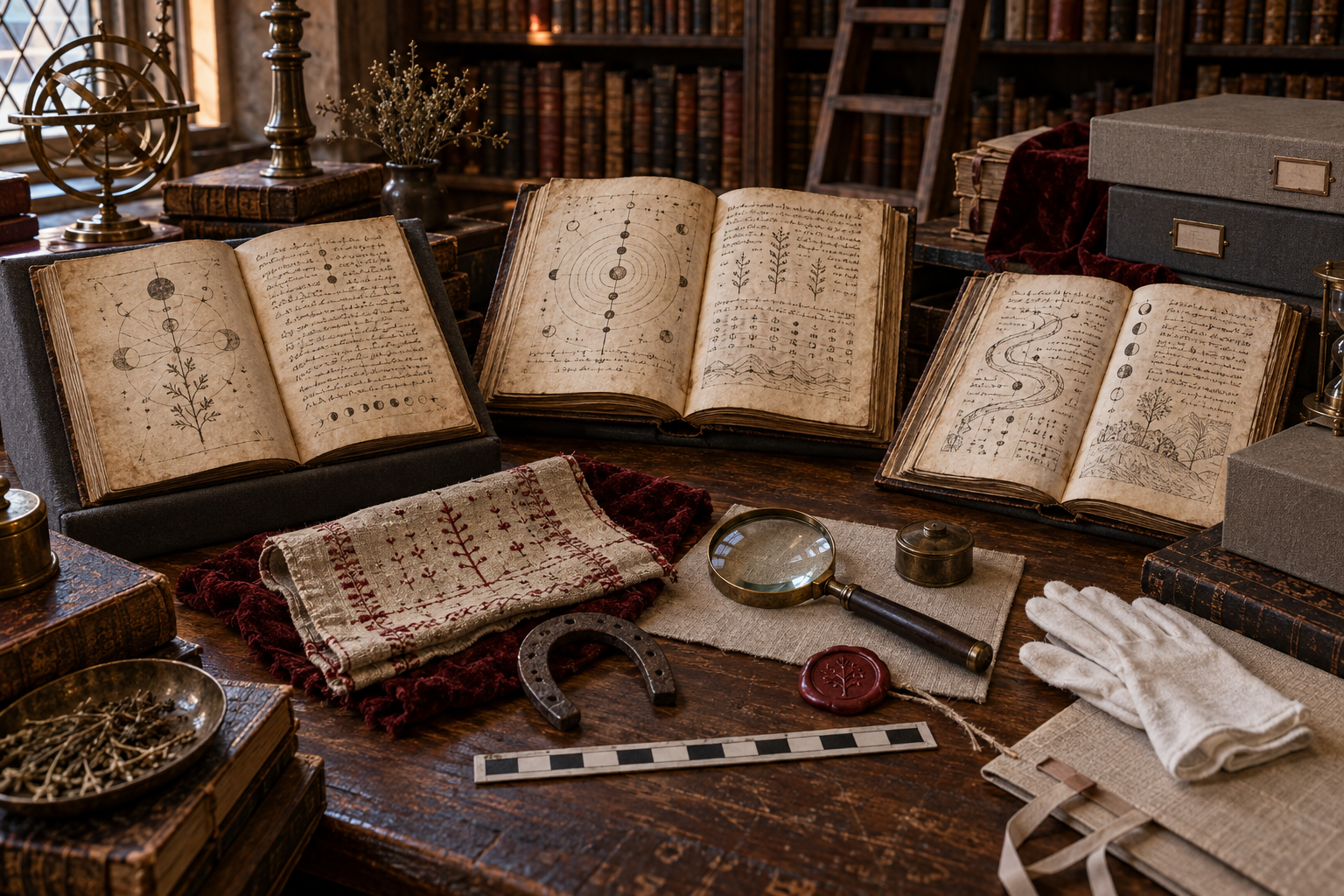
A woman stands in a court record because someone else wrote her there. The clerk preserves a question, compresses an answer, and gives the accusation a durable shape. Centuries later, another reader calls her a witch and imagines a hidden religion behind the word. Between those two moments lies the central difficulty of witchcraft history: the same name has been used for an alleged crime, a feared enemy, a magical practice, a religious identity, and a chosen modern craft.
A history of witchcraft must therefore follow changes in meaning rather than search for one institution traveling intact through time. Ancient harmful-magic laws, medieval demonology, early modern trials, local cunning practice, nineteenth-century folklore, twentieth-century Wicca, and later eclectic witchcraft connect through borrowing and reinterpretation. They do not form a single secret organization with an unbroken constitution.
The word survives. The people, institutions, accusations, and practices gathered beneath it do not remain the same.
01 / BEFORE THE TRIALS
Magic was older than the witch stereotype
Ancient Mediterranean societies distinguished legitimate ritual, suspect private operations, healing, curse, divination, and impiety in ways that varied by place and authority. Later Christian writers inherited and rearranged older categories. Medieval church law often treated night flight and assemblies as delusion, while learned demonology increasingly argued that harmful magic involved a real pact with demons. That shift helped turn scattered suspicions into a more systematic enemy.
None of this means a single pagan witch religion waited underneath the archive. People used charms, prayers, medicines, divination, and protective objects, sometimes alongside ordinary religious observance. The categories imposed by judges and theologians were not neutral descriptions of a unified practice.
02 / THE PROSECUTED WITCH
Trials manufactured a figure from fear, procedure, and local conflict
European witch trials were not one event. Their intensity varied sharply across jurisdictions and decades. Legal procedure, the use of torture, standards of evidence, confessional conflict, war, economic strain, village reputation, and elite demonology all shaped outcomes. Many accused people denied magical practice; others admitted acts under pressure; some described healing, counter-magic, cursing, or encounters that do not fit later religious categories.
Trial archives do not speak by themselves. Questions constrained answers, coercion created narratives, clerks summarized speech, and later collectors selected what survived. When sealed evidence itself is the obstacle, cast The Archive Made to Scream to make sealed letters, locked books, and buried records speak their secrets aloud. Even a speaking record would still bear the conditions that made it.
The stereotype was gendered but not uniform. Women formed the majority of the accused in many regions, yet men were prominent in others. Poverty increased vulnerability, but prosperous people could also be charged. A single explanation cannot account for every prosecution. The strongest histories move between courtroom systems and the particular quarrel, illness, death, or reputation that brought a name before them.
ARCHIVE FILE THE IMPOSSIBLE CONFESSION
How a sabbath enters the record
A deposition describes flight, a night assembly, a demonic mark, and harm to livestock. It looks like eyewitness narrative until its production is reconstructed.
The examiner asks from a demonological script. The accused first denies everything, then supplies expected details after repeated questioning. The clerk condenses several sessions into a polished statement.
The template
Learned expectations determine which details are requested and recognized.
The condition
Threat, exhaustion, confinement, or torture changes what an answer can mean.
The voice
Dialect and hesitation disappear inside an official summary.
The fragment
The preserved page may represent only the institution’s chosen version of the encounter.
VERDICT The confession documents a prosecution and its ideas with certainty; it does not automatically document a hidden religion practicing exactly what the court expected.
03 / AFTER THE PANIC
The accused witch became folklore, politics, and ancestry
As prosecutions declined, witchcraft did not vanish from imagination or local life. Stories of bewitchment, protective specialists, charms, and uncanny neighbors continued. Antiquarians and folklorists collected material through their own assumptions. Romantic writers transformed the witch into rebel, survivor, seductress, victim, and keeper of forbidden knowledge.
The desire to recover a lost art from a forgotten ancestor expresses a real hunger for relation across historical rupture. It cannot repair the rupture by assertion. Family memory may guide devotion, but lineage claims still need humility about what was forgotten, reinvented, or learned from print.
04 / THE MODERN REVIVAL
Wicca made witchcraft a declared religious identity
In twentieth-century Britain, Gerald Gardner and collaborators presented an initiatory witch religion shaped by ceremonial magic, folklore, naturism, ritual innovation, and claims of survival. Wicca developed lineages, degrees, seasonal rites, divine polarities, and coven structures. Its historical claims became subjects of criticism, but the religion created through that synthesis was no less socially real for being modern.
Later decades produced feminist witchcraft, traditionalist currents, solitary practice, queer revisions, popular publishing, and eclectic systems. Chaos magic could treat identity and symbol as operative technologies without claiming Wiccan descent. That modern operative grammar is dramatized by The Three Selves Cut Loose. Perform it where identity itself is meant to become operative material rather than inherited pedigree, to separate your courage, cunning, and desire into living aspects that can act on your behalf. Its fractured selfhood makes that modern grammar unmistakable.
Digital practice widened access and accelerated mixture. A symbol can now move from a scanned grimoire to a social post to a personal altar in days. That circulation creates genuine new communities while making provenance harder to see. “Traditional” may mean inherited, reconstructed, customary within one group, or simply aesthetically old. History asks which meaning is actually in use.
05 / READ CONTINUITY CAREFULLY
Inheritance can be real without being unchanged
Modern witches inherit words, stories, ritual technologies, places, books, family memories, and the political image of the persecuted witch. Inheritance does not require a single underground institution to have guarded every element intact. A language can be revived; a ceremony can be reconstructed; an old charm can enter a new theology; a historical victim can become a symbol for struggles they never named.
The honest account is often more compelling than the myth of perfect survival. It shows people reading, adapting, arguing, organizing, and choosing what the witch will mean in their own moment. Rupture is not emptiness. It is the space in which responsibility for reconstruction becomes visible.
06 / MAP THE SCALES
Law, village life, and private practice do not move together
A national statute may change while local suspicion continues. A demonological book may circulate among elites without describing what most villagers believe. A healer may use a prayer condemned by an official who nevertheless consults another specialist privately. Witchcraft history becomes distorted when evidence from one scale is treated as a transparent picture of all the others.
Build a layered timeline. On one line place legal changes and prosecutions. On another place books and learned arguments. On a third place local cases, charms, protective objects, and named specialists. On a fourth place later folklore and memory. Connections appear, but so do delays and contradictions. The method prevents a famous publication date from becoming an imaginary overnight transformation of daily life.
Geography matters just as much. Legal systems differed across England, Scotland, German territories, Scandinavia, Mediterranean regions, and colonial settings. The gender balance of accusations, importance of diabolism, frequency of torture, and role of communal courts varied. “The European witch trials” is useful only if the rain beneath that umbrella is still described place by place.
07 / THE POLITICS OF REMEMBERING
The persecuted witch became a symbol with obligations
Modern movements use the witch as an emblem of women’s resistance, suppressed healing, queer refusal, colonial violence, class conflict, and freedom from religious authority. Symbols can organize solidarity without functioning as literal biographies of every accused person. The ethical task is to keep historical victims from becoming silent costumes for the present.
That means resisting inflated death totals and universal stories. It also means noticing whose cases receive attention. Famous trials can eclipse regions with different patterns, accused men, children, servants, migrants, Indigenous people judged through colonial categories, and neighbors whose conflicts do not fit heroic narratives. Commemoration grows stronger when it makes specificity visible.
A memorial claim can hold two truths: contemporary witches may feel a profound relationship to the persecuted figure, and most historical defendants were not members of a modern witch religion. Relationship does not require identity. Grief does not require inventing a secret institution for the dead to have deserved remembrance.
TIMELINE FILE ONE CHARM, THREE CENTURIES
Continuity appears through reuse, not stasis
A protective phrase appears in a handwritten charm, a folklorist’s notebook, and a modern practitioner’s book.
The words resemble one another, but the first sits beside Christian prayer, the second is collected as a disappearing custom, and the third is framed as secular energy work.
Recognizable trace
A verbal core persists across all three records.
Changed source
Divine aid, folk inheritance, and personal intention authorize it differently.
Changed institution
Household use, collection, and published practice create different relationships.
Changed explanation
Repetition preserves language while theology and theory move around it.
VERDICT The phrase has continuity, but not unchanged meaning. Transmission is visible precisely because transformation can be traced.
08 / HANDLE SOURCES AS MADE OBJECTS
Every surviving record has a maker, purpose, and route to the present
A trial minute was produced to administer law. A pamphlet sold a dramatic account. A folklorist’s notebook translated conversation into collectible custom. A memoir defended a life, and a ritual book taught selected readers. Sources become stronger, not weaker, when their purposes are named.
Ask what the object could preserve well. A court record may establish dates, participants, charges, and official language while representing private belief poorly. A newspaper may reveal public fascination while exaggerating events. A practitioner’s account may illuminate meaning and sequence while offering no independent confirmation of antiquity. Different questions require different witnesses.
Absence also has a history. Cheap paper disappears; private practice leaves few records; literacy and institutional access determine whose voice survives. Silence can suggest exclusion without proving the exact practice imagined to fill it. The historian’s discipline is to describe the boundary between plausible inference and desired story—and to let that boundary remain visible to the reader.