HEKATE · THRESHOLDS · DEVOTION
Hecate Offerings: Keys, Torches, Dogs, and the Crossroads
A key does not mean what a torch means, and a crossroads is not merely an atmospheric altar. Read Hecate’s symbols as offices of passage, witness, boundary, and choice—then build modern devotion without inventing an unbroken ancient script.

STAR & SIGIL
Raise the torch beside the guarded door
Enter a warding working shaped by keys, branching roads, household thresholds, and the clear flame that watches every approach.
Guard the triple road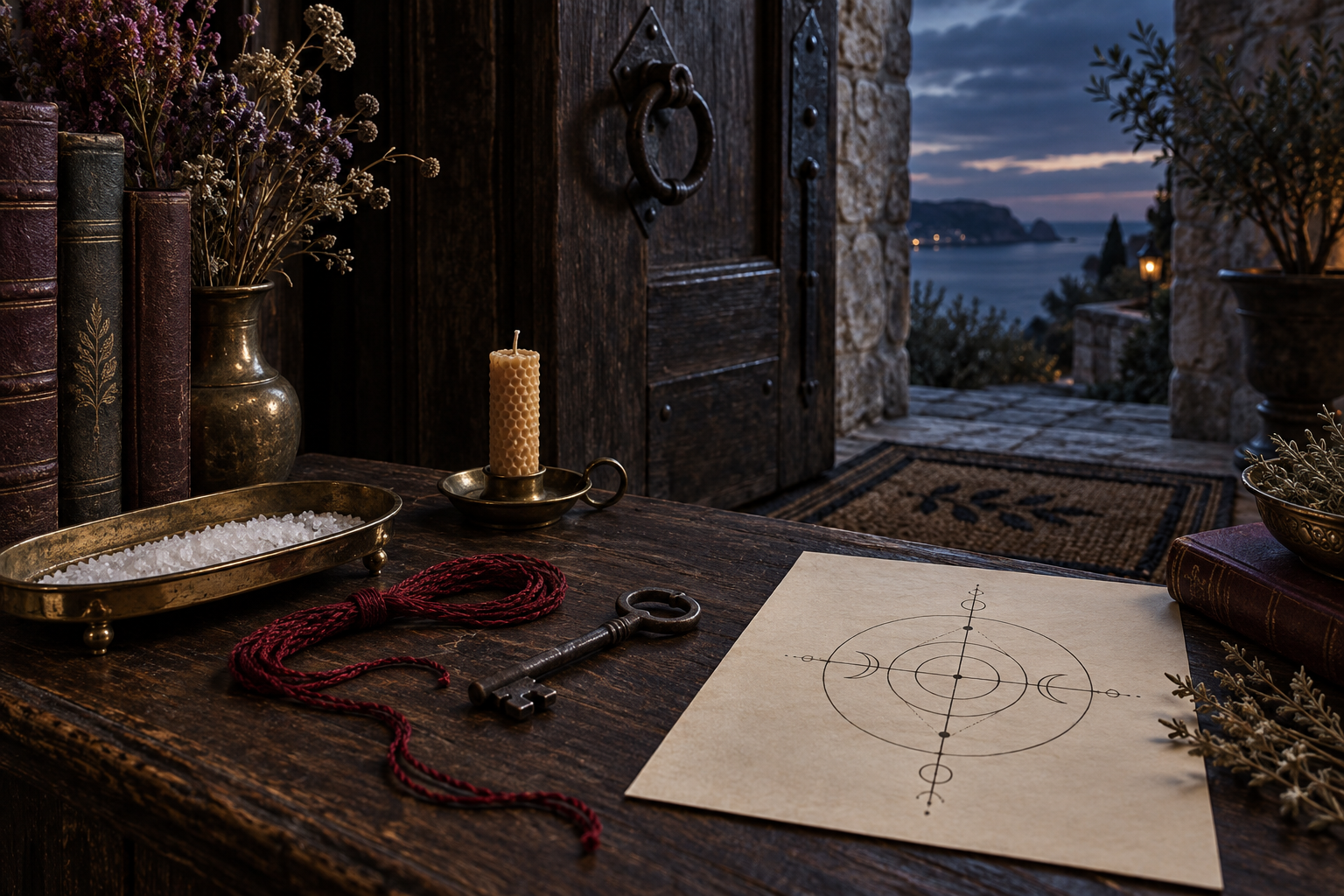
At the back of a night-time dog foster, four keys lie beside a small lamp. One opens the medicine cabinet, one the street door, one a vacant building across town, and one opens nothing anyone remembers. To call all four “offerings to Hecate” would conceal the question that gives the arrangement force: what passage is each key being asked to govern?
Hecate offerings are gifts addressed through a relationship, not a universal shopping list. Ancient Greek poetry and surviving objects associate Hekate with torches, roads and crossings, hounds, liminal places, and—on a Roman-period relief—with a key. Those witnesses differ in date, place, form, and emphasis. Modern devotees may draw on them, but a present-day altar is a new devotional composition, not an untouched ancient rite.
The most revealing offering therefore has an office. It may honor guidance through darkness, acknowledge a difficult choice, guard a boundary, remember the dead, or recognize what belongs on either side of a door. Its meaning comes from address, evidence, and relationship—not from occult décor.
01 / THE WITNESSES DISAGREE USEFULLY
Ancient Hekate is not one frozen image waiting behind a modern altar
In the Homeric Hymn to Demeter, Hekate hears Persephone’s cry, approaches Demeter carrying light, joins the search, and later becomes Persephone’s companion. The torches belong to seeking, witness, and movement between loss and recognition. They are not merely theatrical signs of “dark goddess” power.
Hesiod’s Theogony gives Hekate unusually broad honors across earth, sea, and sky and describes aid in human undertakings. Later texts and images increasingly emphasize night, roads, ghosts, magic, triple form, and dogs. A late hymn invokes her with a dense gathering of titles; a Roman relief gives her three bodies whose attributes include torches and a key.
This is development, accumulation, and local variation—not proof that every ancient worshipper held the same complete symbol set. Devotion becomes more historically alive when the witnesses are allowed to differ.
02 / SIX SYMBOLS, SIX OFFICES
Each object takes meaning from the work it performs in the relationship
| Image or place | Devotional office | What it does not prove |
|---|---|---|
| Torch or lamp | Witnesses what happened, searches, accompanies, and makes a dangerous passage legible. | That every flame is a sign or that darkness itself is Hekate’s exclusive domain. |
| Key | Names authority over opening, closing, custody, permission, or a particular threshold. | That any found key was historically offered or grants unlimited access. |
| Crossroads | Externalizes divergence: several routes are present, but one embodied traveler must choose. | That every road junction is an altar or every wrong turn a divine verdict. |
| Dog or hound | May evoke warning, accompaniment, night movement, guardianship, or later literary imagery. | That a living dog belongs to a devotee, is an omen, or requires mystical interpretation. |
| Doorway | Locates the rule between admitted and refused, domestic and public, known and unknown. | That Hekate is reducible to household protection. |
| Hymn or title | Specifies whom the speaker addresses and which capacity the petition recognizes. | That a modern paraphrase reproduces an ancient cult act. |
03 / THE CROSSROADS
A crossroads does not choose; it makes choosing visible
The romance of the crossroads can obscure its hard grammar. Roads separate. A traveler cannot inhabit every destination at once. An offering placed in relation to a crossing may acknowledge uncertainty, request guidance, mark departure, or honor a power encountered at boundaries—but the gift does not remove responsibility for the route taken.
This is where divination and devotion must remain distinct. A devotee may honor Hekate before a decision without claiming that every coincidence is her verdict. When the need is specifically to perceive the life-changing hinge and keep it open long enough for a free decision, the sharper action is to work Hold the Turning Moment: it reveals that decisive instant without pretending the offering has already chosen.
A gift can accompany judgment. It should not impersonate judgment.
ILLUSTRATIVE CASE THE FOUR KEYS
The black dog at the junction is not the message Mara expected
Suppose Mara coordinates an overnight dog-foster network from a narrow rented storefront. The lease is ending. She has one week to choose between a larger building near the highway and a smaller place three streets away.
For four nights, a black dog appears at the junction when Mara closes. It barks whenever she faces the highway. Mara places the vacant building’s key beside a lamp and begins telling volunteers that Hecate has refused the larger site.
Street key
Custody of the foster’s actual threshold.
Cabinet key
Responsibility for medicine and records.
Vacant-site key
A possible future, not a divine command.
Unknown key
Inherited symbolism without a known lock.
THE TURN AT THE JUNCTION
A night-bus driver recognizes the dog. It has been slipping its collar to wait for her route; the barking begins when the highway bus approaches behind Mara. The animal is neither rejecting the lease nor appearing from nowhere. Its ordinary story does not profane the altar. It releases the dog from carrying a decision humans assigned to it.
04 / THE LIVING HOUND
An association with dogs creates obligations of discernment, not ownership
A Hellenistic lamp from Knidos takes the form of Artemis-Hecate carrying torch nozzles, with a seated hound beside her. Other ancient and later sources connect Hekate with dogs, their cries, roads, and night. That evidence makes the hound an important image; it does not turn every black dog into a dispatched emissary.
Mara’s error is not devotion. It is making a living animal answer a question it cannot consent to carry. The correction is both practical and devotional: identify the dog, return it safely, and examine the lease by its actual conditions.
If a volunteer then misses a turn on the well-known route while transporting the dog home, The Familiar Road Turns Kind can be cast to guide that traveler back from the wrong turn. Its office is the lost route itself, not retroactively declaring the dog divine.
05 / THE KEY
A key is meaningful because it is limited by a lock
The Roman-period triple Hecate relief now held by the British Museum assigns different attributes to its three figures: one bears a nail and key, one two torches, and one a dagger and serpent. The object does not make “key” the sole ancient definition of Hekate. It shows the key operating within an assembled image of differentiated powers.
Modern devotion often makes the key intimate: a house key, a key retired from a former life, a symbolic key made for an altar. Its strongest question is jurisdiction. Which door? Whose permission? Open for whom? Closed against what? An unidentified key may hold mystery, but mystery is not the same as authority.
Mara eventually learns that the fourth key belonged to an obsolete padlock from the storefront’s first year. She can keep it as a memory of beginnings. She cannot use it to claim the next building, the dog, or the goddess.
06 / THE TORCH
The oldest literary torch illuminates a search, not a mood board
In the Homeric Hymn, Hekate does not merely possess flame. She brings it into the search for Persephone after hearing the abducted girl’s cry. Light, attention, testimony, and accompaniment are bound together. A modern lamp may honor those offices more precisely than a dramatic blaze whose only purpose is atmosphere.
The same hymn later places Hekate beside Persephone as attendant and companion. Search reaches relation; the torch’s meaning changes because the narrative advances. An offering can likewise acquire a history. Mara’s lamp first illuminated anxiety, then a mistaken reading, then the discipline of looking again.
That history is devotional substance. It is the difference between an object purchased because it resembles an idea and an object that has learned a relationship.
07 / THE MODERN ALTAR
Historical evidence can discipline devotion without dictating it
A modern devotee may use a key, lamp, dog image, crossroads motif, or hymn because it creates a truthful relation now. The claim should be proportionate. “This object helps me address Hecate as guide at thresholds” is different from “ancient worshippers universally offered this exact object for this exact result.”
Continuity is not the only source of meaning. Study, chosen devotion, repeated attention, community teaching, personal experience, and ethical obligation can all shape a living practice. What matters is not disguising a modern design as recovered certainty.
The offering then becomes capable of reply without every event becoming an answer. A changed feeling, dream, coincidence, barking dog, failed lease, or guttering lamp can be recorded and considered. None must be promoted instantly into divine speech.
08 / WHAT THE GIFT SAYS
The strongest offering names an office and leaves the goddess larger than it
Keys speak of governed passage. Torches speak of search, witness, and accompaniment. Crossroads expose divergence. Dogs carry rich ancient associations while remaining living beings with ordinary needs and owners. Thresholds make permission concrete. Hymns gather titles without exhausting the power they address.
Mara chooses the smaller building after inspecting its safe entrance, finances, and transport routes. She hangs the old storefront key beside the lamp only after the move is complete. It now marks a door responsibly closed. The new key remains in daily use rather than being surrendered to symbolism.
Her devotion has not become less enchanted. It has become more exact. Hecate is not reduced to a black dog, an iron key, or one choice made at night. The objects hold offices; the relationship exceeds them.