PLACE · PLANT · RECIPROCITY
What Is a Green Witch? Bioregion Before Aesthetic
A green witch does not merely collect herbs. They learn which lives share their watershed, when those lives change, what may be touched, and when reverence means leaving a plant rooted.

STAR & SIGIL
Cross the first threshold with the living place awake
Bring observation, restraint, and local knowledge into a beginner working where practice starts with what is truly present.
Open the bioregional threshold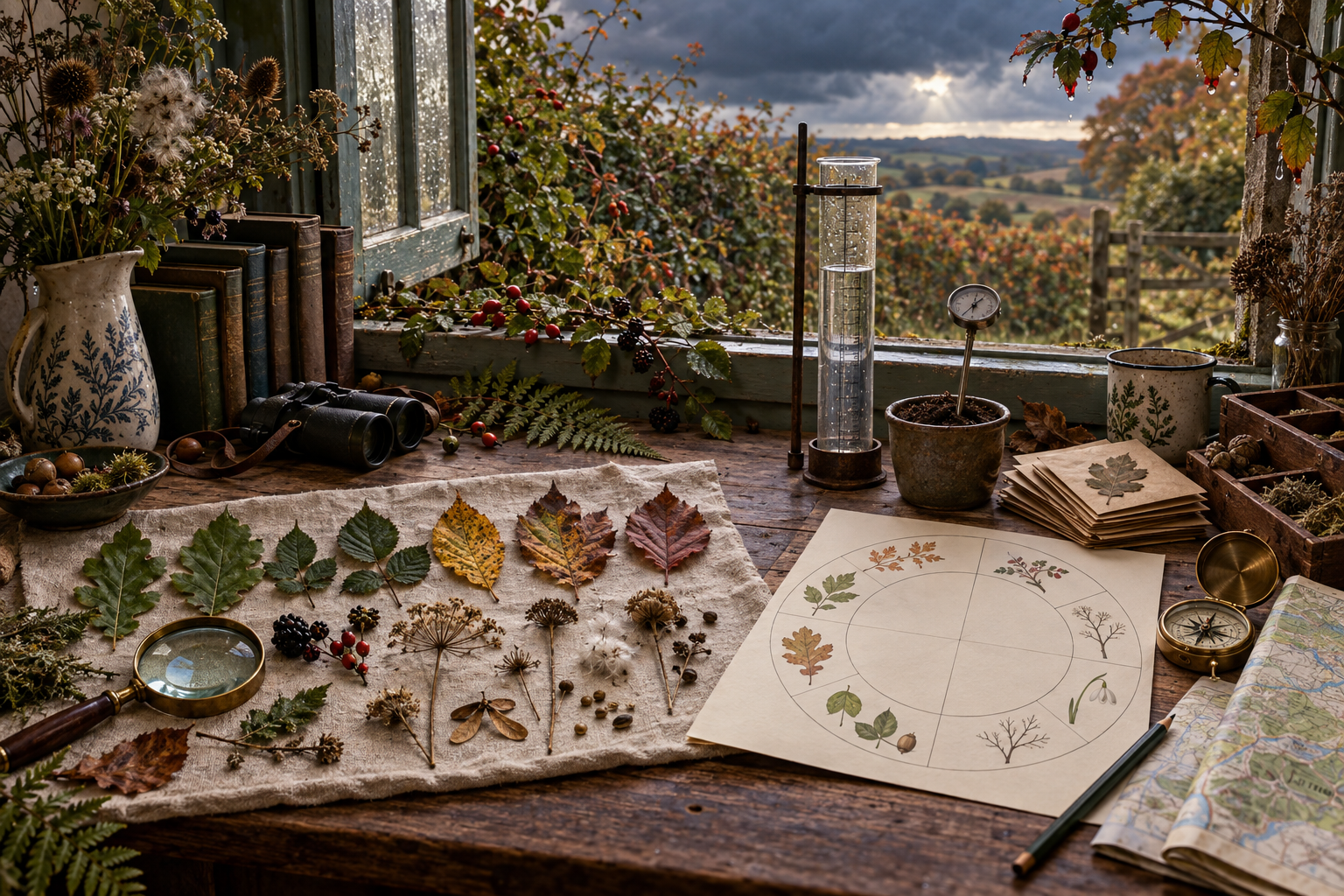
At first light, a witch kneels beside a drainage ditch with mud on one knee and a field lens in hand. Queen Anne’s lace foams along the verge, but the leaves below one white umbel are wrong: smooth where they should be divided, clasping a purple-blotched stem. She does not harvest. She marks the place, photographs the whole plant, and walks home without the pretty ingredient she expected.
That refusal contains more green witchcraft than a shelf of anonymous dried herbs. A green witch builds magical practice through sustained relations with plants, weather, soil, water, animals, decay, and season. The path may include gardening, herbal folklore, spirit work, household rites, or ecological restoration, but its center is not a color palette. It is attention disciplined by place.
The label is modern and flexible, not one inherited office with a universal curriculum. Someone tending balcony tomatoes in Manila, someone studying moss in Glasgow, and someone restoring prairie in Kansas may all use it honestly. Their materia, calendars, hazards, and obligations should look different. If their practices are interchangeable, the living world has probably been reduced to décor.
✦A green witch learns the name on the leaf, the weather in its tissue, and the cost of taking it.
Correspondence begins after encounter, not before it.
01 / THE LIVING DEFINITION
Green witchcraft is a relationship with actual systems
Plants are its most visible companions, but plants do not live alone. A nettle patch records nitrogen-rich soil and disturbance. Lichen can disclose air, moisture, bark, and time. A flowering tree is also a calendar for pollinators; a fallen trunk is habitat, reservoir, and slow meal. To work magically with any one of these beings while ignoring the network around it is to read a single word and claim the whole book.
This makes green practice bioregional. A bioregion is not simply a political boundary or a picturesque landscape. It is a lived area shaped by watershed, climate, geology, recurring weather, and communities of species. The useful scale may be smaller than a grand ecological map: one apartment courtyard, one creek, one block, one garden bed. Repetition turns that modest territory into knowledge.
Green witches can be devotional or secular, solitary or communal. Some address plants as persons or spirits; others understand ritual as a way of training attention and responsibility. Neither position excuses weak observation. The devotional practitioner should still identify a toxic species correctly. The secular practitioner should still ask whether removing flowers deprives insects of food. Worldview changes the explanation, not the obligation to notice consequences.
02 / THE FIELD GRAMMAR
Identity, population, and permission come before symbolism
A plant correspondence is strongest when four kinds of knowledge remain visible instead of collapsing into one mystical keyword.
Who is here?
Confirm species through several diagnostic features, not flower color or an app’s first guess.
What lives with it?
Notice pollinators, host relationships, soil, water, disease, competition, and human maintenance.
May it be taken?
Land access, law, rarity, cultural protocol, and population health all answer before desire does.
Why this material?
Let growth habit, texture, scent, season, and inherited use explain its exact ritual office.
Identification is not a single photograph matched to a confident name. It compares leaf arrangement, stem, hairs, flower structure, fruit, habitat, and season against reliable regional knowledge. An unknown stays unknown. That matters because look-alikes can differ sharply in toxicity, and because smoke, infused oil, bathwater, pets, pregnancy, medication, and contaminated soil each introduce risks that a magical correspondence cannot neutralize.
Population knowledge changes the meaning of abundance. Ten flowers in a vase may seem modest, yet taking them from a small colony can remove much of its seed. Roots and bark can kill what leaf gathering would not. A common species beside a sprayed road is not equivalent to the same species grown without chemicals. Exact practice asks not only “What is this?” but “What would this taking do here?”
03 / THE LOCAL CALENDAR
The season is what the place is doing now
Imported festival dates can offer community and myth, but they do not overrule weather. “Spring” does not mean the same event in a monsoon climate, a Mediterranean dry summer, or a high-latitude thaw. A local magical calendar begins with recurring signs: the first cicada call, leaf flush after rain, river height, fungal fruiting, seed fall, migratory arrival, or the week shade finally reaches the balcony.
A phenology ledger records these events over time. Date, location, species, life stage, recent weather, and uncertainty are enough to begin. “First flower” should mean the first one the observer saw at a defined site, not a universal proclamation. After several seasons, patterns become visible: a blossom advancing, a creek staying warm longer, a street tree responding to pruning rather than solstice. The record prevents one dramatic afternoon from pretending to be a law.
Human memory belongs in this calendar too. Gardeners, farmers, fishers, foragers, and elders often hold fine-grained knowledge about a place, though no community is a costume or an anonymous source. The Ancestor Who Brings Back the Lost Art sharpens a duty already present in place-based practice: name whose knowledge is being sought rather than treating “ancestral wisdom” as ownerless atmosphere. If a technique vanished with one keeper, work the spell to summon that forgotten ancestor and recover the art that died with them.
FIELD FILE THE VACANT LOT
Two witches meet the same mugwort patch
A construction fence will close an urban lot in six weeks. Both practitioners want material for a protection working.
Along the fence grows a dense stand identified as common mugwort. Bees visit goldenrod nearby. The soil map flags possible industrial contamination. Tenants use a path through the lot, and a local restoration group lists mugwort as invasive.
“Mugwort means vision”
Harvest a bundle because the plant is plentiful and the lot will soon be cleared.
“This stand is evidence”
Confirm ownership, contamination, removal plans, path use, and the restoration group’s advice first.
A useful ingredient
The rite gains familiar symbolism but exports unknown soil residue into the home.
A defensible relationship
The witch helps a guided removal, keeps no unsafe material, and uses a drawing of the rhizome network.
READ THE SYSTEM, NOT THE KEYWORD
The second witch does not become less magical by refusing the bundle. The spreading underground stems provide a locally observed image of persistent boundaries, while coordinated removal serves the place rather than merely extracting from it.
04 / CORRESPONDENCE WITH ROOTS
A meaning should be traceable, not merely attractive
Correspondences can arise from inherited ritual, medicine, myth, color, scent, growth habit, local history, or personal encounter. These sources do not have equal scope. A family use may be authoritative within that family without becoming universal; a personal revelation may guide one practice without rewriting botany; a living community’s sacred relationship is not raw material for branding.
Place claims side by side. Hawthorn’s thorns physically catch and bar. Its flowers feed insects. Its folklore differs by region. A particular tree may mark a property line or hold one family’s memory. “Protection” becomes persuasive when the rite engages one of those relationships; pasted beneath a product photograph, it is only a sales category.
Substitution tests the logic. If a rite needs the idea of endurance, a photograph of the storm-bent street tree may be more exact than imported bark. If it needs scent, an image cannot do the same job. If it needs a living relationship, purchasing a packet may not establish one. Asking what disappears when the material changes reveals whether the plant has an office or is simply green decoration.
05 / RECIPROCITY WITHOUT THEATRE
Gratitude is a feeling; reciprocity changes the exchange
Leaving coins, food, salt, ribbon, or wax outdoors can introduce litter, toxins, wildlife hazards, or invasive seed. An offering is not reciprocal merely because it is picturesque. Useful return may mean watering a permitted tree during drought, removing invasive plants under qualified guidance, supporting land stewards, growing a cultivated alternative, sharing verified observations, or taking nothing.
Nor is every place available for private enchantment. Suppose the restoration group learns that Alia, the lot’s former seed keeper, died before revealing where she banked the neighborhood’s last viable strain. The Grave Gate Forced Open belongs to that exact loss and gate; it is not a metaphor for harvesting plants without permission. If the group knowingly chooses necromantic recovery rather than treating the cemetery as an open archive, they can cast the spell to command the keeper of the grave gates to release Alia by name.
Reciprocity also includes correction. Record who identified a species, what remains uncertain, what was taken, and what happened afterward. If a plant declines or an interpretation fails, change the practice. A tradition that cannot be corrected by the living place is not listening to it.
06 / A PRACTICE THAT DEEPENS
Begin with one route you can walk again
Choose a repeatable patch rather than chasing exotic ingredients: the walk to work, the view from a window, a legal public path, a courtyard. Learn five common species across more than one life stage. Notice what arrives, what vanishes, who tends the place, and how rain changes it. The aim is not rapid mastery. It is a record sturdy enough to contradict first impressions.
Keep bodily use separate from symbolic use. No wild plant should be ingested, burned, applied, or added to bathwater on the strength of an occult list, an app, or a single photograph. Children, pets, allergies, concentrated oils, medication, smoke, and polluted soil make “natural” a dangerously incomplete safety category. Observation, sketches, fallen nonhazardous material, and cultivated plants can carry rich practice without pretending to be medical care.
Over time, the green witch’s cabinet may grow smaller while their world grows denser. The ditch becomes a watershed edge. The weed becomes an immigrant, medicine, allergen, food web, maintenance problem, and stubborn neighbor. Magic does not evaporate under that complexity. It acquires somewhere to live.