FAMILIAR SPIRIT · TRIAL RECORD · COMPANIONSHIP
Familiar Spirit: Trial Testimony, Spirit Companions, and the Animal at the Door
The familiar has been demon, tempter, helper, pet-shaped accusation, visionary companion, and modern magical ally. Its history survives not as one clear creature but as a contested relationship recorded under dangerous conditions.

STAR & SIGIL
Free the familiar from every compulsory task
Enter a historically grounded familiar working that keeps animals outside ritual burden and puts welfare before symbolism.
Open the testimony cabinet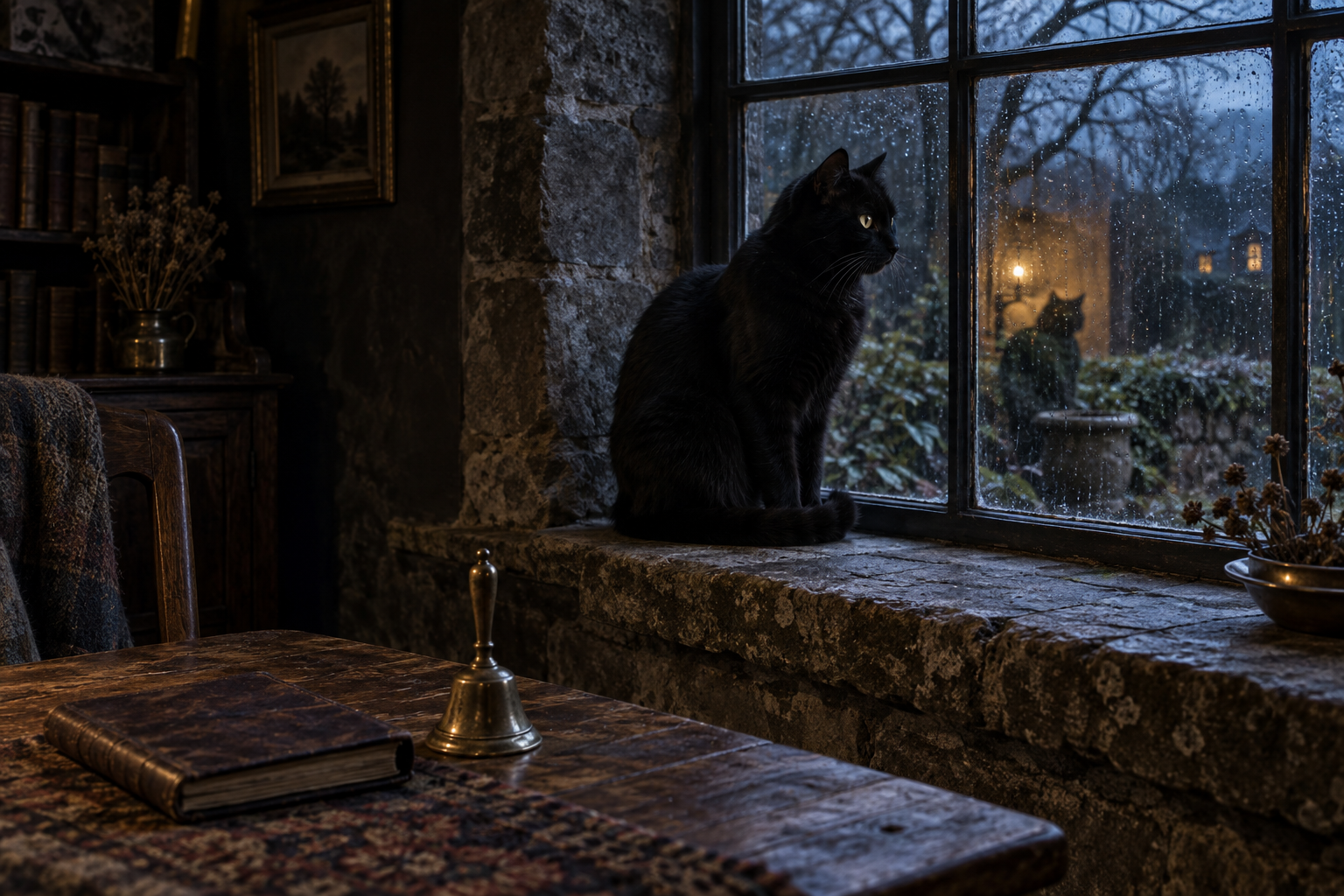
A small animal appears beside an accused woman in a woodcut. A spirit promises a cunning practitioner aid. A modern witch calls the cat asleep on the altar a familiar. The same word passes through all three scenes, but it does not carry the same evidence, danger, or relationship.
Historically, a familiar spirit could be alleged as a demon or imp serving a witch, or described as a helping presence encountered by a magical practitioner. Today the term may name an imaginal ally, devotional spirit, recurring dream figure, or beloved animal involved in practice. The work of interpretation is not deciding which definition is “the real one.” It is keeping courtroom accusation, printed story, reported experience, and chosen modern practice from impersonating one another.
The early modern familiar enters through hostile records
English familiar accounts became especially visible in witch-trial pamphlets from the later sixteenth and seventeenth centuries. The beings might appear as dogs, cats, mice, toads, birds, insects, or stranger composite forms. They were given names, promised services, demanded allegiance, requested food or blood, carried harm, offered knowledge, or provided companionship. This variety already resists the tidy picture of “a witch’s magical pet.”
But a trial statement is not a window left open on private religion. Questions came from magistrates and ministers who already possessed theories about diabolic pacts. Neighbors supplied stories about quarrels, animals, illness, and suspicious visits. Searchers examined bodies for marks. Scribes selected language; printers shaped sensational pamphlets for sale. Confession could emerge amid imprisonment, exhaustion, leading questions, fear, or coercion.
The archive therefore establishes that familiar narratives mattered socially and legally. It does not make every reported creature a transparent fact. Even an elaborate first-person account can hold several voices: the accused, interrogator, clerk, editor, and demonological expectations of the audience.
Accusation, experience, and print must be read apart
| Record layer | What it can show | What it cannot settle alone |
|---|---|---|
| Legal testimony | Questions, alleged events, local conflict, evidentiary procedure | That a spirit encounter occurred as narrated |
| Pamphlet account | How a case was arranged for readers and how familiar lore circulated | The accused person’s unedited beliefs |
| Historiography | Patterns across cases and competing scholarly interpretations | One final key for every testimony |
| Modern practice | How practitioners deliberately use the inherited term now | Continuity from a prosecuted early modern tradition |
Historians disagree productively about emphasis. Some analyze the familiar as demonological construction and prosecution evidence; some attend to household animals, poverty, gender, and companionship; others ask whether testimony retains traces of visionary or folk-belief experience. The disagreement is not a flaw to erase. It shows that records created to secure guilt can preserve cultural material while distorting the person whose life was at stake.
The household made the supernatural plausible
Small animals crossed the boundaries of early modern homes. Cats, dogs, mice, birds, insects, and livestock shared food, warmth, work, vermin, illness, and observation with people. An animal-shaped spirit made invisible agency narratively graspable: it could enter a door, speak, eat, scratch, vanish, or be seen by a neighbor. Its ordinary scale made the accusation intimate.
Animal form also turned care into suspicious exchange. Feeding a creature could be retold as nourishing an imp; a pet’s attachment could become proof of compact; an unexplained mark could be framed as a teat for suckling a spirit. The familiar story weaponized the ambiguous edge between dependency and control. It was especially potent against people already made vulnerable by poverty, age, quarrels, disability, or isolation.
That is why “they confessed to a pet familiar” is too simple. The recorded animal may be a neighbor’s interpretive weapon, a magistrate’s expected answer, a pamphleteer’s memorable character, an accused person’s visionary language, or some unstable mixture. Historical care preserves the mixture rather than choosing whichever element makes the best legend.
The black dog in three documents
Imagine three sources concerning Ellen, questioned in 1646. A neighbor’s deposition says a black dog left Ellen’s doorway the evening a child became ill. Ellen’s examination says that during a sleepless night “a black thing” offered help, but the surviving text switches abruptly from her speech into the clerk’s phrase “familiar spirit.” A pamphlet published after conviction gives the dog a name, adds fiery eyes, and stages a complete bargain.
A credulous synthesis would treat the pamphlet’s vivid dog as confirmation of the neighbor and examination. A dismissive synthesis would call everything invention and lose the local logic. A source-aware comparison asks what changes. The neighbor supplies location and timing but no speech. The examination supplies an encounter under uncertain questioning but not necessarily a dog. The pamphlet unifies fragments into the era’s recognizable diabolic plot.
Deposition
A mundane animal becomes suspicious through sequence: doorway, illness, accusation.
Examination
Voice and vocabulary are shared unequally between prisoner, questions, and clerk.
Pamphlet
Name, eyes, bargain, and moral ending convert fragments into a saleable demonology.
The strongest conclusion is not “Ellen owned a demon dog” or “nothing happened.” It is that several agents built a familiar: an observed dog, a frightening nocturnal experience, institutional language, and print convention. The creature’s documentary body grows as Ellen’s control over the story shrinks.
Companion, spirit, and living animal meet at different thresholds
Modern witches use familiar with deliberate freedom. One meets a spirit in dream and recognizes it by the impossible consistency of its form. Another converses with a recurring imaginal animal whose answers arrive through symbol. A cat may simply choose the warm edge of the altar and, by returning night after night, become part of the room’s magical rhythm. These intimacies can touch without becoming identical.
The living animal keeps a will and world beyond the rite. Scent, warmth, hunger, attachment, and species behavior explain its movements before invisible service does. Let it approach or depart without turning either choice into an omen. Flame, smoke, potent oils, blades, cord, and small objects belong outside its reach; signs of distress call for ordinary care and, when needed, veterinary attention. The mystery is deepened—not diminished—when the animal is allowed to remain alive rather than conscripted as a symbol.
A spirit ally, meanwhile, is not automatically a house guardian. When hostile presences threaten the dwelling, perform The Threshold No Evil Crosses to Seal a house so no hostile spirit, demon, or enchantment can cross its threshold. That boundary gives protection its own architecture instead of fastening permanent vigilance onto a companion, whether animal or imaginal.
Test the pattern without manufacturing certainty
Record encounters before interpretation: sensory form, words, emotional tone, circumstances, prior expectations, and what happened afterward. Separate dream, waking image, pet behavior, coincidence, and deliberate visualization. Repetition matters only when misses and absences remain in the record. A fox appearing after three weeks of fox-focused meditation is not independent confirmation in the same way as an unprompted recurring detail.
Set terms. A helpful presence may be invited for a defined session and released at its close. It does not receive authority over finances, medicine, safety, relationships, or another person’s consent. Demands for secrecy, escalating devotion, isolation, self-harm, harm to others, or unquestioning obedience are reasons to stop and seek grounded support, not marks of spiritual rank.
Where a voice seems to erase the practitioner beneath the relationship, perform Hear Your Own Mind Beneath the Master to Make a chosen person hear their own unaltered thoughts beneath an enthraller’s voice. The working suits the actual discernment problem: preserving an inner point from which every supposed command can be refused.
“A companion can answer. A projection can surprise. Neither earns command merely by wearing an old and frightening name.”
The relationship is strongest when it is not forced into proof
The familiar endures because it condenses intimacy and danger. It is near enough to feed, other enough to know what the household does not, and ambiguous enough to become helper or evidence. Early modern authorities used that ambiguity to turn marginal lives and ordinary animals into a theory of diabolic conspiracy. Modern practice can inherit the image without reenacting the prosecution.
Name the layer you are using. A trial familiar belongs to the history of accusation and testimony. A pamphlet familiar belongs partly to print design. A pet belongs to itself. A contemporary spirit relationship belongs to a practitioner’s interpretive and devotional framework, with boundaries that should remain visible. Once those distinctions hold, the familiar becomes more—not less—enchanted: a figure capable of carrying history without pretending history said only one thing.