INVITATION · EXCLUSION · OWNERSHIP
Door Protection Spell: Who the Threshold Welcomes, Refuses, and Remembers
A door is never just a gap in a wall. It decides who may enter, whose name counts as permission, and whether the house recognizes the hand already holding the key.

STAR & SIGIL
Teach the door the difference between guest and access
A threshold becomes formidable when its lock, invitation rule, and symbolic office agree. Continue into a warding operation built for explicit boundaries.
Set the invitation ward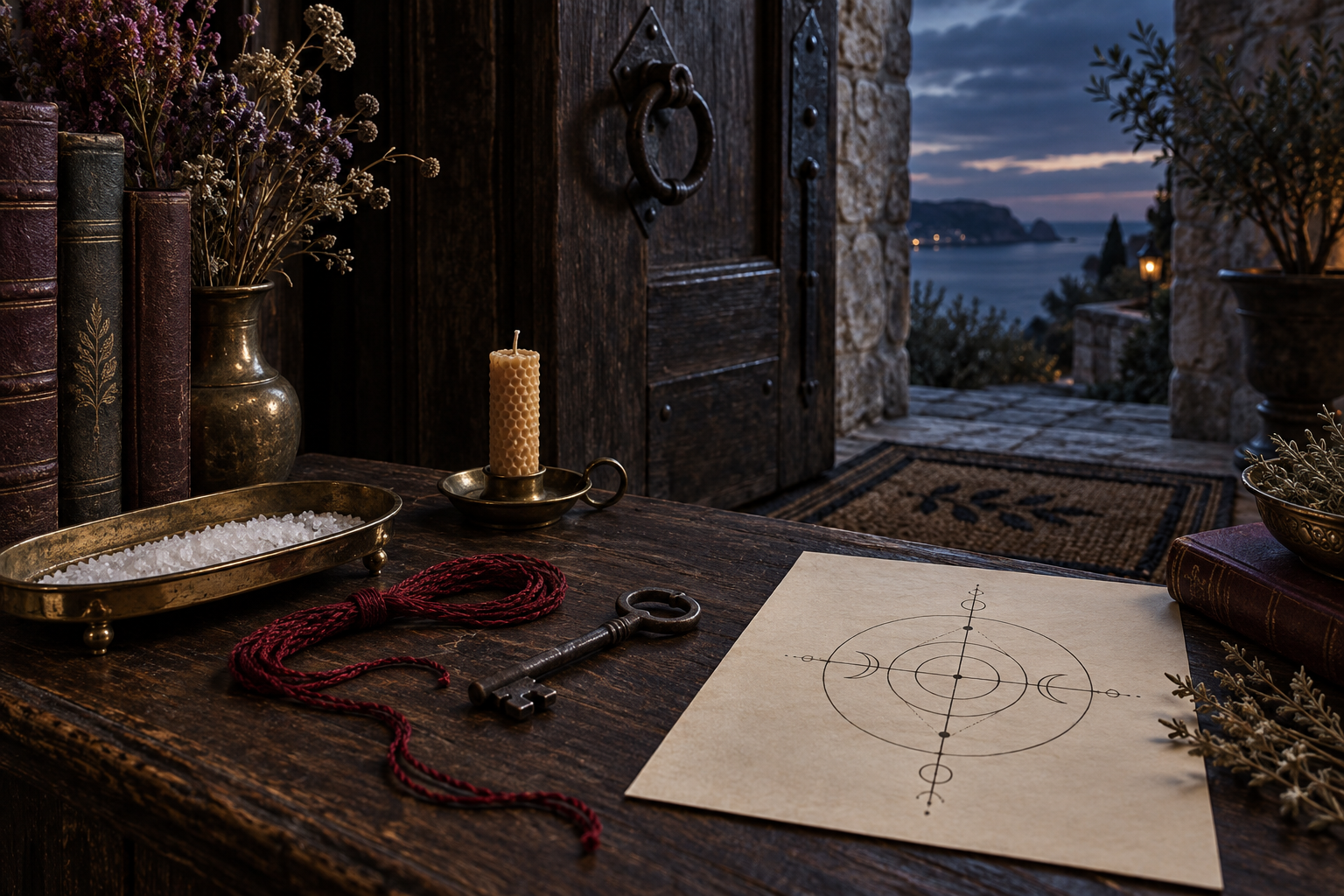
The front door opens for the key, the code, and the familiar face. At 2:17 in the morning it refuses all three. Inez owns the townhouse, remembers the new keypad number, and sees herself clearly in the brass knocker. Still, when she reaches for the handle, the foyer beyond the glass appears impossibly far away—as if the house has placed a second street between her hand and home.
Behind her stands Calder, the cousin she has just asked to leave the family business. He touches the same handle. The latch yields. The door has not jammed. It has made a decision about ownership that contradicts the deed.
This is the high drama concealed inside door protection. A door is more than an obstruction placed in a wall. It is a machine of relationship: it invites, excludes, recognizes, and assigns authority. A protection spell at a doorway therefore does not merely make entry difficult. It declares what the household believes a visitor, a threat, a gift, and an owner to be.
01 / THE WALL THAT CAN SAY YES
A doorway is a controlled exception
A wall creates separation. A doorway interrupts that separation without abolishing it. This makes every door paradoxical: a breach deliberately built so the boundary can continue to function. Its power is not permanent closure but selective opening.
That selection gives the doorway its ritual density. Guests pause there. Names are announced there. Gifts change hands there. Shoes, weather, news, strangers, and returning householders pass from one order into another. Even an open door distinguishes the person still outside from the person received within. Hospitality is not the absence of a boundary; it is one of the boundary’s most sophisticated acts.
Door protection becomes legible when it names the selection being made. A working may refuse hostile intent, block a particular being, reject an object, conceal the entrance, or preserve the resident’s authority. Those are different verdicts. “Protect this door” is atmosphere. “Let no coerced gift enter” is jurisdiction.
02 / FOUR VERBS OF THE THRESHOLD
Invitation, exclusion, recognition, and ownership are not interchangeable
A guarded doorway can fail while remaining physically closed—or succeed while standing wide open.
| Function | The doorway decides | The dangerous confusion |
|---|---|---|
| Invitation | Whose crossing transforms arrival into welcome. | Treating social politeness as unlimited spiritual permission. |
| Exclusion | Which person, force, object, or intention must remain outside. | Naming a vague enemy so broadly that the house rejects necessary change. |
| Recognition | Which signs establish identity: face, name, key, scent, kinship, oath, or intent. | Assuming familiarity proves harmlessness. |
| Ownership | Whose authority can open, close, welcome, refuse, or transfer custody. | Mistaking possession of access for the right to govern entry. |
03 / WELCOME IS A FORM OF POWER
An invitation changes the visitor’s status
Crossing a threshold as a guest is not the same as crossing as an intruder, even when the footsteps are identical. Invitation supplies a role. It can confer temporary belonging, access to private knowledge, permission to touch household objects, or protection under the host’s roof. That is why stories about supernatural entry often turn on hospitality: permission can reach where force cannot.
Yet invitations are specific more often than they appear. Welcome to dinner is not welcome to search a desk. Welcome tonight is not permanent access. Welcome for you is not permission to bring every influence attached to you. A protective threshold must distinguish the person from the permissions surrounding the person, or one affectionate yes can be interpreted as a door without hinges.
Objects complicate the grammar. A parcel, heirloom, charm, letter, or borrowed coat may cross in someone’s hands while carrying an intention the householder never accepted. The courier is welcome; the burden is not. Where the crossing danger resides in an object disguised as courtesy, cast The Threshold Rejects the Enchanted Token to prevent an enchanted token from crossing the threshold of a chosen person’s home. It separates hospitality toward the bearer from consent to the influence being borne.
04 / WHAT THE DOOR THINKS IT KNOWS
Recognition is the hidden mechanism of permission
Every selective boundary needs criteria. Modern locks recognize metal cuts, codes, fingerprints, devices, or authorized credentials. A magical doorway may be imagined as recognizing a name, bloodline, declared purpose, emotional signature, household bond, or the authority of the person who set the ward. The more poetic the criterion, the more carefully its consequences deserve reading.
Blood does not guarantee loyalty. Familiarity does not guarantee safety. A legal owner may be a stranger to the daily life of the house, while a tenant, child, caretaker, or invited dead may belong profoundly without holding the deed. Threshold magic becomes politically revealing here. Whatever sign it accepts as identity also reveals whose claim the household treats as real.
Inez’s crisis is not that the door fails to recognize her face. It recognizes a competing story more strongly. Calder managed the building for twelve years, admitted contractors, kept spare keys, and told every relative that he “held the place together.” Habit has made his authority architectural. When Inez removes him from the business, the human arrangement changes in an afternoon; the doorway continues enforcing the older hierarchy.
CASE FILE THE HOUSE THAT CHOSE THE WRONG HEIR
Inez at the impossible front door
The lock functions, the deed is valid, and the threshold still recognizes yesterday’s authority.
Inez inherits the townhouse and its failing family company. Calder retains a key as operations manager. After discovering that he has pledged company assets without permission, Inez removes his access and changes the code. That night she returns with the records. Her code works; the latch clicks; the hall recedes when she reaches forward. Calder arrives, touches the handle, and the door opens inward.
Invitation
Inez was welcomed as family for years, but never treated as the person whose word governed the house.
Exclusion
The threshold excludes a challenge to the old order, not a person carrying obvious hostility.
Recognition
It reads Calder’s practiced custody as identity and Inez’s legal authority as an unfamiliar claim.
Ownership
The key proves access; the doorway’s obedience reveals who has been allowed to command.
THE VERDICT
The protection has not vanished. It is protecting continuity itself—an inherited arrangement in which Calder is the house’s acting voice. The ward has confused repeated service with permanent sovereignty. Inez cannot understand the event by asking whether the door is strong. She must ask which version of the household its strength preserves.
05 / REFUSAL NEEDS AN OBJECT
A ward is only as precise as what it refuses
A protection aimed at “bad energy” asks the threshold to judge a category broad enough to include grief, justified anger, difficult news, necessary conflict, and predatory intent. The result can become spiritually flattering: pleasant visitors seem safe, disturbing visitors seem dangerous. But a charming adversary may cross smiling, while a loyal friend carrying a terrible warning feels heavy at the door.
Precision changes the logic. Exclude a named adversary, a hostile spirit, an enchanted object, coercive intent, or unauthorized command, and the boundary has something it can distinguish. Each choice leaves other risks untouched. That is not weakness. It is the cost of a protection that means anything.
Named exclusion is especially powerful because it separates danger from mood. A particular person may arrive cheerful, apologetic, disguised, represented by another, or invoked only in conversation. The question is no longer whether the visit feels ominous. When one known adversary must lose both the route and the right of crossing, cast The Door No Malice Can Remember to bar a named adversary from finding or crossing your chosen threshold. Forgetting the door closes approach and entry together.
06 / WHO MAY SPEAK FOR THE HOUSE
Ownership is authority, custody, and responsibility in tension
Houses rarely belong to one person in only one way. The deed names legal ownership. Rent establishes contractual possession. Labor creates custody. Memory creates attachment. Kinship creates expectation. A spirit of place, in traditions that recognize one, introduces another order of belonging entirely. Door protection reveals which claim has been given the deciding voice.
This is why changing a lock can solve access without settling authority. Calder can lose his key while the family continues asking him for permission. Inez can enter while still believing she is a guest in the role she inherited. The doorway dramatizes this lag. Its refusal makes visible an arrangement everyone else has learned not to mention.
A mature threshold is neither permanently suspicious nor helplessly hospitable. It can recognize a resident without making every resident sovereign. It can welcome a guest without surrendering the house. It can reject a burden without condemning its bearer. And it can release an obsolete custodian without erasing the years in which that custody was real.
Protection at the door is therefore an act of authorship. The household defines itself through crossings: whom it receives, what it refuses, whose identity it trusts, and who may revise the rule. Every opening reenacts that constitution. Every closing proves that welcome still has an edge.
Read the doorway in both directions
Ask not only what cannot enter, but what cannot leave: secrets, obligations, residents, grief, authority, or an old definition of home.
The threshold after the key turns
At dawn, Inez does not ask Calder to open the door again. She speaks through the glass and names the authority that ended when she dismissed him. The hall contracts to its ordinary length. When she pushes, the door is only a door—heavy, scratched, and answerable.
Its ordinariness is the final lesson. Protection does not make a threshold dramatic; it makes its judgment exact. A guarded door should not merely keep danger outside. It should preserve the household’s power to know what crossing means.