PLANET · MOON · DEADLINE
Candle Magic Timing: Which Clock Has Authority?
Wednesday may favor Mercury, the next Mercury hour may begin after midnight, the Moon may be waning, and the application closes at five. Timing becomes magic only after one clock is allowed to rule.

STAR & SIGIL
Choose which clock governs the candle
Timing becomes useful when tradeoffs are explicit. Follow the chosen moment into a working about one decision and its consequences.
Test the chosen ritual moment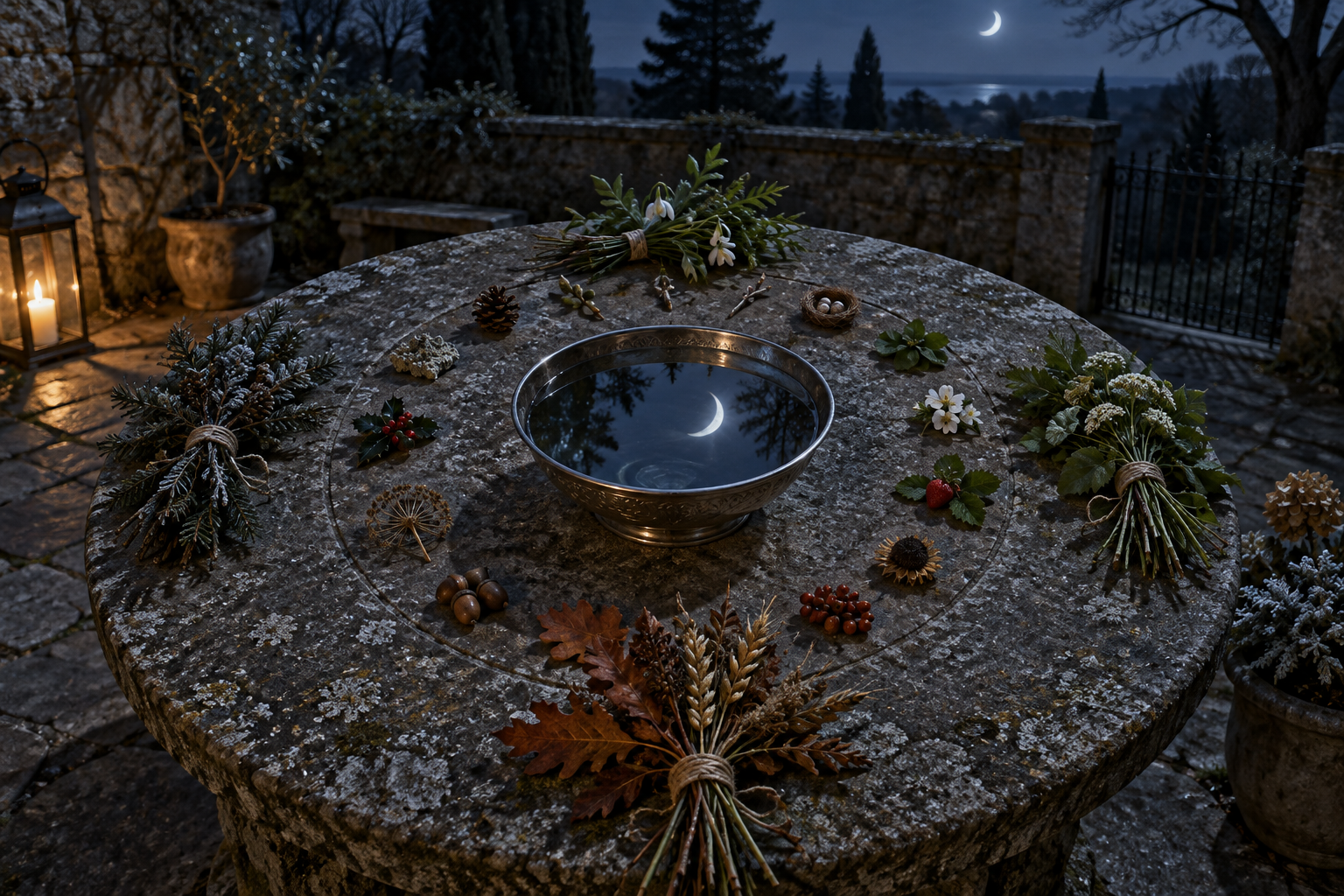
At 4:12 on Wednesday afternoon, Celia’s application is complete. The grant portal closes Friday at five. Wednesday belongs to Mercury, whose hour will return after midnight. Thursday belongs to Jupiter, promising expansion, but the Moon is waning. The next waxing Moon begins after the deadline. Celia leaves the file unsent because the sky has not yet agreed with itself.
It never will. Planetary days, planetary hours, lunar phases, civil deadlines, and the candle’s own attended burn interval are different clocks answering different questions. Their disagreement is not an error to solve by searching harder. It is the condition that makes election meaningful: the practitioner must decide which temporal layer has authority.
Candle magic makes time visible. Wax diminishes, flame persists, and a chosen interval acquires a beginning and end. Astrological timing can give that interval character, but it cannot rescue a missed submission, replace sleep, or make an unsafe hour sacred. A workable election does not collect every favorable sign. It establishes a hierarchy among clocks.
01 / THE COMPETING CLOCKS
Timing systems disagree because they measure different things
Civil time coordinates appointments, contracts, work, transit, medication, sleep, and deadlines. It is socially enforced rather than occult, yet its consequences are often the least negotiable. The Moon’s phase describes changing illumination geometry across roughly 29.5 days. A planetary day assigns one of seven traditional planetary rulers to an entire weekday. A planetary hour divides local daylight and darkness into twenty-four unequal portions. The candle adds a fifth scale: the interval during which transformation is visibly held.
These clocks can support one another, but they cannot be collapsed. A Friday Venus hour during a waxing Moon may look harmonious for attraction. If it begins while the practitioner is driving, working, asleep, or unable to supervise flame, the election is unusable. Practical availability is not a disappointing compromise. It is part of the ritual condition.
The first act of timing is therefore jurisdiction. Which clock can actually close the door? A grant deadline can. Sunrise can end a planetary night. The exact lunar phase can pass. A preferred weekday will return next week, but the opportunity may not. The hierarchy should be written before the calendar is searched, or desire will keep changing the rules until a perfect moment appears.
02 / THE WEEKLY ATMOSPHERE
Planetary days give a broad frame rather than a minute of perfection
In a widespread Western correspondence, Monday belongs to the Moon, Tuesday to Mars, Wednesday to Mercury, Thursday to Jupiter, Friday to Venus, Saturday to Saturn, and Sunday to the Sun. The sequence gives each day a broad field: lunar care or memory, Martial conflict or courage, Mercurial speech and exchange, Jovian expansion, Venusian attraction and value, Saturnian limits, Solar visibility and authority.
A day ruler is generous because it leaves hours of ordinary life available. A negotiation can use Wednesday without pretending every minute is equally Mercurial. A boundary can use Saturday without postponing an urgent refusal for six days. The petition and action supply detail while the day supplies atmosphere.
The convention is inherited, not physically emitted by weekdays. Wednesday does not cause emails to succeed, and Friday does not certify consent. Its value lies in recurring structure: a practitioner can align attention with a recognizable cycle without needing minute-by-minute surveillance of the heavens.
03 / HOURS THAT CHANGE LENGTH
A planetary hour is not a fixed sixty-minute square
Traditional planetary hours divide the span from local sunrise to local sunset into twelve parts, then divide sunset to the next sunrise into another twelve. Because daylight changes with season and latitude, a daytime planetary hour can be longer or shorter than sixty civil minutes. Day and night portions usually differ from each other on the same date.
This makes location essential. A generic chart made for another city may assign the sequence correctly while placing its boundaries at the wrong civil times. Daylight-saving changes can introduce another mismatch between clock labels and local solar events. Precision that ignores location is decorative precision.
The ruling sequence traditionally cycles through the seven classical planets, while the first hour of each day belongs to that weekday’s ruler. The pattern matters because it produces the weekday order itself. Yet calculation does not create obligation. A locally exact Saturn hour at 2:43 a.m. may be a worse ritual choice than a safe Saturday afternoon if wakefulness, household conditions, and flame supervision deteriorate.
Some operations make the appointed instant the entire magical claim. The Hour Obscurity Dies concentrates the operation into one declaration: name the hour your years of obscurity end and your rise begins. Perform it where the threshold needs one declared moment rather than a broad favorable period.
04 / WHAT EACH CLOCK CAN OVERRULE
A hierarchy prevents election hunting from consuming the opportunity
The order below is not universal; it demonstrates how a practitioner can decide before favorable correspondences begin competing.
| Clock | What it contributes | What outranks it |
|---|---|---|
| Safety and capacity | An alert operator, attended flame, stable household conditions, adequate sleep. | Nothing inside the election. |
| Civil deadline | The actual period in which an action remains possible. | Safety, law, and conditions outside the practitioner’s authority. |
| Planetary day | A wide recurring thematic field. | Safety, deadline, and practical availability. |
| Planetary hour | A narrower local emphasis within day or night. | Every higher layer when calculation creates strain or delay. |
| Lunar preference | A slower metaphor of increase, culmination, decrease, or darkness. | The operation’s chosen primary clock. |
05 / THE SLOWER LUNAR BACKGROUND
The Moon changes the metaphor more often than the deadline
Lunar phases arise from the changing geometry of Sun, Moon, and Earth. Waxing means the visible illuminated portion is increasing; waning means it is decreasing. Full and new mark opposition and conjunction, not physical reservoirs of maximum and minimum magic. The astronomical condition is real. Its ritual meaning is interpretive.
Waxing can support increase, full moon visibility or culmination, waning reduction, and dark moon concealment or rest. Other systems privilege lunar sign, mansion, aspects, visibility, or motion. Adding these layers changes the theory of timing. It does not simply make the same election more accurate.
A Mercurial application under a waning Moon need not be contradictory if the Moon is subordinate. The waning condition might describe editing, removing clutter, or reducing hesitation while Mercury governs submission. Conversely, if lunar increase is the central grammar, waiting may be coherent—provided the opportunity survives.
Cloud cover changes visibility, not phase. A calendar date surrounds an exact astronomical moment, and local experience may not match the printed icon. The practitioner should state whether the rite follows precise phase, visible appearance, moonrise, or a broader night. These are choices, not secret measures of authenticity.
CASE FILE THE UNSENT APPLICATION
Celia waits for four clocks to agree while the fifth closes
A strong Mercurial action is available on Wednesday. The search for Jupiter, waxing light, and a perfect hour turns timing into delay.
Celia completes a grant application at 4:12 p.m. Wednesday. The portal closes Friday at 5:00 p.m. She prefers Mercury for writing, Jupiter for expansion, and a waxing Moon for increase. The Moon is waning. A calculated Mercury hour begins after midnight, when she will be exhausted. She postpones submission to Thursday, then notices a more attractive Jupiter hour Friday at 4:36 p.m.
Mercury day
The application is complete during the broad day associated with writing and exchange.
Jupiter hour
The late interval offers expansion imagery but almost no recovery from upload failure.
Waning Moon
The lunar condition can describe final editing; it need not veto submission.
Portal clock
This is the only clock that can make the opportunity inaccessible.
LET THE DEADLINE GOVERN
Celia submits Wednesday with a safe buffer, using Mercury as the primary ritual correspondence and the waning Moon as an editing image. Jupiter becomes optional support rather than a reason to approach the closing gate at the last minute.
06 / THE FLAME’S OWN INTERVAL
A candle creates ritual duration without controlling the future
Once lit, a candle makes time perceptible as consumption. A brief flame can frame the final review of a petition. A repeated interval can mark stages. A longer burn can sustain attention through one bounded task. The appropriate duration comes from the operation and the candle’s safe use, not from the fantasy that more burned wax equals more power.
The candle interval may sit entirely inside a planetary day while crossing two planetary hours. That is not automatically a flaw. If the operation began under the chosen ruler and the hierarchy did not require completion within that hour, nothing has been violated. Rules should not appear retroactively because the flame lasted longer than expected.
Nor does a candle finishing early or late rewrite the election. Wick, wax, vessel, temperature, and airflow influence burn rate. The astronomical and civil clocks continue independently. Material variation can be recorded without being promoted into a celestial correction.
The expert’s distinction
An election chooses when an
operation begins or occurs. Duration governs how long the operation
remains open. They are related only if the design explicitly joins them.
07 / WHEN THE MOMENT PASSES
A missed election is not the same as a missed opportunity
A planetary hour returns through the sequence. A weekday returns in seven days. A lunar phase returns across the synodic cycle. Their recurrence can reduce panic: one missed symbolic window does not mean the work is forbidden. Civil opportunities may be less forgiving.
If an actual opportunity has passed, timing magic changes office. It may support review, mourning, a second route, or deliberate return. The Moon’s Returning Key gives that return a lunar limit by seeking to draw one missed opportunity back within reach before the next new moon. Turn the lunar key by performing the spell, drawing the missed opening itself back. Its deadline does not pretend the original window never closed.
Repeatedly missing action while refining elections is evidence worth reading. Timing may have become avoidance wearing astronomical language. A good clock helps the practitioner arrive. It does not make arrival perpetually conditional upon one more calculation.
08 / THE ELECTION RECORD
Write down what ruled—and what was deliberately ignored
A clear record names location, local sunrise and sunset if planetary hours were used, the chosen hierarchy, the actual start and end, the lunar convention, and the practical action. It also records omitted layers. “Lunar sign not considered” is more honest than crediting it after success.
This prevents outcome-driven astrology. If the application succeeds, every favorable detail should not suddenly become causal. If it fails, every difficult aspect should not be recruited as explanation. The election organized the work; it did not guarantee the committee.
The best review asks whether timing improved readiness, coherence, and follow-through. Did the practitioner submit with margin? Did the chosen interval support attention? Did sleep and safety remain intact? These questions keep the sky in relationship with action rather than above it.
The hour after the candle goes out
Celia’s Wednesday submission does not contain every favorable clock. It contains the clock she chose: Mercury’s broad day for a completed act of writing and exchange. The waning Moon becomes revision rather than prohibition. Jupiter can bless ambition without holding the upload button hostage.
No election removes uncertainty. It makes a deliberate beginning inside it. The best time for candle magic is not when every heaven agrees. It is when the chosen symbolism and the possible action can still meet.