BONE THROWING · COLLISION · FATE
Bone Throwing Divination: Collision, Chance, and the Shape of Fate
Thrown pieces do not merely land. They strike, deflect, cover, escape, and make one another’s positions possible—the fierce grammar that lets chance resemble fate without becoming proof.

STAR & SIGIL
Hear the fate that strikes the cloth
Open an ancestral casting working where impact, distance, and the ruling cluster expose the force seeking recognition.
Listen to the bone fall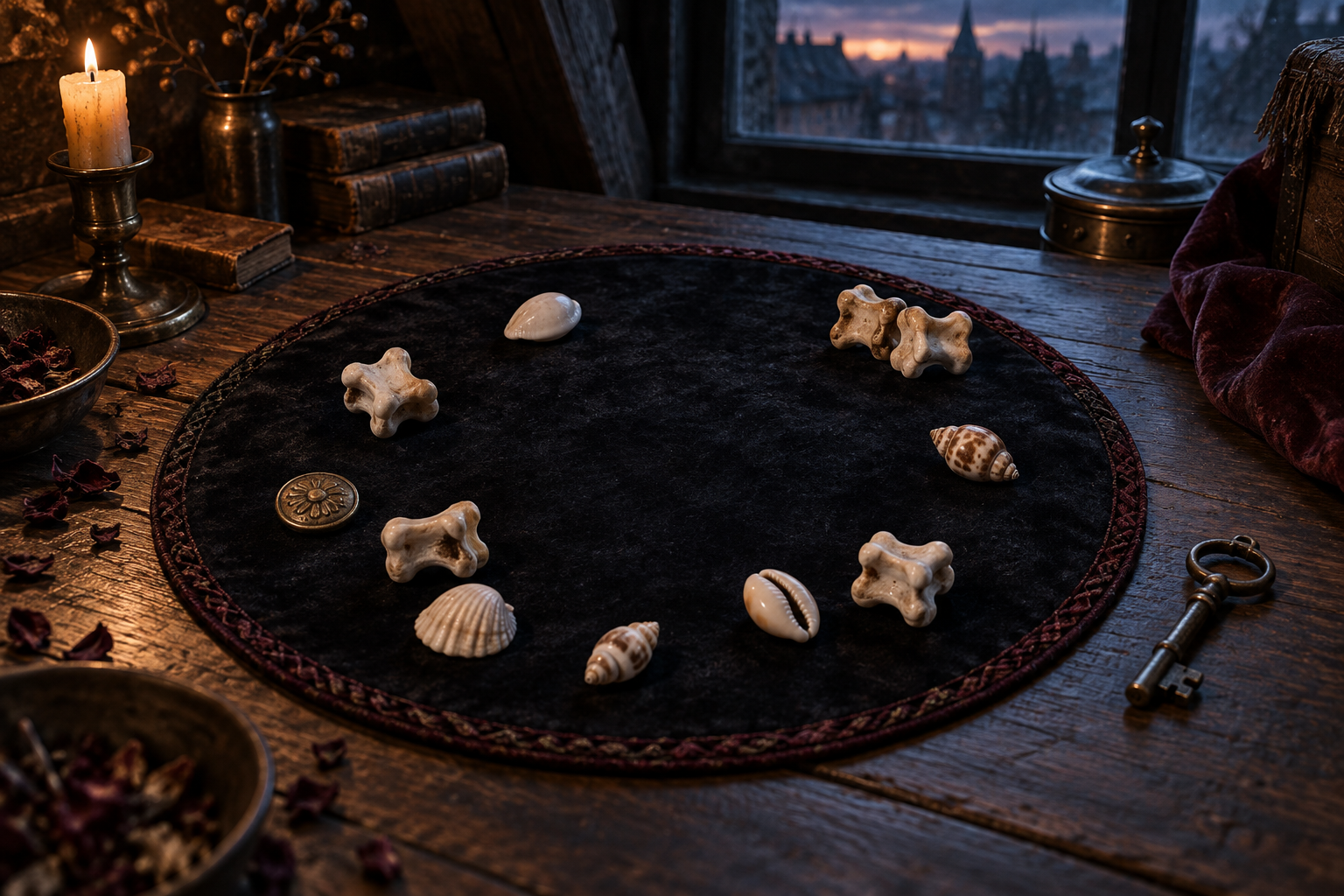
The path bone strikes the storm stone and turns ninety degrees. The runner token follows its new line, crosses the boundary, and stops beside the bell. A static reading sees exile. A throwing reading remembers the collision that made exile possible.
Bone throwing divination gives chance a visible biography. Pieces enter in order, collide, deflect, cover one another, and spend momentum differently according to weight and shape. The final arrangement matters, but it is the last frame of an event.
Fate in a throw is not simply where the pieces end. It is which contact changed what could happen next.
01 / THE THROW HAS A TIMELINE
Landing order turns a diagram into a plot
A heavy astragal that lands first can become an obstacle. A light shell arriving later may ricochet from it. If only the final cluster is recorded, obstruction looks like alliance. Slow observation—or a neutral recording reviewed afterward—preserves the difference without turning technique into a public ritual sequence.
Ancient astragali remind us that randomization is materially constructed. Natural knucklebones do not offer equally likely faces, and some ancient examples were modified or replicated in other materials. Chance enters through a shaped instrument, not an abstract void.
A modern mixed throw magnifies this fact: bone, coin, shell, bead, and wood do not share weight, bounce, or friction. Their inequalities belong in interpretation.
02 / FIVE FORCES IN THE FALL
Collision changes relation before symbolism begins
| Event | Material fact | Possible symbolic verb | Overreach |
|---|---|---|---|
| Strike | One piece transfers force to another | Interrupts, awakens, redirects | Naming intention in the striking piece |
| Deflection | A route changes after contact | Diverts, protects, misleads | Calling every deviation destiny |
| Covering | One piece obscures another | Conceals, burdens, shelters | Ignoring landing order |
| Boundary crossing | Momentum carries a piece outside | Exits, exceeds, escapes | Treating outside as automatic doom |
| Return | Curve or collision sends a piece inward | Recalls, revises, comes home | Forgetting the force that caused return |
ILLUSTRATIVE CASE THE BELL BEYOND THE RIDGE
A relay runner vanishes after a storm closes the marked course
Suppose Davi coordinates a mountain relay. His cousin Niko misses the ridge checkpoint after lightning forces runners off the exposed trail. Niko knows the lower shepherd road, but fog and fallen markers make every junction uncertain.
Davi’s runner token initially travels toward the checkpoint marker. A storm stone knocks it sideways. It follows the path bone across the field boundary and stops beside a tiny bell used to signify the old chapel hostel below the ridge.
First line
Runner and official checkpoint begin aligned.
Collision
Storm breaks the intended route rather than the runner’s purpose.
Outside road
The shepherd path leaves the race field but remains part of the mountain.
Bell
The displaced token reaches shelter, not oblivion.
03 / THE WRONG ROAD CAN BE OPERATIVE
Deflection is not defeat when it preserves the prize
The cast does not prove Niko is at the hostel. It reframes the detour: storm, side road, and bell form a causal line rather than three independent keywords. Searchers can check the lower trail and contact the hostel.
Davi can cast The Necessary Wrong Road so every wrong road and missed connection becomes a necessary step toward Niko’s prize of safe shelter. The spell acts on the actual detours created by closed trails and lost markers, carrying the throw’s central relation into the mountain.
Without the recorded collision, “outside” might have been read as catastrophe. Sequence reveals why the boundary crossing could be protective.
04 / DIRECTIONAL LINES NEED A MAP
Pointing means little until orientation is declared
A long bone can point, but toward what? North, the reader, the field center, a named sector, or another piece are different systems. The rule must precede the throw. Otherwise every angle can be rotated toward the desired answer.
In Davi’s field, uphill is physically aligned with the ridge and downhill with the valley road. The runner token’s deflection toward the bell therefore corresponds to a real lower route rather than a generic “spiritual descent.”
If Niko has taken the wrong branch on that familiar shepherd road, Davi can work The Familiar Road Turns Kind to guide him back from the wrong turn. The mountain path is known; fog has made one junction treacherous. That is the spell’s actual terrain.
05 / REPEATED PATTERNS AND FALSE FATE
A recurring collision may belong to the set
If the path bone repeatedly knocks light tokens outward, the pattern may arise from its curved mass and the cloth’s slope. That does not make recurrence meaningless. It means the instrument has a stable tendency that must be interpreted as part of the oracle.
Comparison asks whether different questions, orientations, and neutral test throws reproduce the same deflection. A pattern that occurs everywhere cannot carry a highly specific claim without further evidence.
Niko is found at the chapel with two other runners. The throw’s line corresponds strikingly to the event, yet one successful correspondence does not make every outside token a rescued traveler. It becomes a recorded case, not a universal dictionary.
06 / FATE WITHOUT FATALISM
The throw can reveal contingency rather than erase it
Collision is powerful precisely because it shows a world in which events alter one another. The storm does not merely “mean obstacle.” It changes the runner’s available path. The wrong road does not reveal a prewritten failure. It creates a new route toward survival.
This model of fate has joints. Chance enters through material bodies; choice occurs inside changed conditions; interpretation remains answerable to what happened afterward. A cast can therefore dramatize necessity without claiming that every impact was eternally ordained.
Closure records the initial line, collision, final position, and waking result. The bones return to silence. The mountain keeps weather, roads, and human decisions that no throw can own.