BONE CASTING · FIELD · RELATION
Bone Casting Divination: Read the Field Between the Pieces
A cast does not scatter meanings at random. Center, boundary, distance, contact, and the spaces no piece enters turn a handful of objects into a temporary world.

STAR & SIGIL
Gather the speaking company
Enter an ancestral working where tokens, distances, and clusters reveal the relationships moving beneath a present question.
Cast the ancestral field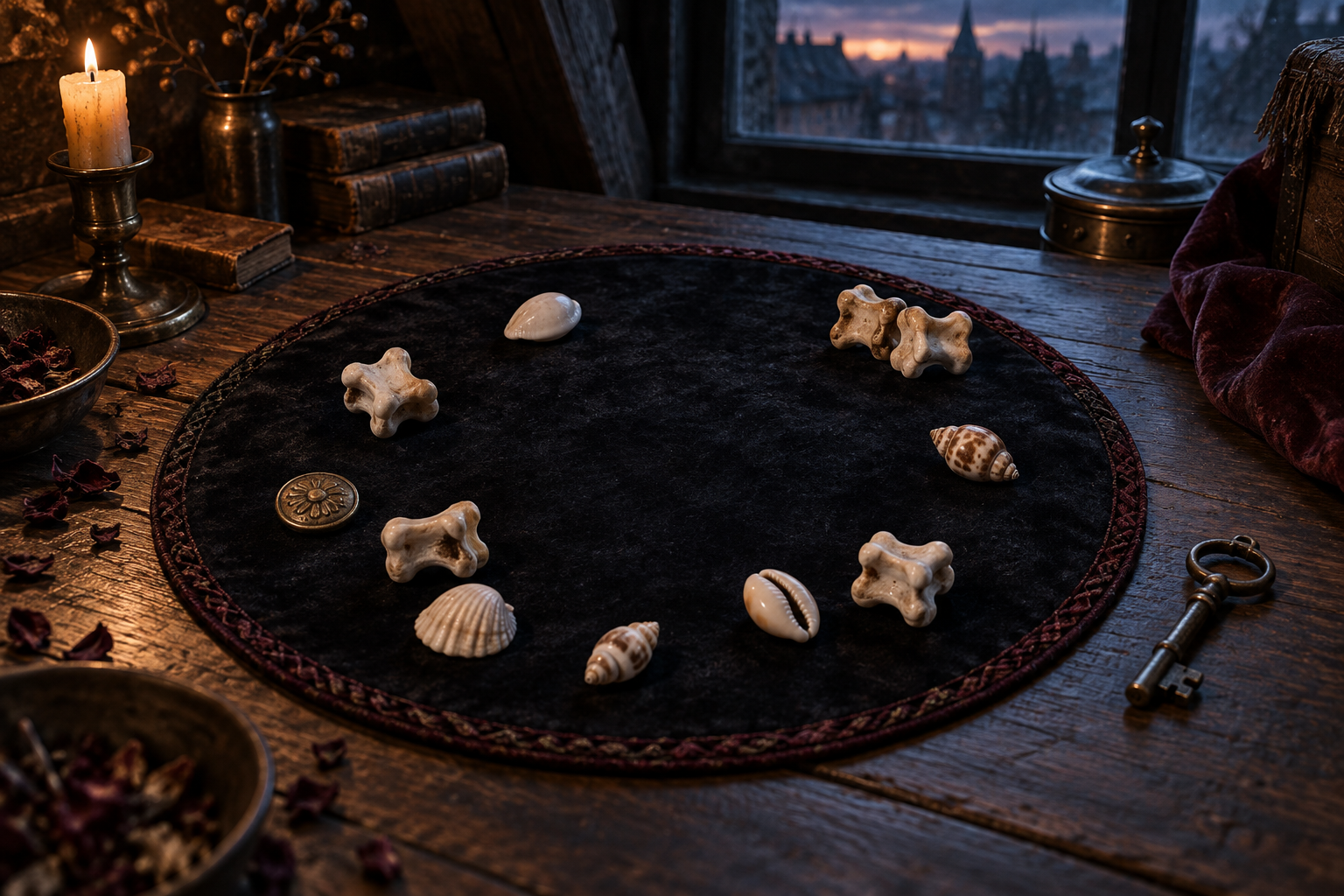
The jaw fragment lands at the border. A brass button faces inward. Two shells touch, while the center remains empty enough to feel louder than any object. Bone casting divination begins here: not with a list of fixed meanings, but with a temporary field in which pieces acquire relation.
A contemporary casting set may include animal bones, teeth, shells, stones, coins, buttons, keys, and personally significant objects. That mixed vocabulary should not be projected backward as one universal ancient system. Greek and Roman astragali, Chinese heat-cracked oracle bones, and culturally specific African divination ensembles belong to distinct material histories and ritual authorities.
The serious reader names the set, the field, and the rule before asking the fall to become a story.
01 / A SET IS A DECLARED WORLD
Bone does not make every object ancestral
A sheep astragal has several stable landing faces because of its anatomy; a long rib splinter points; a tooth bites visually; a button presents face and back. Material form creates tendencies before symbolism begins. Weight and curve also affect where a piece can travel.
Historical caution sharpens the practice. Ancient astragali could serve play, randomization, dedication, or divination, and context is what distinguishes those offices. A museum object described as fortune-telling evidence does not authorize treating every knucklebone everywhere as the same oracle.
A personal set is strongest when provenance remains legible. “Button from the troupe’s first costume” carries more accountable meaning than “metal always means power.”
02 / THE CASTING FIELD
Center, rim, sectors, and outside are different jurisdictions
| Field relation | What it can express | What must remain visible |
|---|---|---|
| Center | Dominant pressure, declared subject, or present focus | Whether the center was defined before the cast |
| Rim | Threshold, fading influence, arrival, or departure | Orientation and which side counts as inward |
| Contact | Alliance, collision, burden, or transmission | Which piece covers, points, or landed first |
| Open interval | Separation, withheld relation, room, or refusal | The method’s distance rule, not visual preference |
| Outside | Exclusion, loss, witness beyond the question | Whether outside pieces count at all |
ILLUSTRATIVE CASE THE EMPTY CENTER
A puppet troupe asks who owns its final play
Suppose Amadi’s traveling shadow-puppet troupe dissolves after its founder dies. A sealed trunk holds drafts, contracts, and correspondence. Three performers each claim the founder promised them the unfinished final play.
Amadi’s set contains a carved joint for authorship, a costume button for the troupe, a key for custody, a shell for public voice, and a small jaw for testimony. The joint and button touch at the eastern rim. The key lands outside. The jaw points toward the locked trunk. Nothing occupies the center marked “sole owner.”
Empty center
No piece accepts the question’s premise of one unquestioned heir.
Joint with button
The play’s making remains articulated with collective labor.
Key outside
Custody exists beyond the field of artistic entitlement.
Jaw toward trunk
Testimony points toward records before it points toward a claimant.
03 / FOLLOW THE RELATION INTO EVIDENCE
A cast can redirect the question without settling it
The jaw’s direction and the exiled key make the trunk newly important, but they do not report what its papers say. If those sealed letters and locked books continue to withhold the founder’s intention, Amadi can cast The Archive Made to Scream and make the records speak their secrets aloud.
The distinction protects the oracle’s authority. The cast identifies the missing jurisdiction; the archive supplies its own testimony. Neither needs to impersonate the other.
04 / CLUSTERS ARE SENTENCES
Contact needs a verb, not a sentimental conclusion
Joint touching button might mean authorship joins troupe, the troupe burdens the work, or collective labor animates the script. Orientation narrows the options: the joint lies atop the button, while its hinge opens toward the empty center. The relation is not simply “together.” It stages dependence and unfinished articulation.
Clusters become narrative only after the reader states what each geometry permits. Covering differs from touching. Parallel differs from converging. A piece trapped beneath three others differs from one surrounded at equal distance.
Amadi’s final task is public: tell collaborators that no sole-heir claim survived the evidence. He can cast The Crown of the Unignored Voice so that spoken truth carries supernatural authority without silencing another will. The cast gives him a structure to explain; the crown lets the truthful account hold the room while dissent remains possible.
05 / SYNTHESIS WITHOUT VERDICT THEATRE
Tell the shortest story the field can support
The defensible synthesis is compact: collective work remains attached to authorship; custody sits outside the claimants’ argument; testimony points to the trunk; sole ownership occupies no center. “The founder commands a cooperative” would exceed the cast.
Repetition may strengthen a relation if the same rule and question are preserved, but repeated throwing can also chase a desired heir. A second cast is not an appeal court for disappointment.
Closure records pieces that landed outside, accidental rebounds, and the wording of the question. The set returns to its container without becoming a permanent jury over the troupe.