ANIMALS · BEHAVIOR · TRADITION
Animal Omens: Read the Encounter Before the Symbol
A fox crossing a road is first a fox crossing a road. An animal omen begins only when a tradition, a question, and an observer make that movement consequential—and different traditions do not make it mean the same thing.

STAR & SIGIL
Let the animal keep its own life
Enter an animal-centered working built around distance, habitat, and observation before any symbolic relationship is named.
Open the ethical field route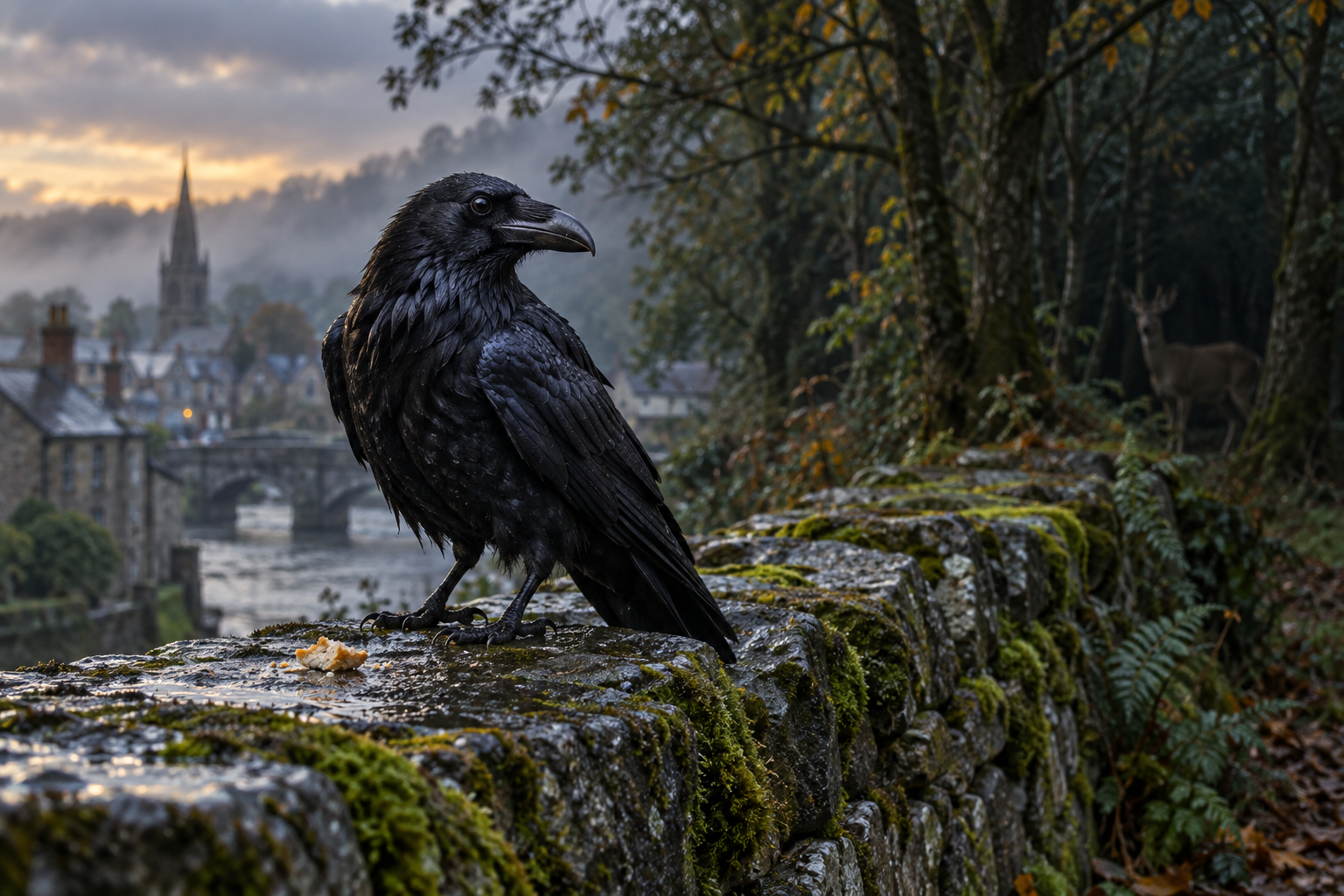
At the edge of the road, a fox stops and looks back. The encounter feels arranged: the hour is early, the city is quiet, and the animal stands exactly where a difficult journey begins. Yet the fox has its own morning—territory, hunger, young, traffic, scent. An animal omen becomes worth reading when the animal’s life is not erased to make it a symbol.
There is no single occult dictionary in which owl equals death, deer equals gentleness, and fox equals cunning everywhere. Animal omens belong to particular systems of observation. Species, behavior, direction, season, place, question, and cultural authority can all change the meaning.
Read what the animal did before what it represents
A photograph encourages symbolic reading because it freezes an animal into an emblem. Omens unfold as verbs. A bird calls, circles, drops, approaches, strikes, nests, flees, or feeds. Two ravens flying east are not equivalent to one raven repeatedly entering a house. A fox crossing at dusk is not equivalent to a sick fox moving in circles at noon.
Historical systems often preserve this grammatical precision. Mesopotamian terrestrial omen series classified remarkable animal appearances and behaviors in conditional statements. Surviving commentaries show scholars explaining difficult entries rather than consulting a universal bestiary. In Syro-Anatolian bird divination, observations could be combined to answer a posed question positively or negatively. Roman authors distinguish birds that signify by flight from birds that signify by cry. The animal’s action is structural, not decorative.
“The creature is not a noun placed in your path. It is a life performing a verb.”
Begin with a field note stripped of interpretation: “At 6:42 a.m., one red fox emerged from the drainage verge, paused while two cars passed, crossed north to the wooded strip, and did not return.” Only afterward add association. This preserves the encounter from becoming whatever later events demand.
Identification matters because resemblance is not identity. A crow is not a raven; a hawk is not automatically an eagle; tracks may belong to a domestic dog rather than a wolf. When identification remains uncertain, keep it uncertain. “Large dark corvid” is a stronger foundation than a mythically convenient species chosen after the fact.
Augury, omen scholarship, and weather lore are not one practice
Ancient references to “animal omens” conceal very different operations. Roman augury was embedded in public religion and political procedure. Its observers, marked spaces, categories, and rules did not amount to spontaneous personal symbolism. Cicero’s dialogue preserves both the claim that divine order speaks through birds and the skeptical objection that interpretation and civic expediency sustain the system.
Mesopotamian scholarship built textual corpora. A raven dropping something into a building could be reported to a king and interpreted through established parallels; a falcon losing prey could bear a different political forecast. The authority lay not in “raven energy” or “falcon energy” but in the exact event, its textual classification, and the scholar competent to report it.
Natural-history writing adds a third mode. Pliny records frogs croaking unusually, bees remaining in hives, ants carrying eggs, or earthworms emerging as weather prognostics. Whatever one thinks of each claim, the proposed chain is environmental: animals respond to changing conditions. A creature can therefore provide information without serving as a supernatural messenger. Traditional weather lore, formal divination, and personal encounter may overlap, but they do not become identical because an animal appears in each.
| Mode | What gives the observation meaning? | Typical consequence |
|---|---|---|
| Formal augury | Authorized ritual field, inherited categories, posed undertaking | Proceed, delay, repeat, or reject public action |
| Omen series | Recorded conditional parallels and expert interpretation | Forecast for ruler, household, city, or campaign |
| Ecological indicator | Animal response to weather, habitat, food, threat, or season | Expect a material change in local conditions |
| Personal sign | Biography, question, repetition, private devotional frame | Reflection, attention, or a bounded choice |
Behavior first does not mean symbolism never
An animal close to a house may be following food, water, shelter, warmth, artificial light, breeding opportunity, or an altered habitat. A bird striking a window is responding to transparency or reflection. A nocturnal animal visible by day may be displaced, feeding young, habituated, injured, or ill. Discovering such a cause does not profane the encounter. It identifies what actually brought another life into view.
The ecological layer can deepen symbolism. A heron returning to a restored wetland speaks differently once you know the water has again become capable of feeding it. A fox using railway margins reveals hidden corridors through a fragmented city. A moth at a porch lamp may become an image of attraction precisely because artificial light has interrupted its navigation. Material knowledge gives metaphor teeth.
Modern magical language sometimes treats animals as summoned props. That is a separate claim from observing an omen, and its scale should be named. The Many Beasts as One is a consequential command working designed to Call every beast within hearing and command them as one great creature. Cast it only when that vast collective act—rather than a single creature’s ambiguous appearance—is truly the operation being sought.
When behavior suggests injury, entrapment, poisoning, or a dangerous encounter, the meaningful response is practical attention. The omen may be that a place has become hostile to life. Symbolism should not make the suffering animal wait while the observer searches for a personal message.
The fox at the divided road
Lea is driving before dawn to decide whether to accept a position in another city. At a fork, a fox appears from the right verge, waits through one passing car, crosses toward the left-hand road, and disappears into scrub. Lea’s grandmother used “fox” affectionately for someone who found an unadvertised way through trouble, but the family has no transmitted omen rule about fox crossings.
Place
A peri-urban fork bordered by drainage land and scrub: plausible fox habitat.
Behavior
The fox waits for traffic, crosses directly, and seeks cover; nothing indicates pursuit or invitation.
Inheritance
“Fox” means resourceful detour in Lea’s family vocabulary, not a universal prophecy.
Question
Not “Which road did it choose?” but “What unadvertised route have I failed to ask about?”
The literal event offers no directional command. The left road simply leads to cover, while the right is exposed. Lea refuses the easy reading that the fox has selected her route. She carries forward the family association instead: look for the way not listed in the obvious options.
At the meeting she asks whether the new position could begin as a six-month secondment rather than a permanent move. The employer agrees to consider it. The fox did not authorize the contract or predict success. Its movement, read through Lea’s actual family language, produced a third question where she had imagined only stay or leave. The eventual written terms—not the sighting—must decide whether the route is real.
A recurring animal is a pattern only after the baseline is known
Three hawk sightings can feel insistent. But three hawks beside the same highway may be one resident bird using the same thermal or hunting perch. Repetition becomes interpretively interesting when the observer records date, time, location, behavior, and likely identity. Without that baseline, frequency is a mood.
A bounded protocol keeps wonder alive. State the question before the observation window. Define which species and behavior would count, and for how long. Record nonappearances as faithfully as appearances. At the end, interpret once. If the rule changes after every sighting, the animal can never fail to confirm the story.
Sometimes the pattern points toward human help rather than an animal message. If an encounter sharpens awareness of a danger only another person understands, cast Meet the Savior First to Arrange to meet the one person who can save you before you encounter the danger they understand. The animal may open the question; the working explicitly seeks the knowledgeable encounter.
Most animals seen in ordinary life are doing ordinary animal things, and “ordinary” is not another word for meaningless. Migration, hunting, nesting, evasion, and adaptation are already profound. A respectful omen reading does not require the creature to have arrived for you. It asks what became visible because your lives briefly crossed.
That crossing can also revise the observer. The important result may be increased attention to a watershed, nesting season, road corridor, or vanishing habitat rather than a forecast about personal fortune. An encounter interpreted well enlarges the field of concern. It does not reduce a living neighborhood to scenery around one human destiny.