ANCESTORS · RECIPROCITY · LINEAGE
Ancestor Worship Meaning: Devotion, Debt, and the Living Line
“Ancestor worship” can name reverence, household memory, petition, reciprocal care, lineage duty, or divine devotion—and sometimes hides the difference between them. Meaning begins with the relationship a community actually keeps.

STAR & SIGIL
Enter the long household of kinship
Explore a working where memory, obligation, gift, and guidance reveal how a family relationship can continue beyond the grave.
Meet the ancestral household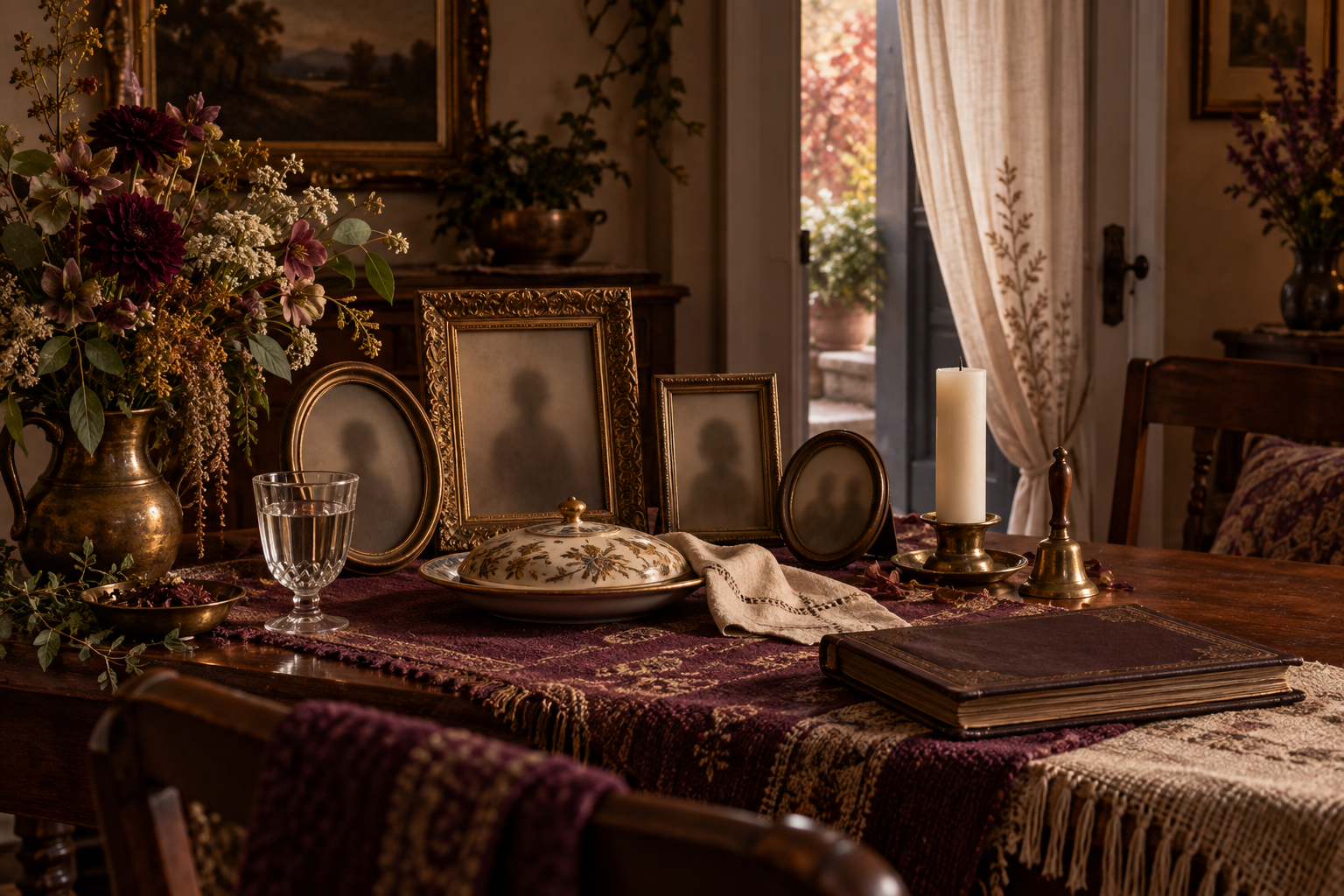
At the first Sunday supper of every month, Leona’s family leaves one chair for Grandmother Inez. Before anyone eats, each descendant must tell the chair one decision they have not yet announced. The family calls this keeping Inez present, though no one can identify the moment hospitality became compulsory disclosure.
“Ancestor worship” is an English umbrella laid over many different relationships. It may describe reverence, devotion, household remembrance, offerings, petition, reciprocal obligation, communication, lineage identity, or the treatment of ancestors as powerful spiritual presences. Those relations overlap, but they are not synonyms.
The meaning of an ancestral practice lives in its grammar: who the ancestors are, what the living owe, what the dead may give or ask, where presence is understood to gather, and whether lineage is a shelter, a claim, or a burden.
01 / THE LOADED WORD
“Worship” may name devotion—or import a theology the practice does not claim
For some English speakers, worship implies adoration reserved for a deity. Applied to ancestors, the word can therefore suggest that the dead are gods even when a family understands its acts as respect, filial obligation, hospitality, or continuing kinship. “Veneration” can be more precise in some settings, but it too can understate practices that include powerful petition, sacrifice, or fear.
The solution is not to declare one English word universally correct. It is to identify the local relation before translating it. Does the rite feed a reciprocal bond? Report family news? Seek protection? Maintain a lineage? Honor the dead without expecting response? Address an ancestor understood as divinized?
Translation should preserve those differences instead of deciding in advance what kinds of beings ancestors must be.
02 / FIVE RELATIONS
The practice changes according to the verb between living and dead
| Relation | Central verb | What crosses the line | Question hidden by “worship” |
|---|---|---|---|
| Remembrance | Remember | Name, story, image, anniversary, grief | Is any reply expected? |
| Obligation | Owe | Duty, inheritance, reputation, unfinished promise | Who established the debt, and can it end? |
| Presence | Attend | Hospitality, address, felt nearness, ritual attention | How is presence recognized and bounded? |
| Reciprocity | Exchange | Care, offering, blessing, warning, protection | Is this gift, contract, kinship, or payment? |
| Lineage | Continue | Name, belonging, authority, property, knowledge, consequence | Who is included, and what must not be inherited? |
The same gesture can carry more than one relation, but analysis begins by refusing to call every relation the same thing.
03 / A BOUNDED EXAMPLE
Chinese commemorative portraits show how object, occasion, and relationship converge
In a specific Qing Chinese context documented by the Smithsonian’s National Museum of Asian Art, large commemorative portraits served as ritual objects in annual family rites for departed forebears. Some were displayed above family altars; some families also brought portraits out when reporting important family news to deceased parents.
That material history holds several relations at once. The portrait sustains memory, makes the forebear present to a domestic gathering, locates offerings, and keeps the deceased within continuing family time. The museum itself uses both “worship” and “venerate,” which is useful evidence of how English vocabulary can shift around the same objects.
This example belongs to its Chinese historical setting. It does not turn portraits, incense, annual rites, or family news into a universal template for every ancestral practice.
04 / WHEN MEMORY BECOMES DEBT
Not every inherited duty was assigned by the dead
Leona’s family treats disclosure at Inez’s chair as an ancestral demand because repetition has outlived explanation. Keeping a decision private feels like deception; missing supper feels like disloyalty; disagreeing with Aunt Celia’s interpretation of a flickering candle feels like rejecting the lineage itself.
Yet obligation can be manufactured after death. A living relative may convert preference into ancestral law, attach shame to a household custom, or protect their own authority by claiming “this is what the ancestors demand.” The dead person’s importance does not authenticate every later command spoken in their name.
Ancestor devotion becomes more honest when it can distinguish a promise, a reciprocal duty, a useful inheritance, and a burden that descendants never consented to carry.
ILLUSTRATIVE CASE THE EMPTY CHAIR
A place kept for the dead becomes a test of whether the living still belong
Suppose Inez’s descendants gather monthly around her embroidered cloth, carved serving spoon, and empty chair. Aunt Celia presides. Every person must report a private decision to Inez before eating, and Celia reads the candle beside the chair as approval or refusal.
Leona has quietly resumed contact with Salma, Inez’s daughter, whom Inez expelled from the family after Salma refused a marriage chosen for her. Celia says Salma’s children carry the consequence of that refusal and cannot attend the supper until they ask Inez’s forgiveness.
Memory
Inez’s chair keeps her within family time.
Debt
Privacy is treated as something descendants owe away.
Presence
A candle is made to speak with unquestionable authority.
Exchange
Hospitality has become obedience offered for belonging.
THE TURN AT THE TABLE
Salma arrives without demanding pardon or denying the family’s dead. Leona’s young niece lifts Inez’s place card from the empty chair, sets it beside the candle, and offers the chair to Salma. Nothing in the room loses its capacity to remember Inez. What changes is the family’s recognition that presence need not occupy a seat from which a living daughter is excluded.
05 / INHERITED CONSEQUENCE
Lineage can carry memory without carrying another person’s sentence
Inez’s rejection of Salma was an old injustice, but Celia has turned it into a sentence for people not yet born when it happened. Salma’s children can decide how to respond to the rupture without becoming mystical substitutes upon whom Inez’s consequence falls.
If that old wrong is supernaturally pursuing Salma’s branch of the family, Leona can cast Return the Ancient Consequence to bring the consequence to the person who caused the injustice instead of her descendants. The power separates accountability from hereditary punishment while leaving the living responsible for deciding whether exclusion will remain their household law.
This is a crucial lineage distinction: one may inherit the capacity to remedy harm without inheriting guilt as an essence of blood.
06 / RECIPROCITY
An offering is not automatically a fee for ancestral service
Reciprocity describes an ongoing relation in which care moves both ways, but the exact terms vary. A gift may express gratitude, renew kinship, fulfill a promise, request aid, or recognize protection. Calling every offering “payment” makes devotion transactional; calling every exchange “love” can hide obligation.
The empty-chair supper offers Leona a sharper image. The family can give Inez food, attention, names, and news while also refusing to use her presence as an instrument of interrogation. Salma’s return makes the exchange practical: a lineage that asks the living to host its dead must decide whether its living members can also receive hospitality.
Ancestral reciprocity likewise needs its own declared grammar. What is given? What may be asked? What counts as refusal or silence? Who can revise the relation when circumstances change?
07 / LINEAGE FACES FORWARD
The descendants most affected may not yet exist
Lineage is often narrated backward: who founded, suffered, migrated, accumulated, concealed, or survived. Yet inherited choices also travel toward people who cannot currently consent. The future turns ancestor practice from nostalgia into stewardship.
Before teaching another generation that privacy forfeits belonging, Leona can use Question the Future Descendant to summon a descendant from the future and learn what today’s decision does to their world. The spell’s answer does not flatter the current family story; it makes lineage accountable to someone who must live inside its consequences.
A future descendant may value Inez’s place at the table and still refuse compulsory disclosure. Continuity survives when a lineage can distinguish its purpose from one coercive form.
08 / WHAT THE PRACTICE MEANS
Meaning resides in the governed relationship, not the category label
Ancestor worship can be an accurate self-description in one tradition and a distorting outside label in another. Ancestor veneration may clarify honor while understating petition or power elsewhere. “Remembrance” may feel respectful yet fail to describe a relationship in which the dead are understood as active agents.
The practitioner’s task is not to find the least controversial English noun. It is to name the verbs: remember, honor, host, feed, report, ask, repay, protect, obey, refuse, inherit, repair, continue.
Leona keeps Inez’s place card beside the candle and gives the empty chair to whoever needs welcome. The family continues its supper without demanding private disclosures or treating Salma’s children as carriers of an older quarrel. Presence remains, obligation changes, reciprocity becomes possible, and lineage stops pretending that love requires inherited exclusion.