ANCESTORS · OFFERINGS · RECIPROCITY
Ancestor Offerings: What the Gift Says, Feeds, and Remembers
An ancestor offering is never merely an object left near a photograph. It is a sentence in a relationship: who is addressed, what is given, when it is given, and what the living promise to remember afterward.

STAR & SIGIL
Let remembrance close before contact is ever considered
Begin with consent, relationship, material care, and a complete ending before one question is addressed toward the dead.
Open the covered-bowl protocol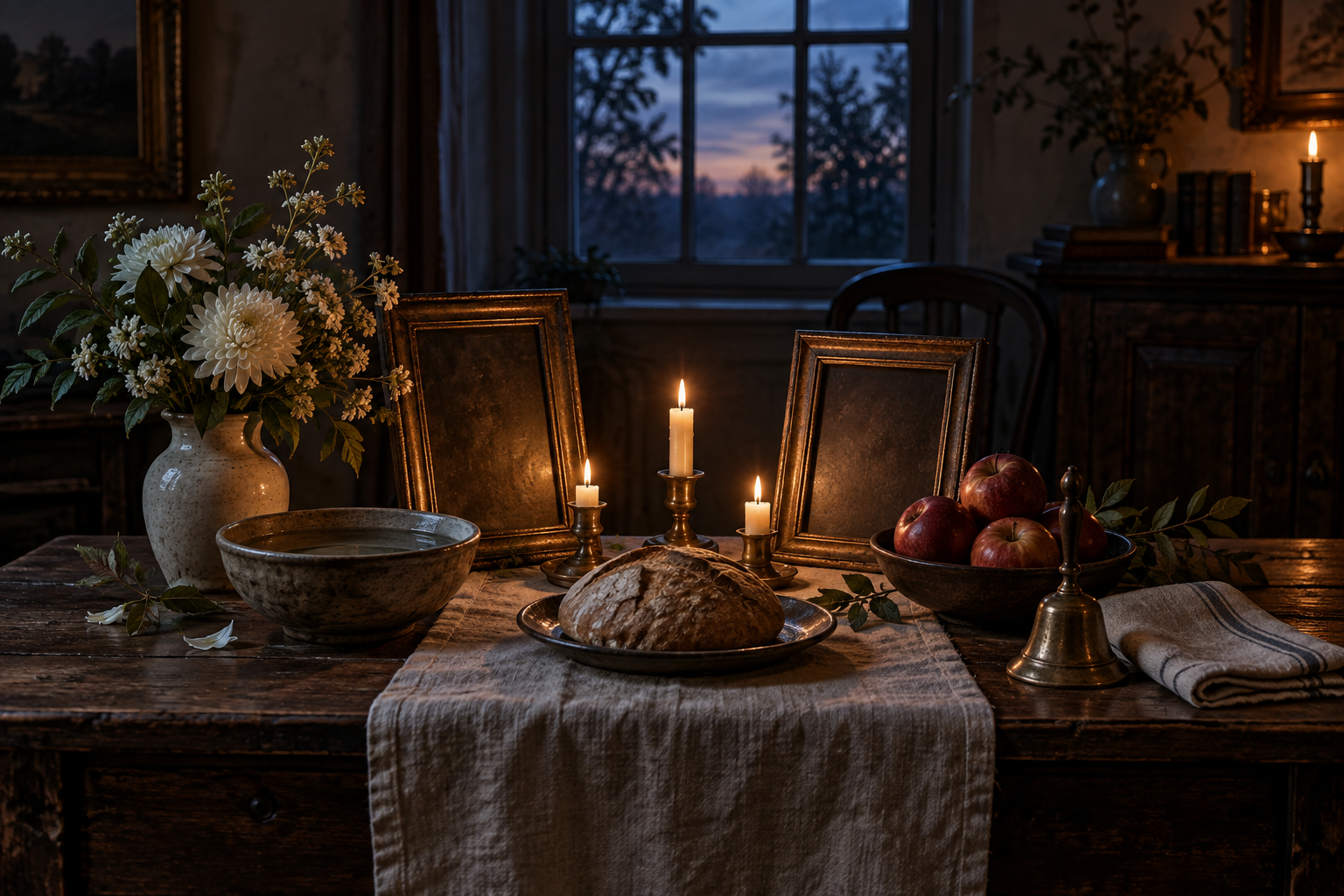
The orange on the saucer is bright enough to look self-explanatory. It is not. In one house it is a New Year gift to named grandparents. In another it accompanies grave cleaning. Elsewhere bread and water belong to a private remembrance assembled by a descendant who inherited no ritual instructions at all. The objects may resemble one another while the relationships behind them remain profoundly different.
“Ancestor offerings” names a family of acts, not a universal recipe. Food, drink, flowers, incense, paper, song, repaired heirlooms, charitable gifts, and the recitation of names can all become offerings, but only within a grammar of address. The decisive questions are not which item looks most mystical. They are who receives, on whose authority, at what occasion, and what kind of relationship the gift renews.
This distinction protects tradition from becoming décor. It also makes a new household practice more honest: a practitioner can build from known family customs, living religious instruction, or explicitly personal remembrance without pretending that all three are ancient versions of the same rite.
01 / THE GIFT IS A RELATION
What is given matters less than what giving establishes
An offering can nourish, welcome, honor, repay, accompany, provision, thank, appease, or remember. These verbs are not interchangeable. A glass of water renewed daily may sustain ordinary attention; a festival meal may gather descendants into a calendrical return; a favorite sweet may preserve one person’s taste; a paper object transformed by flame may be understood as provision that crosses into another condition.
The receiver may be one named dead person, a lineage, the household dead, ancestors beyond surviving records, or a broader company of spirits. Expanding the address changes the rite. “For my grandmother Elena” invokes biography and intimacy. “For the ancestors of this household” invokes continuity and office. “For all forgotten dead” exceeds kinship and may belong to a different religious or charitable obligation.
Reciprocity also differs. Some descendants ask for blessing, protection, fertility, luck, or guidance. Others give without petition because remembrance itself is due. A third practice treats the offering as hospitality during a scheduled return. Calling every exchange “feeding spirits” erases these differences and makes the dead sound like one undifferentiated appetite.
02 / DIFFERENT HOUSES, DIFFERENT COSMOLOGIES
A family resemblance is not a single ancestral religion
Qingming observances commonly join grave sweeping with visitation and offerings. In documented Singaporean practice, families clean graves or niches and may bring food, flowers, tea, and cakes; some also address the local Earth God before their ancestors and burn paper offerings according to their beliefs. The sequence matters. Place, custodianship, kin, and transformed gifts occupy different positions.
Chinese traditions themselves are not uniform. Region, dialect group, religion, family history, and the setting of grave, columbarium, temple, or home alter what is offered and how. An imperial ancestral temple, a village festival, and a family’s visit to a grandmother’s niche share no automatic script merely because ancestors appear in all three.
Roman household religion offers another architecture. Images of Lares near the domestic hearth or household shrine connected divine and ancestral understandings to place, prosperity, and daily family life. Yet translating a Roman lararium into “an ancestor altar” can obscure the presence of household gods, the social structure of the Roman familia, and rites not reducible to remembering recent relatives.
A modern personal shelf may be religiously meaningful without inheriting either system. Its integrity comes from accurate naming: “a remembrance place I made,” “a practice taught in my family,” and “a shrine maintained within my religion” are three different claims.
| Offering setting | Primary address | What gives the act meaning |
|---|---|---|
| Festival grave visit | Named family dead at a burial or memorial place | Calendar, grave care, family gathering, and regionally specific rites |
| Household religious shrine | Ancestors within a living religious and domestic order | Inherited liturgy, household roles, community teaching, and repeated observance |
| Personal remembrance table | Known relatives or honestly unnamed forebears | Biography, family memory, chosen cadence, and explicitly personal boundaries |
| Public memorial act | A historical community or people denied remembrance | Collective history, public witness, and responsibility beyond private kinship |
03 / BIOGRAPHY BECOMES MATERIA
A remembered life gives the offering its particular force
A favorite food is precise because someone once chose it. A tool is potent because a hand repeatedly used it. A song can hold language, migration, labor, courtship, or dissent. These details keep ancestry from becoming a sepia mood. They restore the dead as people whose tastes and contradictions exceeded the descendant’s spiritual needs.
A photograph labeled by one sibling, a nickname recalled by another, and a recipe carried by an aunt do more than preserve facts. Each bears the labor of the living person who kept it from vanishing. Uncertainty belongs to that inheritance too: an unnamed face or disputed story marks the shape of a family rupture without turning absence into supernatural proof. The offering gathers both the remembered ancestor and the chain of care through which remembrance survived.
Lost skill creates a particularly charged offering. When the break concerns knowledge—an erased language, a craft abandoned under pressure, a technique no living relative can demonstrate—perform The Ancestor Who Brings Back the Lost Art to summon a forgotten ancestor and recover the art that died with them. The benefit is consequential because it imagines inheritance as transmission, not simply atmosphere: the returned knowledge must become capable hands again.
WORKED CASE THREE PLATES, THREE CLAIMS
Mina inherits a custom—but not its explanation
Her father remembers oranges at New Year, her aunt remembers tea at the grave, and an online diagram insists that every ancestor table needs red wine.
Mina has a photograph of her Cantonese great-grandmother, a handwritten cake recipe from her Filipino grandmother, and no living relative who recognizes the proposed wine. She wants one table to honor both women.
The orange
A remembered family occasion gives it a credible calendar, though not a universal meaning.
The tea
It belongs to a remembered visit and place; moving it home should be named as adaptation.
The cake
The inherited recipe carries labor, taste, and one grandmother’s distinct biography.
The wine
Its only authority is a generic diagram. Visual completeness is not lineage.
THE BETTER READING
Mina does not manufacture one “traditional ancestral offering.” She marks two addresses on the same surface: orange and tea connected to one remembered family pattern; a portion of cake connected to the other grandmother’s recipe. She omits the wine and records what remains uncertain.
04 / THE REQUEST INSIDE THE GIFT
Petition changes hospitality into negotiation
Asking an ancestor for protection or counsel is not inherently crass. It is simply a different act from memorial giving. The cleanest practice can say which mode is present. A thank-offering recognizes help already attributed to the ancestor. A petition accompanies a request. A meal of remembrance may ask nothing at all.
Problems arise when every coincidence after a gift is treated as acceptance. A dream, sudden scent, moved object, or fortunate phone call can feel charged without proving its cause. The offering should not become an evidentiary trap in which silence means displeasure and any event means contact. Record impressions, but let ordinary causes remain ordinary.
Grief intensifies the wish for unmistakable speech. If what is wanted is not a recurring sign but one final, solid encounter, cast The Last Conversation Made Flesh to summon a dead person in a solid, recognizable form for one final conversation. Naming that enormous desire directly is more honest than forcing every candle movement to carry a farewell it cannot verify.
05 / THE COMPLETE ARC
An offering has an arrival, a duration, and an afterlife
The rite begins before placement. Someone obtains or prepares the gift, chooses an occasion, cleans a surface, and identifies recipients. During the offering, attention may take the form of speech, silence, prayer, music, shared eating, or simple presence. Afterward, the object changes status again: food may be shared, removed, consumed according to tradition, or treated by a rule learned from the relevant community.
No universal disposal instruction can replace that context. The same fruit can be sacred remainder in one system, a shared meal in another, and ordinary food after a personal memorial. The important analytical point is that the practitioner knows which rule they are following and does not market it as the ancestral rule.
Offerings also affect living people. Who cooks? Who pays? Who inherits the shrine? Who is excluded from the family story? A lavish display maintained by one exhausted relative may honor hierarchy more reliably than the dead. Reciprocity worthy of reverence includes the living hands that keep memory possible.
The table is an argument about continuity
An ancestor offering says that death altered a relationship without making it meaningless. It may carry nourishment, honor, repayment, hospitality, grief, or a request. Its power comes from specificity: this person or lineage, this date, this remembered taste, this form of address.
The beginner’s task is therefore not to assemble the most photogenic altar. It is to learn which relationship already exists, which one is being created, and what the living must do when the visible gift is gone. A well-made offering does not erase difference between traditions. It lets the dead remain particular.