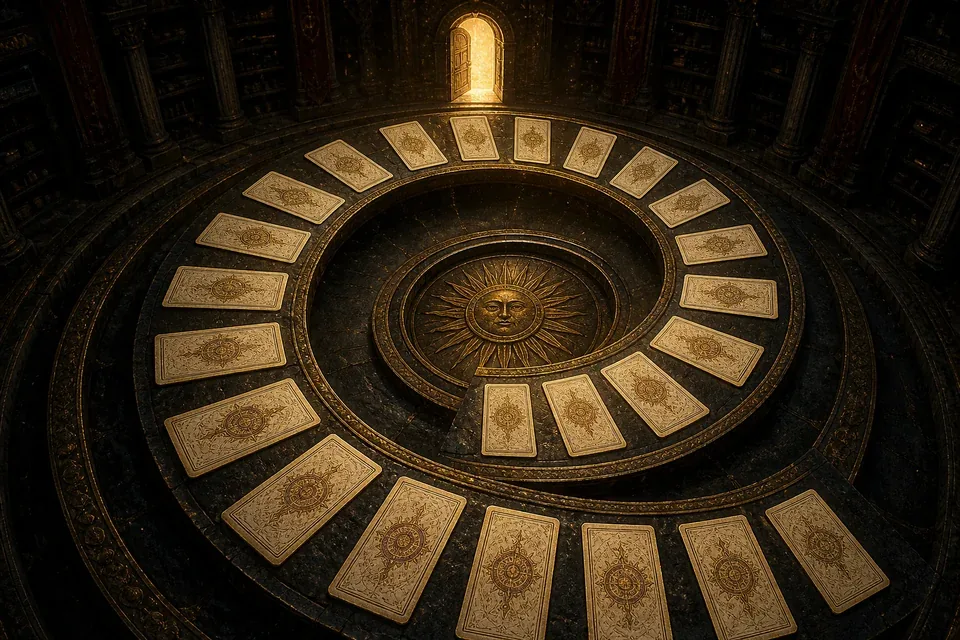
Hero’s Journey uses fifteen positions to tell a change story from ordinary life and a call to act through reluctance, help, trials, return, and a next cycle. It is useful for a long project or life transition when the challenge is understanding the whole arc rather than one decision.
A useful question for this spread
What stage of change am I in, and what would a meaningful return look like?
The question can be made more specific to your circumstances before you draw. Keep the wording open enough for an unexpected card and grounded enough to connect the cards to something you can observe or decide.
The 15 positions, in order
The position labels below follow this version of the spread. Keep the order visible while reading so a compelling card does not cause its place to change after the draw.
- 1Ordinary life
Describe the ordinary setting before change begins.
- 2Reason to act
What makes action necessary or attractive?
- 3Refusal
What hesitation deserves to be heard?
- 4Guide
Which person, text, or resource offers guidance?
- 5First commitment
What small act crosses the first threshold?
- 6Tests
Which repeated challenges build skill?
- 7Difficult approach
What makes the next stage especially demanding?
- 8Greatest trial
Which trial most changes the stakes?
- 9Reward
What is gained besides public success?
- 10Road home
How does the journey return toward ordinary life?
- 11Final test
What remains to be tested at the end?
- 12Return
What does home or community look like after change?
- 13Gift
What can be offered to others?
- 14What changes
What has changed in your way of acting?
- 15Next cycle
What new cycle becomes possible?
How to read the pattern
Do not force a real life into a neat triumph plot. Refusal may be a wise pause; Guide may be a book or friend rather than a mentor figure. Greatest trial and Final test are distinct moments in the story. Return and Gift ask what can be brought back to ordinary life after the intense phase.
After looking at the cards individually, compare the first position with the final one. Notice what changed in between and which cards complicate a simple story. A repeated suit or image can focus attention, but its meaning still depends on the question and the position.
An example reading
If Eight of Cups appears in Reason to act, leaving an old role may begin the story. Four of Swords in Refusal could mark needed rest, not cowardice. Three of Pentacles in Guide may show collaborative help, while the World in Return asks how a completed stage changes daily life.
This example shows how a card can open a question without proving a hidden fact or fixing the outcome. The next useful step is to compare the idea with the real situation and revise it when new information arrives.
Hero's Journey tarot spread FAQ
How many cards are in the Hero's Journey tarot spread?
This version uses 15 cards in a fixed order: Ordinary life, Reason to act, Refusal, and 12 later positions ending with Next cycle. The numbered diagram and position list use the same sequence, so the role of a card stays stable while you interpret it.
What question works best for the Hero's Journey spread?
Begin with “What stage of change am I in, and what would a meaningful return look like?” and replace any broad wording with the situation, decision, or time period you actually want to examine. The spread works best as a structured reflection rather than proof of another person’s private thoughts or a guaranteed prediction.
How do I keep a 15-card Hero's Journey reading coherent?
Read it in three passes: first the individual positions, then nearby groups, and finally the movement from Ordinary life to Next cycle. Write one sentence for each pass so a striking card does not overwhelm the rest of the layout.