
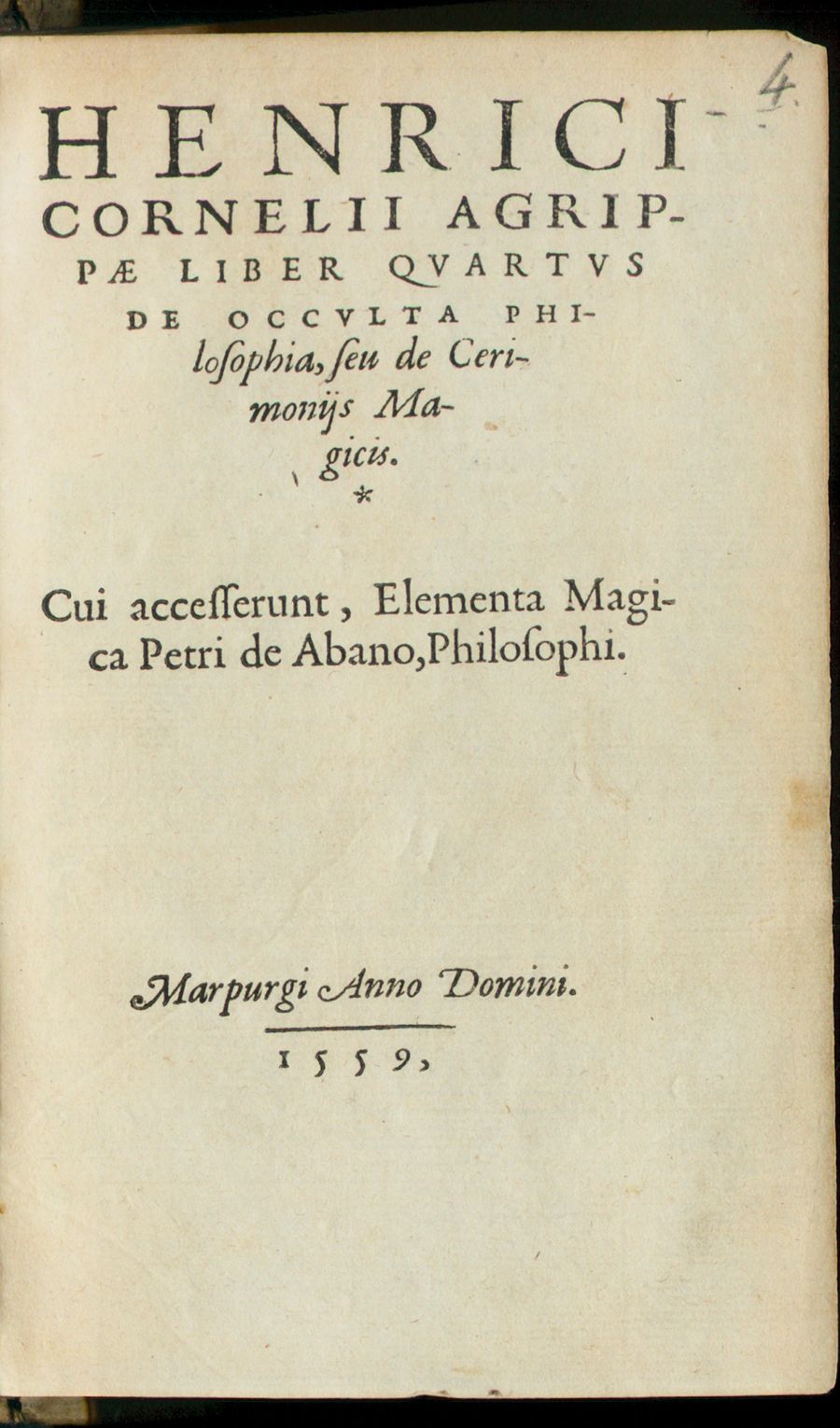
The 1559 book names Peter of Abano, but the text’s own opening sounds like the voice of a compiler building a practical course around an earlier Fourth Book. Its first ritual chapter then turns that editorial promise into a changing, time-specific circle. The relationship between title, introduction, and procedure is more revealing than the famous name by itself.
- Witness
- Bavarian State Library, bsb00080748
- Print date
- 1559, Marburg imprint
- Attribution
- Peter of Abano; treated as spurious
A title page that can be inspected
The Bavarian State Library’s 1559 copy opens by naming a Liber Quartus under Heinrich Cornelius Agrippa and announcing that the Elementa Magica of Peter of Abano have been added. The imprint gives Marburg and the year 1559. This is more than a shelf label: the title page constructs a sequence in which a general work associated with one famous authority is followed by a practical supplement associated with another. “Heptameron” and “Elementa Magica” circulate as titles for the short appended work, while this page foregrounds Elementa Magica. The pairing is physically real in the print even though both authorial claims remain doubtful.
The introduction explains the editorial purpose of that pairing. It says the preceding Fourth Book treats ceremonies in general and appears written for learned, experienced readers; the added Elements will put the procedures in readiness for beginners and describe them almost syllable by syllable. It then calls the circle a fortress protecting operators from evil spirits and makes circle construction the first lesson. That voice speaks as an arranger relating two books to one another. It supplies a curriculum; general principles first, executable forms second; without supplying proof that the historical Peter of Abano wrote the appended manual.
Why Peter’s name needs a qualifier
Peter of Abano was a medieval Paduan physician, philosopher, and astrologer who died long before this surviving print. Wellcome’s record for the 1655 English anthology calls the Heptameron attribution spurious, and Peterson’s source comparison reaches beyond the name on the title page. He identifies close parallels with the Key of Solomon tradition, De quatuor annulis, Liber Semiphoras, and the fifteenth-century Munich necromancer’s manual CLM 849. These parallels include the nine-foot circle, preparation, suffumigations, angel and spirit names, hourly rulers, and weekday conjurations. The work reads as an arrangement of circulating ritual materials rather than an intact treatise transmitted under a secure medieval signature.
That conclusion has a limit. Older ingredients do not by themselves identify the compiler or date the final weekday sequence. Peterson notes that related manuscripts preserve material in different orders and with different levels of detail. One witness explains timing for seals that the print leaves obscure; another supplies signs of a spirit’s appearance that the printed Heptameron sends readers to the Fourth Book to find. The evidence supports a composite transmission and makes the Peter attribution doubtful. It does not reduce every line to a single known source, nor prove when the exact printed arrangement was first assembled.
Worked reading: how the added book turns theory into a circle
The first chapter fulfills the introduction’s promise by converting cosmic categories into writing on the ground. The circle is not a fixed logo. Its form must change with season, day, hour, intended spirits, star, region, and office. Within three nine-foot circles the operator writes, in order, the hour and its angel and seal; the angel of the day and ministers; the present season and its ruling powers; the head of the zodiacal sign; a seasonal name of the earth; and time-specific names of the sun and moon. Around that middle register stand the king and three ministers of the air for the chosen day. Divine names and a cross occupy the protected inner field. The procedure makes timing visible as a nested diagram.
This worked reading explains the 1559 pairing more precisely than the title page alone. The editorial introduction says the earlier Fourth Book is too general; the Heptameron answers with a form that forces the reader to calculate and inscribe every variable before proceeding. It also exposes compilation seams. The print names seals and changing celestial conditions without always explaining how to make the seals, while related witnesses supply timing details that fill the gap. The practical sequence is coherent, but it assumes knowledge beyond its own pages. The year 1559 therefore dates a particular printed teaching package: an attributed authority, an editor’s bridge from theory to practice, and a ritual template assembled from older moving parts.