
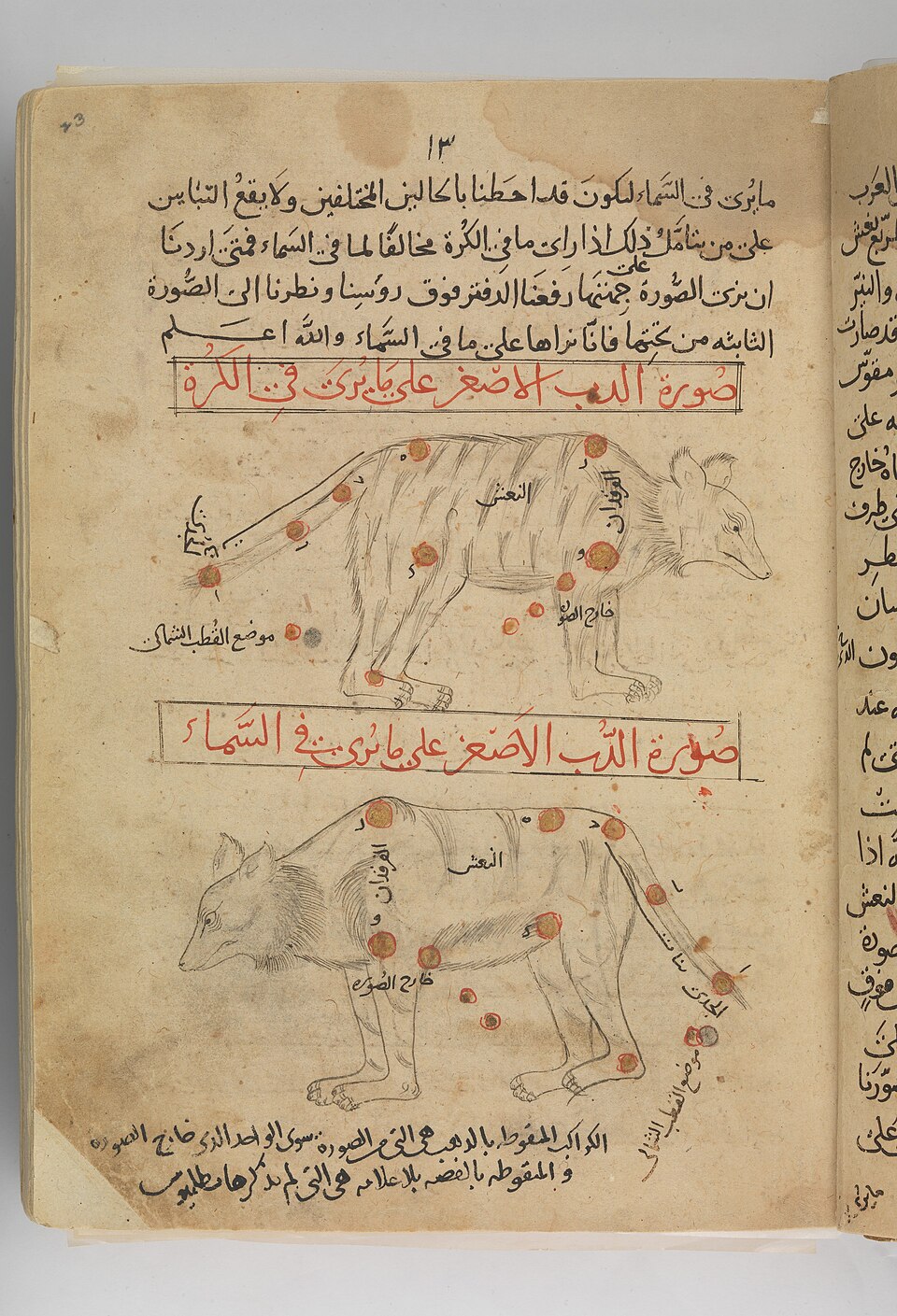
_of_al-Sufi_MET_DP232478.jpg)
Astrological writing often gives a fixed star a zodiac degree. That number is useful only with a date and a coordinate convention. The star has a measured position on the celestial sphere; projecting that direction onto the ecliptic yields a tropical longitude and a latitude. Precession shifts the tropical degree over time. The star’s astronomical constellation and the zodiac sign printed beside its projected longitude answer different questions.
This directory selects 20 recognizable names from the International Astronomical Union’s published name table. The names, J2000 right ascensions, declinations, visual magnitudes, and HR identifiers come from that source. The 2026 coordinates below are calculated independently from those input directions.
Check a birth moment against these stars →
| Star | Constellation | 2026 tropical longitude | Ecliptic latitude |
|---|---|---|---|
| Alcyone | Taurus | 0.36° Gemini | 4.05° |
| Aldebaran | Taurus | 10.15° Gemini | -5.46° |
| Algol | Perseus | 26.53° Taurus | 22.43° |
| Altair | Aquila | 2.14° Aquarius | 29.30° |
| Antares | Scorpius | 10.13° Sagittarius | -4.57° |
| Arcturus | Boötes | 24.60° Libra | 30.73° |
| Betelgeuse | Orion | 29.12° Gemini | -16.02° |
| Canopus | Carina | 15.32° Cancer | -75.82° |
| Capella | Auriga | 22.22° Gemini | 22.87° |
| Castor | Gemini | 20.61° Cancer | 10.10° |
| Deneb | Cygnus | 5.69° Pisces | 59.91° |
| Fomalhaut | Piscis Austrinus | 4.23° Pisces | -21.14° |
| Polaris | Ursa Minor | 28.93° Gemini | 66.10° |
| Pollux | Gemini | 23.58° Cancer | 6.69° |
| Procyon | Canis Minor | 26.15° Cancer | -16.02° |
| Regulus | Leo | 0.19° Virgo | 0.47° |
| Rigel | Orion | 17.19° Gemini | -31.12° |
| Sirius | Canis Major | 14.45° Cancer | -39.60° |
| Spica | Virgo | 24.21° Libra | -2.06° |
| Vega | Lyra | 15.68° Capricorn | 61.73° |
Reading a star entry
Open a name to see its catalogue identity and an explanation of why its geometry matters. Start with the actual ecliptic latitude: a longitude match can be far from a true conjunction on the sphere. Then compare how a historical author named or grouped the star. Ptolemy’s Tetrabiblos discusses the natures of fixed stars by constellation figures, while modern catalogues define individual objects with positions and identifiers. The two kinds of document should not be confused.
Position calculation
The IAU table identifies the named star and gives its right ascension and declination at J2000. Astronomy Engine rotates that direction to the true ecliptic and equinox of a chosen date. The displayed tropical longitude is the angle around the ecliptic; latitude records how far above or below that plane the star lies. The reference date on this page is 1 January 2026 at 12:00 UTC.
The calculation does not propagate individual stellar proper motion, parallax, or perspective effects. It is intended for modern reference dates, not ancient reconstructions. A planet sharing a projected longitude with a star can still be far away on the sky. The chart locator shows that full angular separation and limits automatic matches to stars within 40° of the ecliptic.