
A claimed key changes the genre
The text opens by speaking in Agrippa’s voice and judging the Three Books incomplete for practice. It says the earlier work explained magical principles copiously but theoretically, figuratively, and in riddles; the new book will supply a “key.” That opening is a programmatic claim, not evidence that Agrippa wrote it. It tells us how the anonymous or disputed author wanted the addition to be read: as the practical disclosure that an already famous treatise had withheld. The attribution authorizes the change of genre.
The change becomes visible in the sequence of subjects. The treatise first turns celestial positions into spirit names, then derives characters and seals, describes planetary families of appearances, builds pentacles from names, figures, and scriptural language, regulates times and places, consecrates instruments and books, and finally discusses invocation, dreams, and other ways of receiving an answer. A philosophical hierarchy is repeatedly converted into a material or verbal handle. The text’s internal argument is that likeness and correspondence make contact possible when name, mark, time, place, object, and operator are brought into agreement.
Agrippa’s authentic Book III also discusses religion, divine names, intelligences, prayer, and consecration, so the later work did not invent every theme it uses. Its distinct move is editorial compression and procedural chaining. Book III situates ceremonies within a three-world philosophy and a long account of religious qualification. The attributed Fourth Book extracts compatible topics and makes one stage prepare the next. It reads less like the fourth movement of Agrippa’s natural, celestial, and intellectual architecture than like an attempt to operationalize selected parts of that architecture.
Worked reading: from celestial name to consecrated book
The opening chapters do not present spirit names as a single fixed catalogue. On the 1655 pages, letters and vowels can be calculated from stars, the ascendant, and particular houses. The scheme for beneficent spirits uses the eleventh house and follows the zodiacal sequence, while the contrasting scheme substitutes the twelfth or seventh house and reverses the direction. Whatever one makes of the claimed efficacy, the literary logic is precise: moral classification is expressed as a reversal in celestial geometry. A name is manufactured from a chart rather than merely copied from a list.
The next layers translate identity into something visible. The planetary appearance lists do not give one stable portrait for each spirit. Mercury’s group, for example, moves from a generalized bright, mobile, articulate body to alternatives such as an armed knight, a youth, a woman with a distaff, a bear, a magpie, changeable clothing, or a staff. These are analogical clusters of social role, animal, color, motion, and object. The list functions as a recognition grammar: variation is expected, while mercurial qualities are supposed to hold the alternatives together.
The pentacle chapter then folds different sign systems into one graphic object. It allows a character, sacred image, holy letters, a geometric figure, divine names, and an apt verse to be combined and enclosed with the angelic name. This is more than decoration. The design is a condensed argument that the celestial identity derived earlier, the authority of sacred language, and the protective boundary all refer to the same intended power. The pentacle mediates between taxonomy and encounter.
The later treatment of a ritual book completes that chain. Each spirit’s entry is imagined as joining image, character, oath, and bonds; the consecrated book is placed with holy lamens, kept closed, and opened at the relevant register when the spirit is addressed by its name and character. The same identifiers have moved through four states: calculated language, pictured form, bounded sign, and indexed record. The book is therefore a ritual database as well as an object. Its practical logic depends on cross-referencing the same constructed identity across words, images, materials, and performance.
One cover contains several different machines
Turner’s 1655 volume makes proximity easy to mistake for unity. It begins with a separate geomancy text, where unplanned points become sixteen figures, figures become mothers and daughters, and their placement in astrological houses becomes a judgment. The attributed ceremonial treatise follows with its chain of names, characters, pentacles, consecrations, and invocations. The Heptameron narrows ceremony into a seven-day schedule; the Pictorius text classifies sublunary spirits; astronomical geomancy revises a divinatory scheme; and the Arbatel presents numbered aphorisms and Olympic spirits. These works solve different textual problems even when a reader can combine them.
The earlier print record also preserves visible doubt. The Bibliothèque nationale de France catalogues a 1567 collection whose heading calls the ceremonial book “ascribed” to Agrippa, and the catalogue explicitly marks it spurious. By contrast, Turner’s English title page advertises Agrippa’s Fourth Book across the collected volume. The first wording distances the work from Agrippa; the second uses his name as the anthology’s strongest organizing label. That is evidence of changing editorial presentation, not a newly discovered authorial manuscript.
The boundaries remain legible inside the 1655 object. “Of Geomancy” occupies its own opening run; “Of Occult Philosophy, or Of Magical Ceremonies” begins under a fresh heading; the Heptameron and later works start again under their own titles. A planetary form in the ceremonial treatise, a weekday ruler in the Heptameron, and an Olympic spirit in the Arbatel therefore have different textual homes. Reading the contents as a toolkit explains the binding’s usefulness without assigning every component to Agrippa.
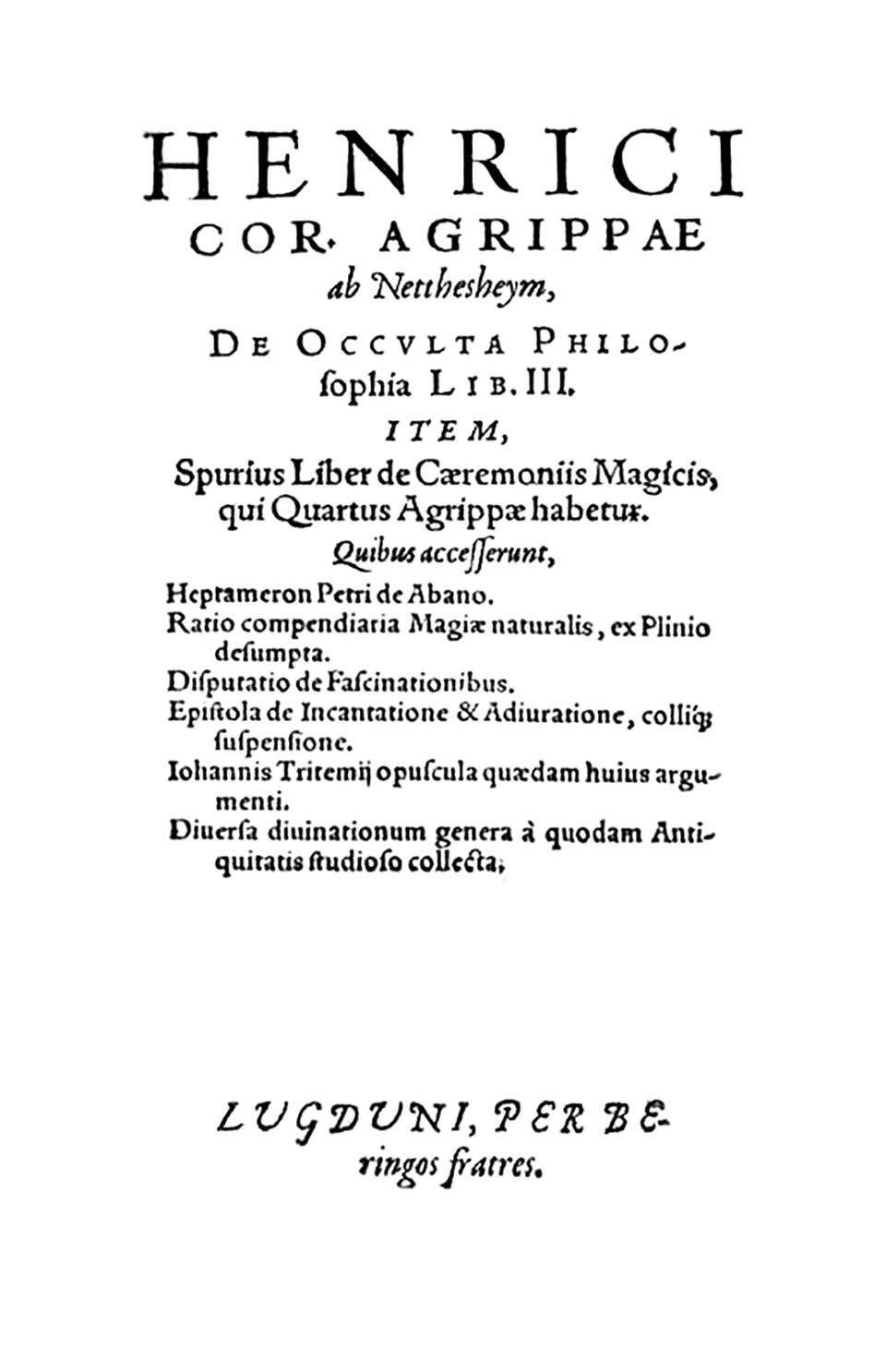
The title leaf reproduced below belongs to a still later compendium and illustrates the endurance of that packaging strategy. It is not the 1533 Cologne title page. The authentic 1533 print announces three books; the 1567 record qualifies the appended ceremonial text; the 1655 translation gathers it with several companions; and later reprints preserve the bundle. Those witnesses show a disputed text becoming commercially and conceptually attached to Agrippa while retaining an internal structure of its own.
Source records
- University Library Freiburg, Cologne 1533 print (B 613) ↗
- 1651 translation, Book III chapter index ↗
- Bibliothèque nationale de France, 1567 collection with the Fourth Book “ascribed” to Agrippa ↗
- Library of Congress, Turner’s 1655 collected volume ↗
- Wellcome Collection, 1655 Fourth Book catalogue ↗
- 1655 Turner volume, page scan and public-domain transcription ↗
- 1655 “Of Occult Philosophy, or Of Magical Ceremonies” text ↗
- Wikimedia Commons, public-domain later compendium title leaf ↗