DEITY WORK · RETURN · SOVEREIGNTY
Working With Persephone: Seed, Crown, and Returning Earth
Persephone is not merely spring arriving on schedule. Her oldest long narrative holds seizure, testimony, a mother's devastating refusal, a seed forced between worlds, and a queen whose return never makes the underworld cease to be hers.

STAR & SIGIL
Carry the crown through descent and return
Enter a shadow working where absence, hidden power, seasonal change, and the terms of return reveal what hardship has made sovereign.
Descend with the seed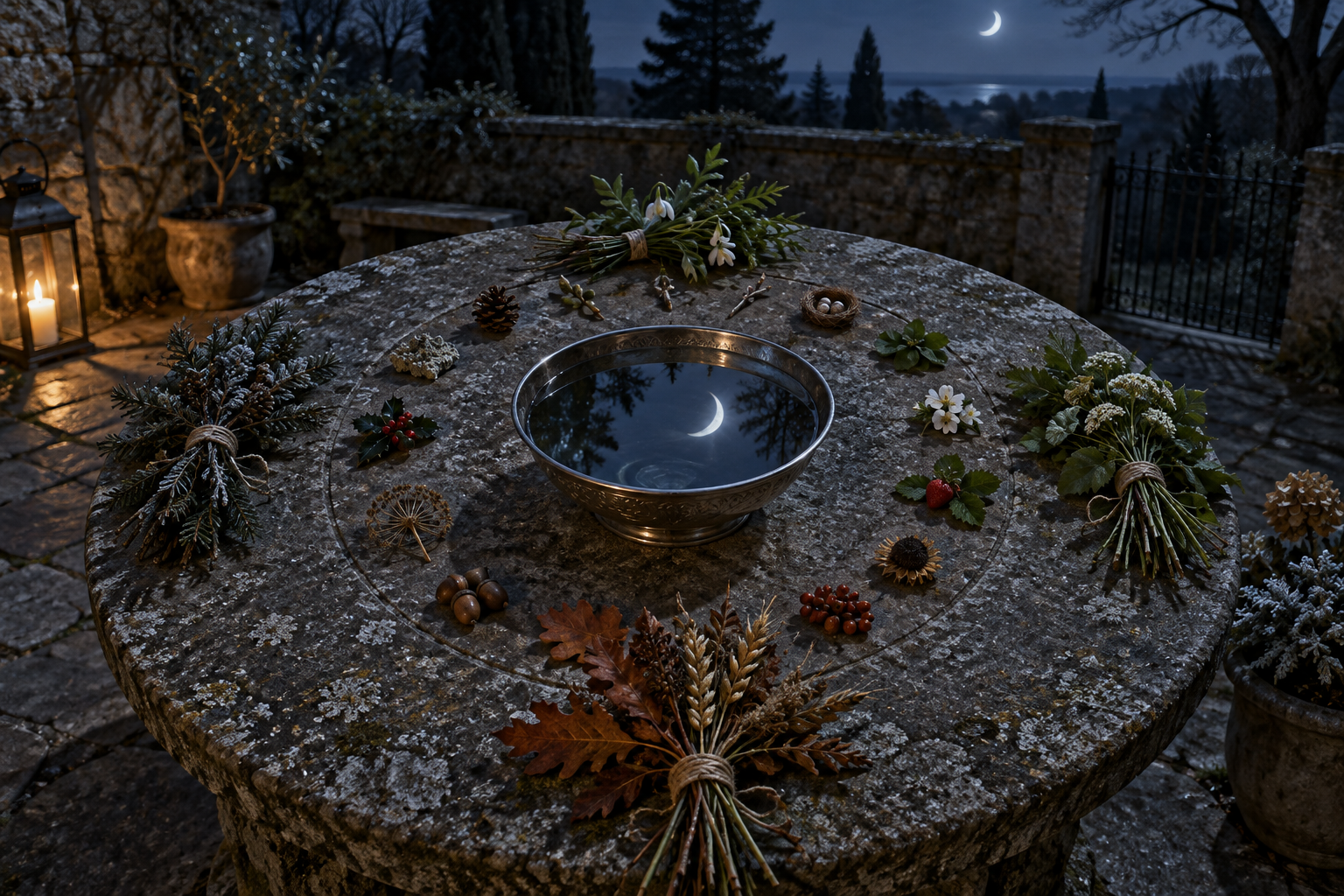
A seed can be a promise, a capture, a future harvest, or evidence that a boundary has already been crossed. Put a crown beside it and the reading changes again. Working with Persephone begins in that refusal to let one beautiful symbol tell the whole story.
The long ancient narrative most readers meet first, the Homeric Hymn to Demeter, does not describe a willing seasonal retreat. Persephone is seized with Zeus's permission; in her own account, Hades forces the pomegranate seed upon her. Demeter answers not with private sorrow alone but with a famine that places divine government under pressure. Return is negotiated because the earth itself has stopped consenting to business as usual.
Persephone therefore holds two truths that devotional shorthand often separates: she is the daughter who tells what was done to her, and she becomes an honored power of the realm below. Sovereignty need not turn coercion into consent. Return need not mean that nothing changed.
01 / THE POEM'S WEATHER
The season turns because Demeter makes absence govern the world
The hymn opens in a meadow engineered as a trap. Earth produces the narcissus at Zeus's design; the ground opens; Hades carries Persephone below while her cry travels upward. Demeter searches, withdraws from Olympus, and conceals seed in the ground. Plows cross fields that cannot answer. Mortals face destruction, while the gods face the loss of sacrifice and honor.
This is not a decorative myth of leaves changing color. Demeter uses fertility as jurisdiction. Nothing grows until the divine order acknowledges the missing daughter. A practitioner who reads only “death and rebirth” misses the poem's sharper claim: grief becomes leverage when the world has depended upon the grieving person's labor.
Nor does the hymn reduce Persephone to agricultural produce. Hermes finds her beside Hades, and she springs up with joy at the command to return. When Demeter asks what happened, Persephone gives a long first-person account. She is witness as well as symbol—the person who names the trick, the force, the companions, and the exact road beneath the earth.
02 / FOUR OFFICES, NOT ONE MOOD
Maiden, daughter, returning power, underworld queen
A durable practice does not force every image into “transformation.” It asks which Persephonean office is actually being addressed.
| Image | What the hymn or witness carries | A modern devotional question | What it cannot prove |
|---|---|---|---|
| The meadow | Beauty, companions, distraction, and an ambush authorized elsewhere. | What invitation hides terms decided without me? | That every flower is Persephone's personal request. |
| The seed | A forced taste that establishes recurring obligation between realms. | What small consent is being treated as a permanent claim? | That coercion becomes sacred because its consequence lasts. |
| The reunion | Joy, testimony, maternal recognition, and negotiated time above. | Who can hear the whole account without editing it into comfort? | That returning restores the person who left unchanged. |
| The throne | Later visual traditions show Persephone enthroned within the underworld. | What authority exists in the place others call only loss? | That one modern altar recreates an ancient mystery rite. |
The symbols deepen when they disagree. A seed can mark continuity while still recording force.
03 / RETURN IS NOT A WEATHER APP
The goddess does not move on one universal modern calendar
The hymn divides Persephone's time, but surviving tellings do not all give the same fraction, and modern summaries often map the underworld portion automatically onto a northern winter. That tidy chart can obscure the Mediterranean setting, where rain and grain do not behave like a New England garden. It also fails immediately for a devotee in the Southern Hemisphere.
Seasonal devotion becomes more exact when it notices actual conditions: the first hardening seed, the local dormant interval, the rain that wakes growth, the harvest whose abundance depends upon a buried beginning. These observations do not reconstruct Eleusis. They let a contemporary relationship speak honestly from its own ground.
The Great Eleusinian Relief offers another correction to the solitary “dark goddess” portrait. Demeter and Persephone flank Triptolemos in an image tied to grain and its transmission. Mother and daughter are not interchangeable, yet their powers meet in a public consequence: mortals eat because divine rupture has reached an arrangement.
CASE FILE THE WINTER HOUSE
The greenhouse Persephone never forbade
Suppose a cemetery horticulturist receives a rare residency, a frightening divination, and seven days in which everyone else seems certain what the goddess wants.
Maris has spent twelve years tending shade beds and heritage bulbs in a crowded city cemetery. A conservatory offers her its once-in-a-lifetime winter residency: sole use of a disused glasshouse, a stipend, and authority to establish a seed collection under her own name. Her mother, Celia, who taught her to garden, hears only the distance and asks why a daughter devoted to Persephone would choose to leave just as the earth goes quiet.
The mother
Celia's love is real. It does not make proximity a divine law.
The black seed
Maris reads dormancy as preparation; her diviner reads it as refusal.
The glasshouse key
The offer grants a domain, not an escape from relationship.
The train north
A seasonal departure has a stated date of return.
THE PROPHECY
Maris asks a respected diviner whether Persephone accepts the residency. Three bone throws are interpreted as a closed gate, a buried seed, and a grieving mother. The verdict is delivered as command: decline, remain, and prove devotion by staying near Celia. Maris obeys before asking whether each sign has only one office.
04 / A GODDESS IS NOT SOMEBODY ELSE'S VETO
Devotion can sharpen choice without confiscating it
Maris's mistake is not taking divination seriously. It is treating interpretation as irreversible jurisdiction. A closed gate may be warning, timing, another route, or simply the reader's frame. A buried seed may be refusal—or the living beginning of the work. Demeter's grief deserves witness, but in the hymn a mother's pain changes divine policy; it does not erase Persephone's testimony.
Once the reading has begun issuing orders in the goddess's name, Maris has an exact magical problem. She can cast Unwritten by Prophecy to become someone no prophecy can bind or command. That spell does not require her to mock the bones or abandon Persephone. It removes the coercive status of the verdict so devotion and decision can meet without pretending to be the same voice.
Persephonean agency is not the fantasy that every circumstance was chosen. It is the capacity to testify about constraint, occupy power without beautifying the harm that preceded it, and cross a threshold as a person rather than as somebody's symbol.
05 / SEED, CROWN, WITNESS
Modern symbols need declared offices
Seeds are compelling in contemporary Persephone devotion because they hold two opposed appearances: burial and stored life. Yet the pomegranate seed in the hymn is not a neutral emblem of empowerment. Persephone says it was forced upon her. A modern devotee can honor return through seed imagery while refusing to turn coerced eating into a romantic initiation.
The crown makes a different claim. South Italian underworld imagery can show Persephone enthroned beside Hades, not merely being carried toward him. In modern practice, a crown may therefore name jurisdiction below, the authority of one who knows the route between populations of living and dead. It cannot by itself tell us what historical initiates did behind Eleusinian doors.
Flowers retain the meadow's doubleness: companionship and trap, delight and engineered lure. A torch can recall search, procession, revelation, or passage. None has a single automatic meaning. A devotee's task is to say whether an object addresses daughter, witness, seasonal returner, or underworld queen—and not demand that one offering flatter all four.
Where does the image occur?
Poem, vase, relief, later retelling, and modern altar are different witnesses.
Who is being addressed?
Kore, daughter, returning goddess, and queen emphasize different relations.
What does the symbol assert?
A seed may hold return without declaring the descent voluntary.
What remains unknown?
Secrecy is not an empty space modern confidence gets to fill.
06 / THE ROAD REOPENS
Return is an altered arrangement, not a rewind
The residency does not come back because Maris discovers the “correct” reading of every bone. It returns because she calls the chair, explains that she declined under a spiritual command she no longer accepts, and asks whether the appointment is truly gone. The practical call matters. Magic concerns the vanished chance precisely because a human road has reopened enough to carry it.
The glasshouse offer was a once-in-a-lifetime opportunity with Maris’s name on it, lost when coercive prophecy made refusal seem inevitable. She can cast Recall the Vanished Chance to call that singular opening back, then meet its return as the future she deliberately chooses rather than as proof that every rejected invitation deserves revival.
Celia remains afraid. Maris remains her daughter. Their relationship changes from “stay to prove love” into a season with departure, visits, calls, and a named return. That is a more demanding mother-daughter reading of Persephone than permanent closeness: absence is admitted, attachment survives it, and neither woman has to disguise her desire as the goddess's decree.
07 / A RELATIONSHIP WITH MORE THAN ONE DEPTH
Working with Persephone means letting the witnesses remain plural
The hymn gives a coerced seed, a daughter's testimony, a mother's world-altering grief, divine negotiation, renewed fertility, and rites whose details it does not hand to modern readers. Visual witnesses can add the enthroned queen and the paired goddesses of grain. Contemporary devotees add their own calendars, objects, vows, and experiences. The layers can speak without masquerading as one uninterrupted manual.
A serious relationship with Persephone may concern descent, but it must also concern who authorized it. It may concern return, but also the terms under which return becomes possible. It may concern sovereignty, but never as an excuse to rename seizure as secret consent. And it may concern seeds—not because every buried thing rises, but because living potential can remain itself while the surface shows nothing.
The crown belongs beside the testimony
Maris enters the glasshouse in the month when its panes hold the least daylight. She does not call that darkness failure. Neither does she pretend the forced refusal was a blessing in disguise. She labels the first seed trays with their dormancy needs, calls her mother after the work, and keeps the return ticket where both can see its date.
That is the demanding beauty of working with Persephone: the road below can become a realm without making the taking right, and the road home can reopen without making the traveler small again.