NIGHT FOLKLORE · CLOCKS · LIMINAL TIME
Witching Hour Meaning: Midnight, 3 A.M., and the Clock That Frightens Us
Midnight owns the phrase in literature; 3 a.m. owns it online. Between them lies a stranger history of bells, watches, cockcrow, broken sleep, and the human urge to give darkness an appointment.

STAR & SIGIL
Keep the night strange without making it a threat
A covered clock, complete record, and daylight folklore audit leave room for mystery while protecting sleep and judgment.
Open the night folklore audit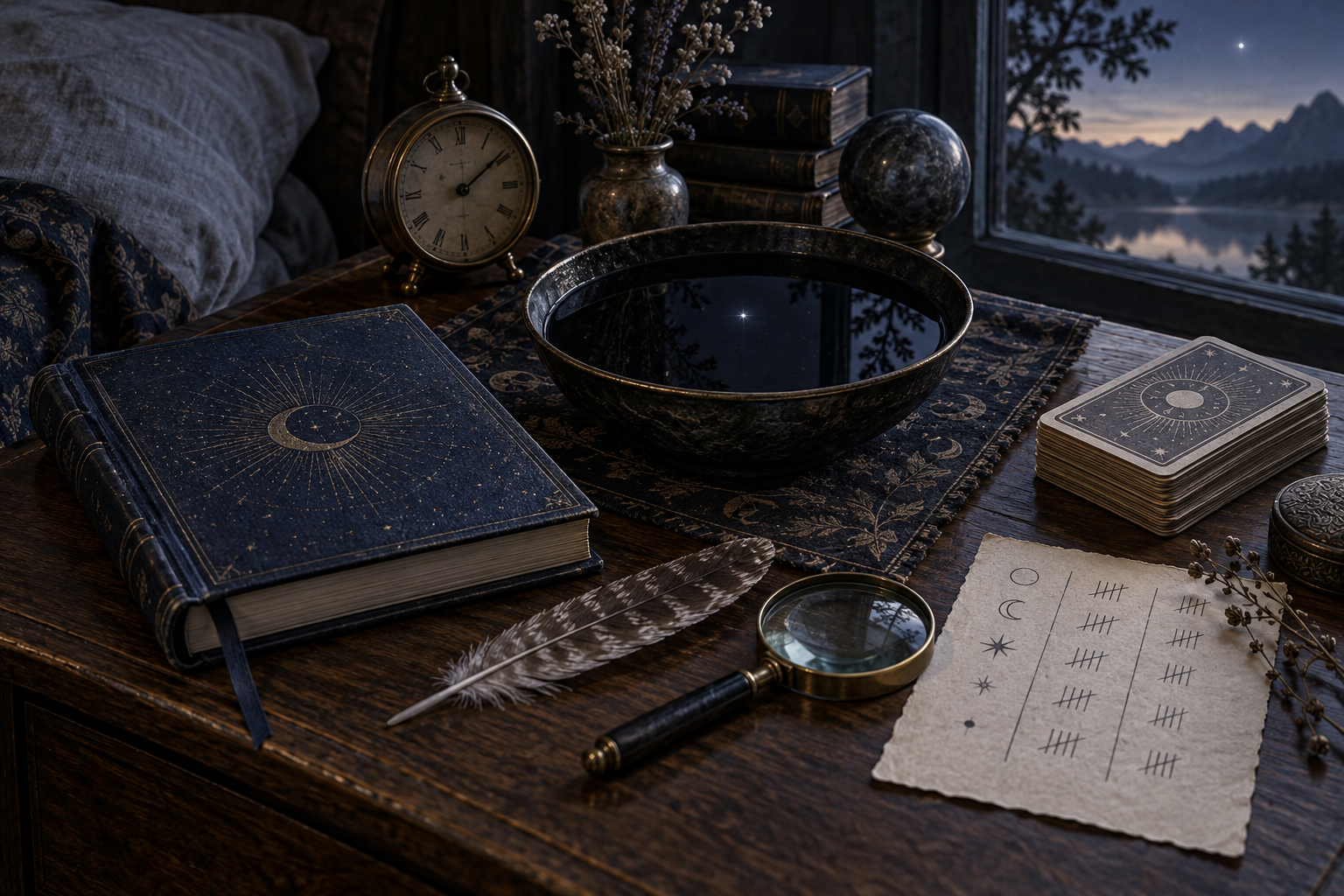
The witching hour is not one internationally agreed appointment with the supernatural. It is a name laid over several kinds of night: midnight as a calendrical hinge, the late watch when a household has gone quiet, the pre-dawn interval when sleep becomes porous, and the modern horror convention of 3 a.m. Each clock tells a different story.
That distinction matters because a precise number can make a legend look older and more unanimous than it is. Midnight has deep literary force because it divides dates and can be announced by twelve bells. Three in the morning has contemporary force because a glowing digital clock makes the instant visible beside the bed. Neither observation establishes a universal law of spirits.
“Witching hour” changes meaning when the timekeeper changes
Before cheap personal clocks, darkness could be organized by sunset, church bells, watches, household tasks, prayer offices, moonlight, or cockcrow. “The middle of the night” was experiential as well as numerical. A winter midnight and a summer midnight occupied very different proportions of darkness, while a watchman’s third watch described an office and interval rather than a luminous bedside digit.
| Night clock | What makes it liminal | What it cannot prove |
|---|---|---|
| Midnight | A date turns; bells dramatize a hinge | That every tradition assigns spirits to 12:00 |
| 3 a.m. | Deep night, digital precision, horror repetition | An ancient worldwide “devil’s hour” doctrine |
| Watch hour | Few witnesses remain awake; custody changes | A fixed modern clock equivalent everywhere |
| Cockcrow / dawn | Darkness loosens and ordinary labor returns | That all nocturnal powers obey one sunrise |
The phrase therefore names a social vacancy as often as a supernatural peak. Most people are unavailable; doors are closed; ordinary witnesses sleep. A sound acquires unusual scale. The refrigerator’s cycle becomes an event, a passing car paints a moving shape on the ceiling, and one wakeful mind temporarily holds the whole house.
Twelve strokes give narrative suspense a body
Shakespeare’s Hamlet calls night’s dangerous intensity a “witching time,” while the play’s ghost belongs to the watched platform, secrecy, and the approach of cockcrow. Later Gothic writing and popular poetry repeatedly recruited midnight because a striking clock can interrupt a room. The audience hears time arrive. Twelve counted sounds prolong anticipation in a way that “sometime after sleeping” cannot.
Literature does more than reflect folklore; it manufactures memorable folklore. A phrase passes from stage to quotation book, newspaper, novel, film, and caption until repetition begins to resemble inheritance. That does not make the image false. It means its authority is aesthetic and cultural rather than a census of what every village believed.
Midnight’s promise is compression: the old date has ended, the new one has barely begun, and an impossible amount might fit in the gap. Working The Midnight Theft of Mastery makes that fantasy extravagant and literal by granting in one night an art, science, or craft that once demanded a lifetime. The night’s supposed emptiness is made to carry years of disciplined time.
The body supplies intensity; the screen supplies a timestamp
The popular 3 a.m. claim often arrives with confident explanations—an inversion of a sacred hour, a maximum of hostile activity, a scheduled opening. Those claims are repeated much more readily than they are sourced. The exact time varies, sometimes becoming 3:03, 3:15, or the whole hour. A universal supernatural rendezvous also sits awkwardly beside time zones, daylight-saving shifts, latitude, seasonal night length, and societies that divided nighttime differently.
Yet the feeling does not require invention. In the small hours, many sleepers encounter a vulnerable border between sleep and waking. Dreams can remain vivid; temporary paralysis can include a sensed presence; darkness reduces visual information; a stressed mind may become alert before the household does. Circadian regulation and sleep architecture create changing conditions across the night, but they do not nominate a demonic minute.
The digital clock completes the enchantment. A person frightened at 3:07 remembers the culturally charged three and may forget undramatic awakenings at 1:42 or 4:26. Online stories then teach the next sleeper what to notice: a pet staring, a device blinking, pipes knocking, a shadow at the door. Expectation does not make the experience unreal. It edits which details become evidence.
“A frightening hour becomes persuasive when the body supplies ambiguity and the clock supplies a name.”
Suppose the apartment wakes at 3:13
Suppose Mara wakes three times in one week and sees 3:13 on her phone. On the third night, she hears two knocks inside the wall and glimpses a figure-shaped darkness beside the wardrobe. A video watched that evening called 3:13 an invitation hour. By breakfast, three separate events have fused into one story: the number summoned the figure, and the knocks confirmed it.
The scene changes when each clock is allowed to speak. The building clock reveals heating pipes cycling shortly after 3:00. The body clock reveals that the dark figure appeared while Mara could not immediately move and dissolved as wakefulness returned. The media clock supplied “invitation hour” before the event. The household clock shows her flatmate starting an early shift at 3:30, adding light and movement in the corridor.
None of those observations orders Mara to abandon occult meaning. They prevent one label from swallowing the event. She may still regard the small hours as spiritually resonant, but she no longer treats recurrence of a number as a command to investigate while frightened and half awake. The unexplained remainder stays a remainder rather than graduating automatically into an entity.
First description
“A presence came at the invitation hour.” The conclusion arrives before the details.
Separated description
Three awakenings, pipe sounds, one paralysis-like episode, corridor light, and prior horror media.
Ritual interpretation
The hour may symbolize solitude or threshold without diagnosing the cause of every sensation.
Darkness changes attention before it changes reality
Deliberate night practice can be potent without pretending that midnight itself guarantees an encounter. Fewer demands compete for attention. A candle or mirror dominates the visual field. Silence magnifies a whispered name. Fatigue may loosen ordinary categories, which can aid imaginative work and also weaken judgment. The practitioner’s task is to know which effect is being sought.
A threshold working asks a different question from a fear test. A threshold working chooses an office for the hour: mourning, divination, writing, vigil, secrecy, or ending. A fear test trawls the dark for proof that the legend is dangerous. The first can close with meaning intact; the second tends to make every unaccounted sound demand another night of surveillance.
Mirrors make this distinction especially sharp. If the night’s purpose is passage rather than diagnosis, work with The Black Glass Passage to give the threshold an extraordinary destination: through one mirror and out through another across the world. That is an enacted crossing, not an instruction to mistake an uncertain reflection for a visitor.
Ask which witching hour, whose night, and what kind of claim
For literary history, midnight is the strongest answer. For contemporary paranormal media, 3 a.m. is the dominant branded number. For older lived nights, watches, bells, seasonal darkness, and cockcrow often matter more than a fixed minute. For sleep experience, the important event may be an awakening whose intensity comes from physiology, environment, expectation, and personal meaning at once.
Night-shift workers expose the limits of a universal clock. At 3 a.m. one person is alone in bed, another is taking lunch beneath fluorescent lights, another is caring for an infant, and another is ending a vigil. Liminality is partly astronomical, partly social, and partly assigned.
The witching hour survives because it answers a durable desire: to believe there is a time when ordinary arrangements loosen. Its richest meaning is not “danger begins at this digit.” It is that time can feel inhabited—by story, bodily rhythm, historical habit, and chosen intention—before dawn restores the usual names of things.