SYMBOL · CONTEXT · ACTION
Witchcraft Symbols and Meanings: Context Before Certainty
A mark does not arrive with one eternal definition. Its history, neighbors, maker, material, and ritual verb decide what it can mean here.

STAR & SIGIL
Do not borrow a symbol until you can read its grammar
The line is only the visible edge of a system. Deepen the method with a cataloged study working focused on taking one complete lesson without flattening its source.
Open the symbol-study handoff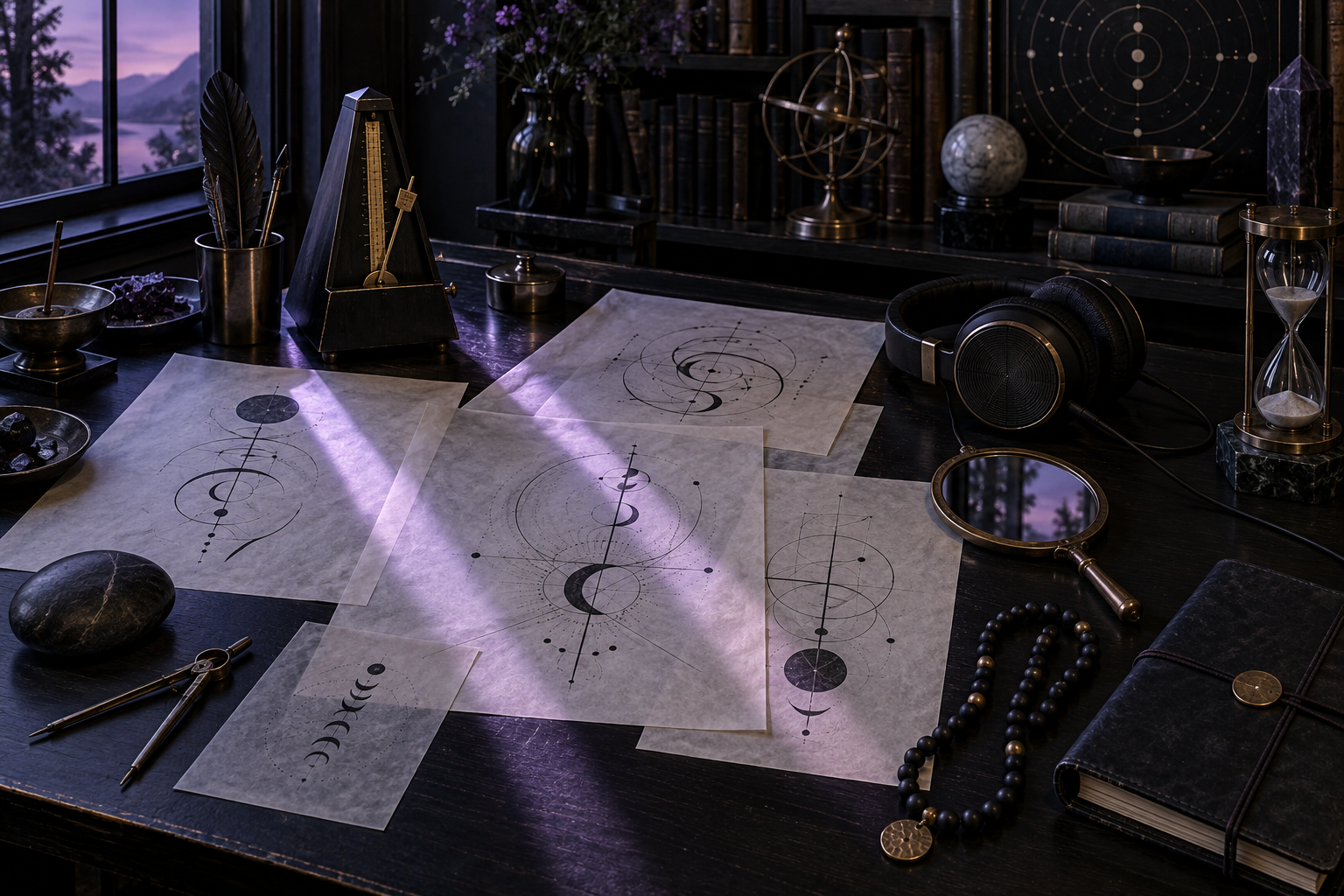
A five-pointed star is scratched beneath a windowsill. Online charts offer protection, spirit, elements, danger, and identity as though the mark were a word with one dictionary entry. But the window faces inward, one point is broken, soot fills the lower lines, and the householder says it was copied from a pendant. Before meaning appears, the mark has already accumulated a maker, place, material, orientation, history, and act.
Witchcraft symbols do not carry universal definitions independently of use. A circle may bound, gather, display completeness, identify a community, or simply frame another figure. A key can signify access in an illustration, provide a physical link to a door, or become an offering within a devotional relationship. The responsible question is not “What does this symbol mean?” but “What permits it to mean that in this setting?”
✦A symbol is not a suitcase packed once for every journey. It is a relationship among shape, history, placement, action, and reader.
01 / BEGIN WITH PROVENANCE
The same shape can belong to different symbolic languages
Start by locating the object. Is it printed in a modern manual, drawn in a manuscript, worn as jewelry, carved into a building, posted as a digital emblem, or made for one rite? Date and community narrow the field. A triangle in an alchemical diagram participates in a different grammar from a triangle on a contemporary elemental altar, even when later readers connect them.
Similarity is evidence for comparison, not proof of identity. Simple forms recur because bodies and tools readily make them. Circles, crosses, spirals, grids, and stars can emerge independently. Claims that every spiral means goddess, every eye means protection, or every knot descends from one ancient code flatten distinct cultures into decoration.
Names also travel. “Pentacle” may mean a pentagram within a circle in popular usage, a broader class of talismanic figures in ceremonial sources, or the earth suit in tarot. Before correcting another reader, determine which vocabulary is active.
02 / READ THE SYMBOLIC SENTENCE
Neighbors and verbs turn an image into an operation
Do not isolate the most recognizable mark. Read center, boundary, direction, labels, repetitions, omissions, and sequence. A name enclosed by a circle differs from a name written across an opening. A line drawn before a petition may establish a limit; the same line cut afterward may cancel or release. Geometry organizes relations before it illustrates ideas.
Memory shows why context matters. A warning sign noticed during infatuation, dismissed, and recalled after the bond changes is not merely an abstract icon. Remember Every Warning Love Concealed gives that history an exact operation: make a chosen person remember every warning they ignored while enchanted by love. Let the remembered signs regain their warning force by performing the spell after enchantment has made caution illegible; their meaning remains rooted in that particular emotional history.
Translate each component into a verb. The boundary contains. The arrow directs. The knot joins or restricts. The repeated name sustains attention. The erased word removes access. If no verb can be named, the component may identify, decorate, authenticate, or remain unexplained. Uncertainty is a better reading than an invented universal correspondence.
SYMBOL FILE ✧ THE CROSSED KEY
One image, four possible readings
A notebook shows a key crossed by a dark line beside a person’s initials.
No legend survives. The surrounding entries concern a locked cabinet, a broken friendship, a threshold rite, and household expenses.
Literal record
The mark may note that the cabinet key no longer works.
Denied access
Initials can connect the crossed key to a revoked invitation.
Closed threshold
Placement beside the rite may mark a boundary as sealed.
Cancelled purchase
The nearby expense list permits an ordinary explanation.
VERDICT The page supports several readings. Confidence should follow contextual evidence, not the drama of the preferred interpretation.
03 / MATERIAL IS PART OF MEANING
Ink, thread, metal, smoke, and screen do different work
A symbol drawn in washable chalk can be temporary by design. The same form engraved in metal claims endurance; stitched into clothing, it moves with a body; placed under glass, it becomes visible but untouchable. Material is not a neutral carrier. It sets duration, portability, reversibility, and the kinds of action available.
Scale and visibility matter too. A public emblem creates identity and recognition. A concealed mark may protect privacy, restrict access, or concentrate significance for one maker. Digital repetition can detach an image from its original caption while giving it new communal meanings. A screenshot preserves appearance while losing sequence and source.
04 / BUILD A GLOSSARY THAT ADMITS CHANGE
Record meanings locally before comparing them broadly
A useful glossary has more than two columns. Record the mark, source, approximate date, community or author, material, placement, nearby words, action, and stated meaning. Add a final column for inference. This prevents an editor’s explanation, a practitioner’s testimony, and a modern guess from collapsing into one voice.
When traditions disagree, preserve the disagreement. An upright triangle may be fire in one modern elemental chart, an abstract geometric compartment elsewhere, and meaningless without labels in another work. The goal is not a master key for every symbol. It is a map showing where particular keys fit.
Claims about forbidden knowledge especially tempt universalization. The Forbidden Truth Returned gives that universal claim its full scale by seeking to restore a forbidden truth to every mind from which it was erased. Undertake that restoration only where collective erasure is truly the wound; even then, perform the spell within its local grammar rather than turning its signs into timeless emblems of truth.
05 / NOTICE WHO CONTROLS THE LEGEND
Interpretation is also a form of authority
The person who supplies the meaning can control the action that follows. A leader who alone interprets marks can turn ambiguity into obedience. A seller can invent alarming definitions and then charge to remove them. A community can reclaim a hostile symbol, while outsiders continue reading only the older insult.
Ask who may revise the glossary and how disagreement is handled. Private symbolism is legitimate, but it should be named as private rather than presented as ancient law. Initiatory meanings may be restricted, yet restriction is not evidence that any online guess is correct. “Unknown outside this context” is a complete and responsible conclusion.
06 / TEST A READING
The strongest interpretation explains more than the shape
A good reading accounts for the whole arrangement with few unsupported assumptions. It explains why the mark is here, why it uses this material, how it relates to neighboring elements, and what changes when the operation is complete. A weak reading recognizes a familiar silhouette and ignores everything inconvenient around it.
Test alternatives. If the symbol were inverted, erased, moved outside the boundary, or made permanent, would the proposed meaning change? If not, the interpretation may be too vague to explain the design. Contrast also reveals when a supposedly essential feature is merely decorative.
Symbols remain powerful without becoming universal code. Their power may lie precisely in their ability to condense a local history, agreement, warning, or ritual action into a form that trained participants can recognize. Context does not drain mystery. It gives mystery a place to happen.
07 / ORIENTATION IS NOT DECORATION
Turning a figure changes the relations it proposes
Orientation attracts dramatic claims, especially when a familiar figure appears inverted. Yet “up” may be determined by the page, wearer, viewer, altar, or direction of ritual movement. A pendant rotates on the body. A manuscript may have been rebound. A photograph can be mirrored. Establish the intended viewing position before treating inversion as deliberate.
When orientation is deliberate, describe the changed relationship rather than reaching immediately for moral labels. A point turned downward may redirect attention, reverse a hierarchy, mark descent, or distinguish one group’s emblem. Which reading is strongest depends on accompanying text and practice. “Inverted means evil” is rarely analysis; it is usually a story imported from elsewhere.
Direction can also encode sequence. Clockwise and counterclockwise movement acquire different associations across communities, but a diagram’s arrows may simply show assembly order. North can indicate geography rather than element. Ask whether direction identifies, values, moves, or transforms before assigning meaning.
08 / RECOGNIZE REUSE AND RECLAMATION
A symbol can keep its history while gaining a new social life
Communities borrow, reject, parody, conceal, and reclaim signs. A hostile label may become solidarity. An old religious emblem may enter occult art with altered theology. A printer’s ornament can later be read as magical. History does not freeze a symbol at its earliest use, but later use should not be projected backward as original meaning.
Power shapes reuse. Taking a restricted ceremonial or Indigenous sign as free-floating aesthetic material differs from adapting common geometry. Ask who names the symbol, who may interpret it, whether the source community describes limits, and what disappears when the mark is detached from language and relationship. Sometimes the responsible choice is not reproduction.
Reclamation has boundaries. A practitioner may reclaim a sign for themselves without granting outsiders permission to deploy it casually. Meaning is therefore social as well as semantic: who addresses whom, under which history, with what consequences.
09 / KEEP A READING LEDGER
Confidence should be visible, revisable, and earned
When a mark matters, preserve the observation before polishing the interpretation. Sketch its exact orientation, note dimensions and damage, record what stood beside it, and separate what the maker said from what an observer inferred. A dated photograph can retain placement, but it cannot preserve the order in which gestures were made or explain whether a stain preceded the design. Those absences belong in the record too.
Then grade the reading. “Stated” means the source names the sign’s purpose. “Corroborated” means repeated examples in the same body of practice support it. “Plausible” means material and context fit, though no explanation survives. “Speculative” marks a useful possibility with weak evidence. These labels keep an attractive theory from quietly hardening into fact, and they let a later discovery improve the account without embarrassment.
Imagine finding three chalk crescents beside a cellar door. The household journal calls that doorway “the cool store,” a later family member remembers a moon blessing, and the crescents point toward a hinge worn by repeated use. Storage notation, household devotion, and protective threshold work all remain possible. The ledger does not force a winner; it shows exactly why each reading stands where it does. That disciplined openness is not failure. It is the difference between interpreting evidence and recruiting a mysterious shape to confirm a story already chosen.