MINERAL · SYMBOL · RITUAL OFFICE
Witchcraft Crystals List: A Mineral Cabinet of Forces
A useful crystal cabinet does not alphabetize vague virtues. It distinguishes quartz from glass, glitter from gold, treatment from deception, and the material fact from the magical action built upon it.

STAR & SIGIL
Read the hidden geometry of stone
Build a mineral vocabulary from structure, color, weight, and repeated use before assigning each crystal its place in the chamber.
Study the mineral cabinet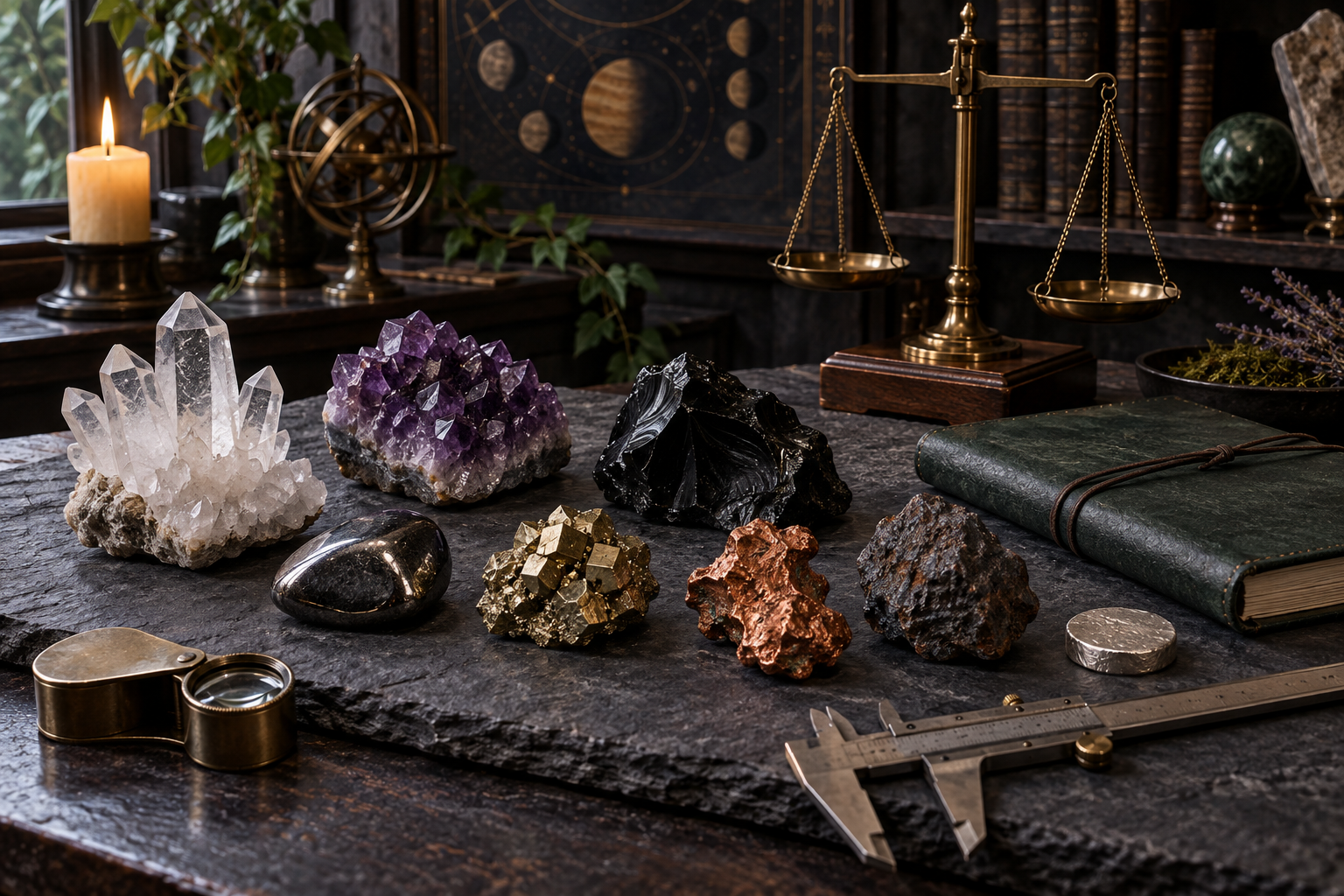
The yellow cluster in drawer twelve is labeled citrine. The sharp black shard beside it is labeled crystal. The brass-bright cube below them is labeled gold stone. None of those names is innocent. One identifies a quartz variety, one stretches a magical retail category around volcanic glass, and one mistakes resemblance for substance.
A witchcraft crystals list becomes useful when it keeps material identity and magical office in the same cabinet without confusing them. Mineral species, structure, color, treatment, locality, cut, and use all shape how a stone enters ritual imagination. They do not scientifically establish a supernatural effect.
The occultist’s question is therefore not merely “What does this crystal mean?” It is: what is this material, what quality has caught the imagination, what action is being asked of it, and does the chosen symbolism survive honest identification?
01 / THE CABINET
Organize by ritual action, then name the material exactly
A generic list gives amethyst “peace,” citrine “money,” obsidian “protection,” and clear quartz “amplification.” A working cabinet asks what action those words conceal. Does peace mean quieting attention, ending conflict, or holding a boundary? Does money mean opportunity, retention, circulation, or profit? Different offices demand different symbolic arguments.
Quartz supplies clarity, color variation, visible inclusions, and durable crystalline form. Obsidian supplies fracture, darkness, reflection, and a history of rapid volcanic cooling—but it is glass, not a crystal. Pyrite supplies metallic luster and geometric habit while remaining iron sulfide rather than gold. Malachite supplies banded green copper mineral imagery that can suggest growth, warning, or concentrated possession.
SIX OFFICES IN THE CABINET
Clear quartz
Transparency and inclusions make attention, amplification, and distortion visible together.
Amethyst and citrine
Related quartz colors and common heat treatment complicate every simple story of fixed essence.
Obsidian
Volcanic glass can be polished into a dark reflective field; it belongs here by magical use, not mineral class.
Pyrite
Brassy metallic luster resembles gold while crystal habit insists on a different identity.
Schorl
Black tourmaline’s striated, dense-looking form supports modern boundary symbolism.
Malachite
Green bands and copper content make possession, circulation, and guarded value legible themes.
ILLUSTRATIVE CASE DRAWER TWELVE
An inherited cabinet contains three false labels and one honest transformation
Suppose Jo inherits a lapidary teacher’s traveling cabinet. The labels were written over forty years by different hands. She must decide which names describe minerals, which describe trade treatments, and which describe ritual jobs.
Jo assumes heated citrine is spiritually counterfeit, obsidian is a black crystal, and pyrite is valuable because it contains sleeping gold. The cabinet appears to rank natural purity above human alteration.
Citrine
Yellow-to-orange quartz; much commercial citrine is heat-treated amethyst.
Obsidian
Volcanic glass whose magical category is broader than its geological identity.
Pyrite
Iron sulfide whose gold resemblance invites symbolic comparison, not chemical equivalence.
The turn
Treatment is not fraud when disclosed; the dishonest act was the cabinet’s erased history.
THE CABINET REOPENS
Jo keeps the heated citrine and relabels it accurately. Its magical office becomes transformation through heat rather than imaginary untouched abundance. Correct identity expands the story instead of impoverishing it.
02 / SEMBLANCE AND SUBSTANCE
Pyrite teaches the difference between resemblance and result
Pyrite’s brassy yellow metallic luster invites the name “fool’s gold,” but its cubes and other crystal forms are not failed attempts to become gold. In magic, resemblance can be an intentional bridge without becoming a geological claim.
When resemblance is not enough and literal transmutation is the aim, Jo can cast The Gold Sleeping in Stone to change common stone into enduring gold. The spell makes the impossible result explicit; the pyrite specimen remains valuable as pyrite rather than being praised for a substance it does not contain.
03 / THE GLASS AMONG CRYSTALS
Obsidian belongs by use without pretending to be a mineral crystal
Obsidian forms when silica-rich lava cools rapidly enough to become volcanic glass. Its conchoidal fracture can create keen edges; polished surfaces can become dark mirrors. Contemporary crystal practice often includes it because the category is devotional and commercial as well as geological.
The cabinet inventory names a polished obsidian disk, but its slot is empty. Jo learns that her cousin concealed that disk immediately before disputing the inheritance; she can cast The Hidden Object Brought Forth and make him bring her the object he most recently hid. Its return restores a specific missing specimen. It does not make every gap in an old cabinet proof of theft.
04 / COLOR IS A CLUE, NOT AN IDENTITY
Purple quartz and green copper mineral carry different kinds of evidence
Color names are seductive shortcuts. Purple does not make every specimen amethyst; green does not make every banded stone malachite. Dye, coating, light, matrix, and trade naming can all complicate what the eye thinks it recognizes.
Magical symbolism can still begin with color, but it should not end there. Malachite’s green bands may support growth or money symbolism; its copper mineral identity and distinctive pattern also evoke concentration, movement, and custody. Amethyst’s purple belongs to quartz whose color history may include irradiation and heat.
05 / THE WORKING LIST
A serious entry records identity and office separately
| Material | Material fact | Symbolic action | Question that keeps it exact |
|---|---|---|---|
| Clear quartz | Quartz, transparent to included | Focus, disclose, magnify | What exactly is being made louder? |
| Amethyst | Purple quartz | Temper, clarify, transform | Is calm, sobriety, or altered perception meant? |
| Citrine | Yellow-orange quartz; treatment common | Warm, circulate, increase | Is the goal opportunity, revenue, or confidence? |
| Pyrite | Iron sulfide with metallic luster | Simulate, structure, attract attention | Is resemblance a bridge or being mistaken for result? |
| Obsidian | Volcanic glass | Reflect, cut, reveal silhouette | Is the work mirroring, severance, or concealment? |
| Schorl | Black tourmaline-group mineral | Mark boundary, endure, bar passage | What named force is the boundary meant to stop? |