PLACE · MEMORY · PRACTICE
What Is Folk Magic? Knowledge That Belongs Somewhere
Folk magic is not one old religion or a basket of rustic tricks. It is practical sacred knowledge made local—and altered whenever people, prayers, and problems cross a border.

STAR & SIGIL
Begin where your own ground keeps its secrets
Step into practice through local observation and honest inheritance, without dressing borrowed fragments as a universal tradition.
Open the first local working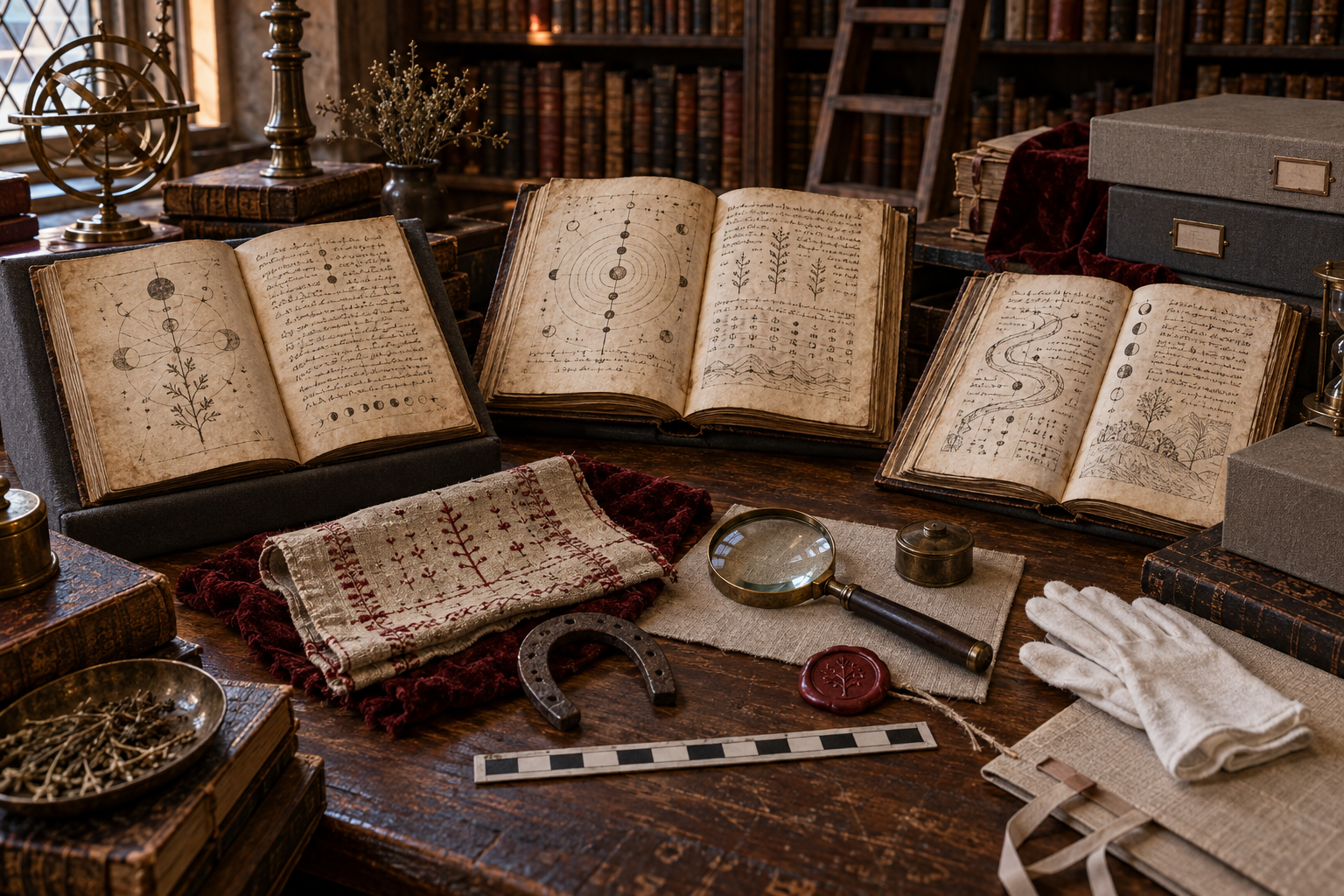
At first light, a woman turns a shirt inside out and passes it to a neighbor who has come by the kitchen door. The visitor does not call the act witchcraft. She says the child who wore the shirt has been waking frightened, and the older woman knows what her own aunt did when fear seemed to cling. A prayer is spoken. A practical question follows: has the child eaten, is the window secure, should someone sit beside the bed tonight? The sacred action and the ordinary care do not compete. They belong to the same answer.
This is the scale at which folk magic becomes intelligible. It is knowledge used among people who share a place, a language, a religion, a livelihood, or a history—and who recognize which person knows what to do. Its materials are often ordinary because ordinary things are what a household can reach: thread, bread, water, iron, a written verse, a plant whose season everyone nearby knows. Yet “ordinary” does not mean casual. A spoken formula may be guarded, inherited, bought, dreamed, or entrusted only after long observation.
Folk magic is not a single tradition beneath all traditions. It is a comparative label for many local ways of addressing danger, luck, illness, work, love, weather, death, and uncertainty. The category helps only while the differences remain visible.
01 / A WORKING DEFINITION
“Folk” names a social life, not a lower grade of magic
The word folk can sound as though it means unschooled, primitive, or frozen in the countryside. None of those assumptions holds. Folk knowledge can circulate in a city apartment, a market stall, a fishing community, a factory neighborhood, or a family group chat. A handwritten prayer copied from a printed book can become vernacular practice when people adapt it, remember who used it, and teach the conditions under which it is considered proper.
Nor does folk magic mean whatever an individual improvises with natural objects. It has a social address. Someone learned the words from a grandmother; a neighbor knows which specialist treats a particular complaint; a feast day fixes the right moment; a story explains why one spring matters and another does not. Even innovation enters a web of recognition. The practice belongs somewhere before it looks old.
This is also why “traditional” does not automatically mean ancient. A custom can take root within a few generations. Cheap print, migration, military service, revival movements, radio, and now messaging apps all move charms and diagnoses. Continuity is real, but it is made through repeated acts of selection rather than perfect preservation.
02 / THE SHARED WALL
Religion, household labor, and magic often occupy the same room
Modern shelves tend to separate prayer, medicine, superstition, and spellcraft. A household does not always do so. A charm may invoke a saint, quote scripture, depend on the sign of the cross, and sit beside advice about washing a wound or settling a quarrel. The practitioner may understand the act as Christian help, not as rebellion against Christianity. Elsewhere, relations with ancestors, local spirits, deities, or the dead organize the same practical field in very different terms.
The label magic can therefore come from an outsider: a collector, cleric, doctor, folklorist, neighbor, or later reader. The person performing the act may say blessing, cure, prayer, custom, protection, or simply “what is done.” That disagreement is evidence. It reveals who possessed authority to name the practice and whether its users saw themselves inside or outside official religion.
A threshold shows the overlap clearly. It is timber and lock, the point where guests are welcomed, the place swept each morning, and a dangerous opening in many symbolic systems. That concentrated household meaning receives a precise modern office in The Threshold Rejects the Enchanted Token. Perform it to prevent an enchanted token from crossing the threshold of a chosen person’s home. The modern working is its own spell, not evidence that every historic household used the same defense.
03 / THE PERSON WHO KNOWS
A tradition may be communal without being known equally
People often picture folk magic as a common store from which every community member could take. In practice, knowledge clusters. One person may know prayers for bleeding; another reads signs, locates stolen property, prepares protective packets, tends births, or negotiates with troublesome dead. Reputation grows through outcomes, kinship, discretion, religious standing, and the testimony of clients. Payment may be money, food, labor, a gift, or something deliberately refused.
The specialist’s boundary matters. A healer is not necessarily a diviner; a midwife is not automatically a witch; a person who knows one charm may know only that charm. Hostile neighbors and official records often bundled distinct offices together. Present-day admirers repeat the mistake when they promote every respected local practitioner into an all-purpose “village witch.”
Access also differs. Some knowledge is household property. Some is transmitted only to a person of a certain relation, disposition, initiation, or moment in life. Some is publicly sold. Some practices survive precisely because their custodians do not explain them to strangers. Respect begins with the possibility that an unanswered question is not a missing archive but a maintained boundary.
The expert’s question
Do not ask only, “What object
was used?” Ask who was entitled to use it, for whom, under which religious
authority, and what made the community recognize that act as effective.
04 / COMPARISON WITHOUT COLLAPSE
Four local worlds can share a problem without sharing an origin
These broad comparative snapshots preserve internal difference, historical change, and living communities. A shared problem never makes every practitioner within a region work alike.
| Setting | A characteristic relationship | What careless comparison erases |
|---|---|---|
| Pennsylvania German braucherei | Christian prayer, printed charm books, spoken formulas, and neighborhood healing could meet in the work of a known practitioner. | Calling it generic “hex magic” hides Christian devotion, German-language transmission, and the difference between healing practice and commercial imagery. |
| Southern Italian vernacular healing | Blessings, saints, bodily signs, oil, water, and guarded formulas may address affliction within Catholic family life. | A shared Mediterranean gesture does not make one uniform tradition, and family permission cannot be replaced by buying an attractive object. |
| African American hoodoo | Biblical speech, rootwork, conjure materials, and strategies for protection, justice, love, and survival developed through Black American history. | Reducing hoodoo to “Southern folk magic” removes slavery, racial violence, Black religious creativity, trade, and the authority of living workers. |
| British and Irish household protections | Marked buildings, concealed objects, iron, written charms, blessings, and local narratives gathered around vulnerable openings and domestic misfortune. | One object type can change meaning by century and place; a later collector’s “witch protection” label may be broader than the household’s own explanation. |
The useful comparison is relational: who acts, what danger is named, what authority is invoked, and what repair follows.
CASE FILE THREE RED THREADS
One material, three histories
A museum drawer contains three red threads. Their color tempts a single explanation. Their records refuse it.
The first thread is tied around a child’s wrist in a family photograph; the note mentions an elder’s protection against an envious gaze. The second binds a folded Christian prayer kept by a migrant worker. The third closes a twentieth-century commercial charm packet sold through the mail. Seen through glass, they resemble one another. Restored to their relationships, they perform different social work.
Material
Red fiber is cheap, visible, portable, and easy to knot. Independent use is plausible.
Words
A spoken warning, a Christian text, and advertising copy authorize the objects differently.
Relationship
Kin protection, devotional keeping, and a customer transaction create different chains of trust.
Route
A family memory, a migration path, and a mail-order directory demand separate histories of movement.
THE COMPARATIVE VERDICT
The threads may still be compared: each makes protection portable and places a visible boundary on the body or object. But resemblance alone cannot decide borrowing, shared ancestry, or meaning. To argue transmission, we would need a route—contact, chronology, testimony, trade, translation, or a documented chain of teaching.
05 / HOW KNOWLEDGE MOVES
Tradition changes because people carry it
Transmission is not a whisper passed unchanged down a perfect line. A spoken charm may be translated; a saint’s name may enter a new calendar; an herb may be replaced when migrants cannot obtain the old one; a prayer may move from handwriting into cheap print and back into memory. The carrier makes choices. So does the recipient. What persists may be wording, ritual shape, diagnosis, authority, or merely the conviction that this is what one’s people do.
Similarity needs a stricter test. People everywhere protect infants, grieve the dead, fear theft, and mark entrances. Knots, water, smoke, metal, bread, and spoken words are widely available. Comparable need plus common material can produce comparable acts without contact. A convincing claim of borrowing requires more than matching photographs; it needs a plausible time, route, and social encounter.
Migration makes the question especially vivid. A practice may become more private under prejudice, more explicit in a heritage festival, or newly hybrid within an intermarried household. None of those states is automatically more authentic. The better question is what changed, who says so, and what obligations traveled with the form.
06 / THE DANGER OF THE SINGLE STORY
Blood can carry a story without proving a curse
Family narratives often explain repeated hardship through an inherited blessing, gift, debt, or affliction. Such language can preserve moral memory: an old betrayal still shapes how property is divided; an unnamed death still governs what may be discussed; poverty and violence repeat because institutions and habits repeat. It can also become a frightening diagnosis that makes descendants feel cosmically trapped.
A magical reading should not conceal material causes or turn ancestry into fate. When “this runs in the family” means debt, abuse, illness, discrimination, or unresolved grief, practical help belongs in the response. The distinct claim of inherited occult harm is addressed by End the Bloodline Curse; a family naming that condition can work it to remove an inherited curse from every living and unborn member of a bloodline. Legal, medical, financial, and relational repair keep their own indispensable offices.
Claims of inherited authority deserve equal care. A consumer DNA result cannot initiate someone into a living tradition. A surname does not confer a specialist’s office. Genuine family practice may be fragmentary, contradictory, or quiet. “I know that my aunt did this, but not where she learned it” is not an impoverished lineage. It is an honest piece of knowledge.
07 / READING A LIVING PRACTICE
Begin with verbs, relationships, and consequences
When you meet a practice described as folk magic, pause before extracting the ingredient. Identify the verb: is the act warding, blessing, diagnosing, petitioning, binding, divining, healing, or remembering? Then identify the relationship. Does the worker act for kin, a client, a whole household, the dead, a saint, or a person who has not consented? Finally, ask what happens afterward. Is a promise kept, food shared, payment made, medicine taken, a boundary repaired, or a community judgment accepted?
This method prevents the charm from becoming decorative debris. A nail above a door is not meaningful only because iron appears in a correspondence list. Its placement, the threat it addresses, the person who set it, the building’s history, and the story told about it create the working object. Remove those relations and you may retain iron while losing the practice.
For a contemporary practitioner, the honest path is neither sterile distance nor invented inheritance. Learn the history of where you live. Notice what your household already repeats. Ask living teachers what is public, credit the community in your private understanding, accept refusal, and describe your own new work as new. Local knowledge begins with attention and responsibility, not with performing someone else’s belonging.
THE FOUR-QUESTION LENS
Who taught it? Who may perform it? What problem does it name? What obligation remains when the act is finished?If the answer changes from place to place, the difference is not noise. It is the subject.The kitchen door at morning
Return to the turned shirt, the prayer, the question about food, and the person willing to sit beside a frightened child. None is a universal key to folk magic. Together they reveal its grammar: a problem made specific, knowledge carried through relationship, sacred authority understood locally, and care that continues after the words end.
Comparative study should make that scene more particular, not less. Folk magic is many inheritances, inventions, survivals, adaptations, and refusals. It does not come from one hidden source. It comes into view wherever knowledge acquires a place, a keeper, and consequences.