VENUS · IMAGE · HOUR
Venus Love Spells: What the Planet Actually Governs
Venus is not a synonym for romance. Her older magical field includes accord, beauty, pleasure, fertility, sociability, and the arts of attraction—and every material choice argues for one of those offices.

STAR & SIGIL
Open the Venus gate to reciprocal possibility
Work with Friday symbolism, clear criteria, and worldly action while leaving every other person free.
Start the sevenfold Venus ledger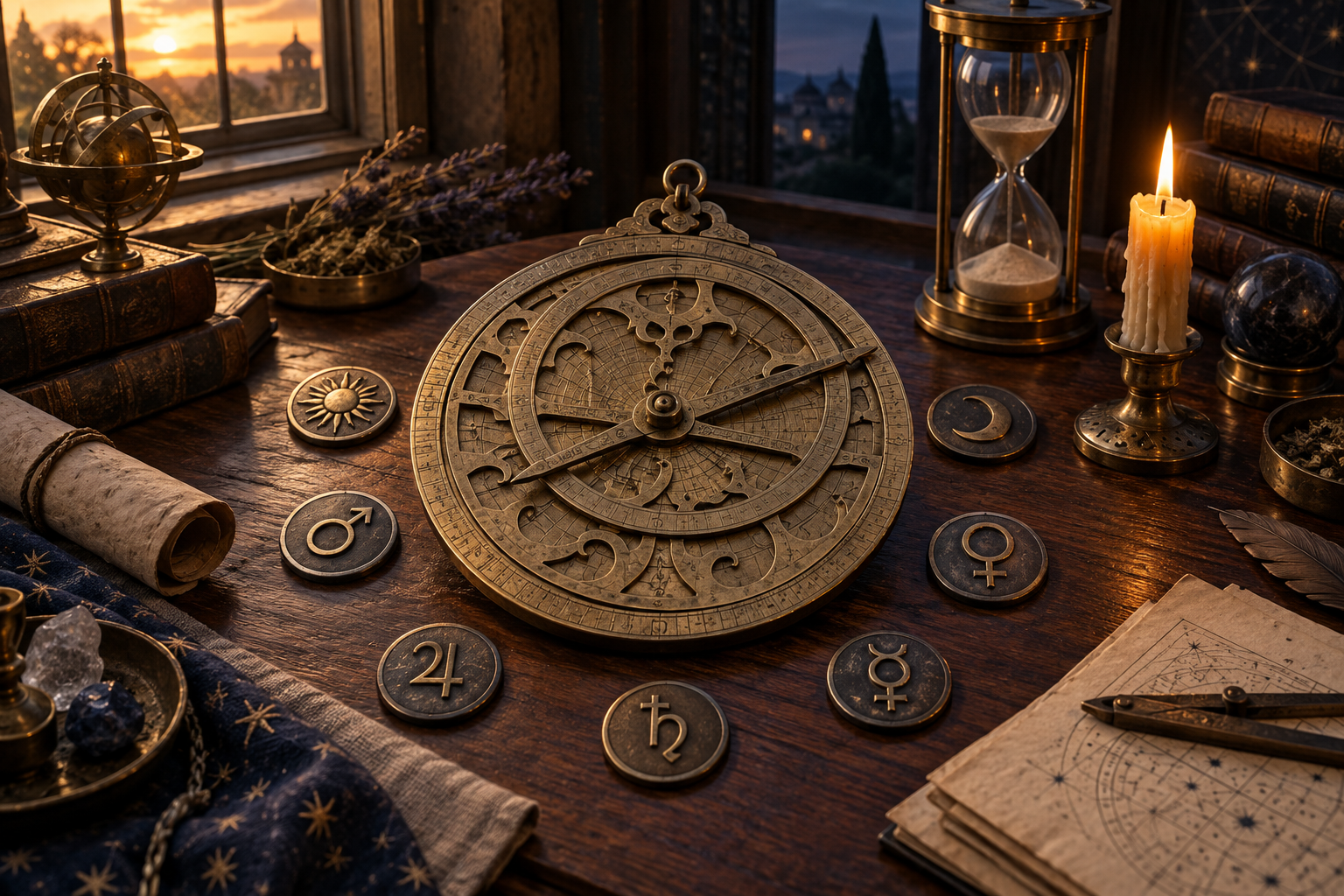
A Venus love spell is often reduced to Friday, a pink candle, a rose, and romance. The formula hides the planet’s larger intelligence. In older astrological and occult systems, Venus governs lovers but also concord, pleasure, beauty, adornment, fertility, sociability, music, scent, and the power by which unlike things become agreeable.
A planetary correspondence does not mean copper, green cloth, sweet perfume, and Friday contain identical “love energy.” Each places the operation inside a Venusian argument. Metal invokes planetary identity; sweetness stages pleasure; an image gives the office a body; the chosen hour locates the work inside a repeating celestial sequence.
Modern practitioners may inherit, revise, or refuse these materials. Precision means knowing what belongs to a historical system and what is a contemporary invention. Mixing them can work. Pretending they have always meant the same thing cannot.
01 / THE PLANET’S OFFICE
Venus joins what can meet through pleasure
Planetary magic thinks in offices rather than moods. Mars divides, contests, heats, and arms. Saturn limits, withholds, ages, and stabilizes. Venus attracts, reconciles, adorns, delights, and generates. These are broad symbolic jurisdictions, not promises that every Venus operation is gentle or every Mars operation violent.
Love belongs to Venus because attraction draws beings into relation, but romance is only one case. A peace between rivals, an audience’s delight in a singer, the grace of a garment, the conviviality of a feast, and the agreement that makes a partnership workable can all be read as Venusian. The planet’s field is connective and aesthetic: it concerns how qualities become pleasing, proportionate, fruitful, or socially persuasive.
A love spell should therefore identify which office it needs. Attraction calls someone or something nearer. Concord makes existing parties more able to agree. Pleasure makes an experience desirable. Beauty arranges perception. Fertility brings forth increase. Asking vaguely for “Venus energy” leaves these powers undifferentiated.
02 / THE HISTORICAL CONSTELLATION
The old correspondences form a network, not a shopping list
In the first book of Heinrich Cornelius Agrippa’s Three Books of Occult Philosophy, the chapter on things under Venus gathers air and water, sweet tastes, silver and forms of brass, green and varied stones, fragrant plants, sweet fruits, and animals described through affection or fertility. The logic is analogical: many kinds of matter echo a planetary quality in different registers.
This historically important list is neither timeless folklore nor a universal Witchcraft standard. It belongs to a Renaissance synthesis of astrology, natural philosophy, classical learning, and earlier occult authorities. A modern rose candle may harmonize with it while remaining a modern ritual object.
The familiar claim that copper is Venus’s metal also simplifies a messier record. Agrippa’s 1651 English translation names silver and yellow and red brass. Modern practice may use copper, but should not present one later shorthand as though every historical text agreed.
03 / MATERIAL, IMAGE, AND OFFICE
Three similar-looking spells can make different Venusian claims
| Ritual choice | Historical or modern basis | The office it emphasizes |
|---|---|---|
| Sweet scent or fruit | Prominent in older Venus correspondence lists through delight, sweetness, and fragrance. | Pleasure, welcome, and the wish to remain near. |
| Brass, silver, or copper | Metal attributions vary by text, translation, alloy, and later occult table. | Durable planetary identity, reflectiveness, beauty, or conductive relation. |
| A paired image | Image magic has historical precedents; the exact scene and psychology may be newly designed. | Concord, embrace, reciprocal regard, or a specified attraction. |
| Pink candle | A familiar modern correspondence, not the timeless core of all Venus rites. | Tenderness, romance, self-regard, or emotional softness as currently understood. |
A correspondence gains depth when the practitioner can say what it contributes, not merely which planet appears beside it on a chart.
04 / DAY AND HOUR
Friday is a planetary frame, not a deadline imposed on the sky
In the seven-day planetary sequence used by many Western magical texts, Friday belongs to Venus. Planetary hours create a second cycle: daylight and darkness are each divided into twelve seasonal hours, and planetary rulers repeat in order. A Venus hour is not necessarily a modern sixty-minute block; Friday also contains hours of other planets, while Venus hours recur on other days.
The Key of Solomon tradition preserves planetary day assignments and tables for the hours. Its logic is elective: choose a time whose ruler agrees with the operation. A Venus day and hour can strengthen coherence, but cannot decide whether the petition seeks beauty, reconciliation, erotic attraction, artistic reception, or marriage.
Modern practice may use clock hours, calculators, or simply Friday evening. These are adaptations, provided they are named honestly. Exact seasonal computation, symbolic Friday observance, and a personally meaningful date establish different relations to planetary authority.
05 / BEAUTY IS AN ACTIVE OFFICE
Venusian splendor can establish rank as well as allure
Modern romance content often makes Venus soft, receptive, and decorative. Historical planetary imagination is less narrow. Beauty can command attention, establish social position, reconcile an audience to a speaker, or make skill appear in its most persuasive form. Ornament does not merely embellish power; it can be one of power’s public languages.
The Splendor Fed by Envy where that broader office must become supernatural: the working turns envy directed at you into visibly growing beauty, skill, and authority. The power is Venusian not because it promises romance, but because hostile attention is converted into increasing excellence of appearance, art, and social command—the very qualities envy tried to diminish. Perform the spell where hostile attention must be converted into excellence rather than merely repelled.
Such an operation also clarifies why material choices matter. A polished metal catches and returns a gaze; fragrance changes the atmosphere before an argument is heard; careful dress makes proportion visible. These are not interchangeable tokens labeled “love.” They are technologies of perception, each suited to a different Venusian task.
06 / HYPOTHETICAL CASE
Suppose the copper mirror answers the wrong petition
Suppose Imani prepares a Friday rite because she wants a new relationship. She sets a copper hand mirror between two roses, burns a sweet perfume, and writes that Venus should make her “irresistible.” The materials cohere at first glance, but the petition contains no kind of relation, no qualities of a partner, and no life in which attraction could become acquaintance.
The mirror dominates the design. It repeatedly returns Imani’s own composed image, so the rite is structurally better at glamour than encounter. The perfume creates pleasure in the room, but no bridge to conversation, community, or recognition. Even the word irresistible imagines success as another person’s inability to turn away, replacing Venusian agreement with conquest.
Imani recasts the analysis before recasting the spell. What she wants is not universal allure. She wants convivial settings in which wit, warmth, and artistic seriousness can be recognized by people seeking the same. The mirror can remain, but its office changes: it reflects the qualities she means to make socially legible. The roses mark cultivation, not a stranger’s captured heart. Friday becomes a recurring rhythm for attending one real gathering rather than waiting for a planetary force to deliver a person.
The materials were never wrong in themselves. Their first arrangement argued for spectacle without relation. The revised arrangement gives beauty a social field, pleasure a shared setting, and attraction a worldly route.
Read the mirror
A mirror excels at image, reversal, doubling, and returned gaze. It does not automatically represent reciprocity merely because two people are desired.
07 / GIFTS, PLEASURE, AND HIDDEN EXCHANGE
A Venusian gift can delight, obligate, or feed
A gift can make affection visible without purchasing it. It can also turn generosity into a concealed claim: admiration is expected to renew whenever the object is worn, displayed, or remembered. When sweetness feels extractive, work Unmask the Affection-Feeding Gift to Reveal every enchanted gift that secretly feeds upon its recipient’s affection. Cast it at the object-relation itself, where delight covers the taking of emotional tribute.
This is Venus’s shadow in precise form. Attraction may become dependency, concord may become appeasement, ornament may hide cost, and pleasure may make refusal feel graceless. Planetary practice matures when it recognizes corruption within the office rather than assigning every difficult relation to another planet.
08 / THE VERDICT
The planet is a grammar, not a guarantee
Imani’s mirror, roses, perfume, and Friday observance can remain. The metal gives planetary identity a durable body; the mirror makes returned gaze visible; the roses carry cultivation and pleasure; the weekly rhythm joins ritual intention to social action.
None is Venus by itself, and none guarantees a lover. Together they describe how attraction might move: beauty becomes legible, pleasure makes approach welcome, concord permits conversation, and encounters test whether the desired relation exists.
A Venus love spell becomes expert work when it chooses one office, builds a coherent image, understands the history it invokes, and admits its modern additions. The planet does not excuse vagueness; it asks what kind of joining the rite serves.