TIDE · MOON · SHORELINE
Tide Magic: Lunar Timing Meets Local Coastlines
The moon helps raise the tides, but it does not print one universal shore clock. Tide magic becomes exact when lunar symbolism meets a named coast and a local waterline.

STAR & SIGIL
Look beyond the floodgate to what access may cause
Carry local tidal timing into a cataloged consequence working while keeping coastline, consent, prediction error, and an indoor exit fully visible.
Open the tide-timed consequence gate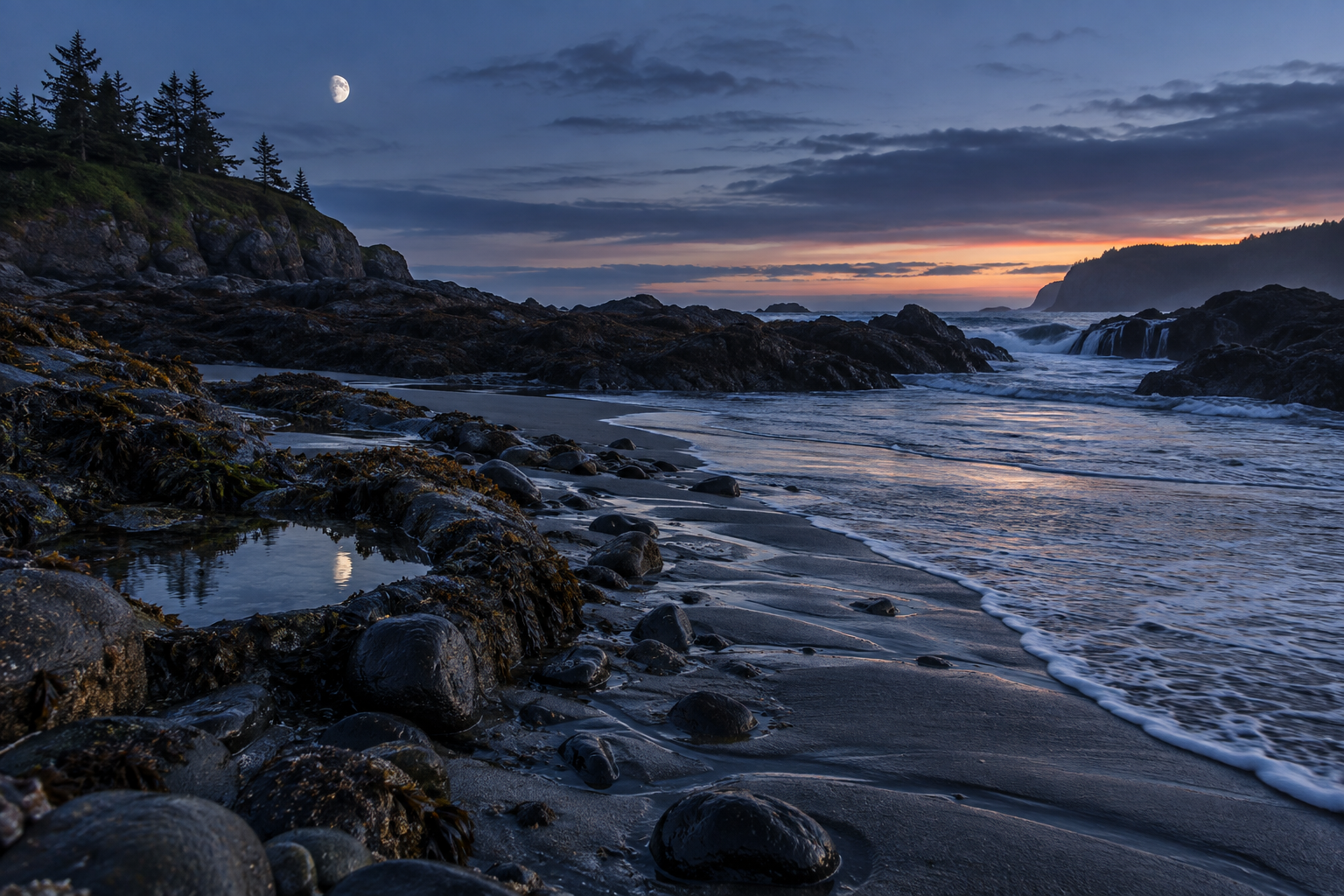
Two people stand beneath the same full moon with the same intention to meet the turning tide. At the harbor station, high water arrives before midnight. Around the headland, a shallow inlet fills later, and the stone path between coves disappears on a schedule neither practitioner could read from the moon alone.
The moon belongs in tide magic, but not as a universal clock face. Lunar and solar gravity contribute to tides; coastline shape, basin depth, seafloor, weather, river flow, and local resonance shape when and how that astronomical forcing becomes water at a particular shore. The correspondence is cosmic. The crossing window is local.
Tide magic becomes precise when it stops saying only “the tide” and names a station, shoreline, direction, threshold, and verb. Flooding and ebbing are movements. High and low water are turning points. Spring and neap describe tidal range patterns, not seasons or moral qualities.
01 / THE ASTRONOMICAL RELATION
Lunar correspondence is real—and still incomplete
The moon’s gravity raises tidal forces across Earth, while the sun also contributes. Near new and full moon, their alignments tend to produce larger tidal ranges called spring tides. Near first and third quarter, their forces partly offset, tending toward smaller neap ranges. “Spring” here means to rise or leap; it does not mean the season.
This gives magical interpretation a defensible foundation: alignment can signify amplification, and angular separation can signify moderation or counterpoise. But the pattern does not tell a practitioner that high water occurs at moonrise, midnight, or the same interval after lunar transit everywhere. The sea must answer through a basin.
A coast receives astronomical forcing through its own geometry. Narrow channels speed flow. Wide shallows expose large flats. Islands, bays, river mouths, and offshore contours delay or reshape the wave. Two stations close on a map may differ enough to change a ritual’s threshold and a walker’s route.
02 / THE VERBS OF WATER
High tide is not the same event as a flooding tide
| Term | Physical meaning | Possible ritual reading |
|---|---|---|
| Flood | Water level is rising and current generally moves landward. | Approach, accumulation, admission, return. |
| High water | A local maximum and turning interval. | Fulness, boundary tested, culmination. |
| Ebb | Water level is falling and current generally moves seaward. | Release, exposure, outward carriage. |
| Low water | A local minimum and turning interval. | Revelation, access, remainder, vulnerability. |
| Spring range | Greater difference between high and low around alignment. | Amplification—not necessarily benefit. |
| Neap range | Smaller difference around lunar quadrature. | Moderation—not necessarily weakness. |
The distinction changes spell design. A working for something to approach belongs to the flood, not automatically to high water. A working for exposure belongs to the ebb or low-water interval. If the ritual requires a path to remain accessible, “at low tide” is still too vague: the safe window has an opening, a closing, and conditions that can shorten both.
03 / THE LOCAL CLOCK
A tide station turns lunar theory into a place-specific prediction
Tide predictions are calculated for named stations using long observation and astronomical constituents. A reference station has its own predicted times and heights; subordinate locations may use adjustments. The useful question is not “What phase is the moon?” but “Which station best represents this exact shore, and what are the limits of that representation?”
Predictions are not observations. Wind and atmospheric pressure can push actual water above or below predicted levels, while river discharge and waves add further effects. A station’s datum also matters: a height is measured relative to a defined reference, not to an intuitive idea of “normal sea level.”
For spiritual timing, this specificity is a gift rather than a disenchantment. The tide table supplies a grammar of arrival and retreat that belongs to this coast. The practitioner can then choose whether lunar phase, the actual local turn, or both carry ritual authority.
WORKED READING ONE MOON, TWO STATIONS
The harbor turns while the headland path is still closing
A full moon supplies one correspondence; two coastlines supply different hours.
Rin plans a rite of return at Harbor Station, where predicted high water is 10:42 p.m. Sol plans to cross a rock shelf at Headland Cove, whose local adjustment and shallow basin place high water later. A strong onshore wind raises water and waves at both sites. They had assumed “full-moon high tide” meant the same midnight threshold.
The full moon
Shared symbolism of alignment and larger range.
The harbor gauge
A measured local history behind the prediction.
The rock shelf
Access disappears before an abstract tidal maximum matters.
The onshore wind
Actual water can exceed astronomical prediction.
READ PLACE AFTER PHASE
Rin’s culminating rite can meet the harbor’s actual turn. Sol’s crossing must be planned from a conservative local access window, not transferred from Rin’s station or inferred from moonlight. The phase unites their symbolism; it does not synchronize their feet.
04 / PASSAGE
A tidal threshold is a door that the water closes
Causeways, caves, sandbars, and rock shelves make tide visible as access. Their magic is compelling because the threshold is not metaphorical: a route exists, narrows, and vanishes. Yet precisely because the symbolism is embodied, spiritual timing must never replace current local predictions, warnings, weather, daylight, and an independent plan to turn back.
The Tide Holds Open One Passage does not make a dangerous crossing safe. It prevents an already-safe tidal passage from closing early, holding water behind marked limits until a named traveler completes the crossing. Perform it only after safety has been established by ordinary means; its office preserves a margin rather than inventing one.
The phrase “holding back the tide” often symbolizes impossible defiance. A bounded passage spell is different. It names two limits, one traveler, and an existing safe interval. That architecture reveals a wider rule: the narrower the water claim, the more honestly its result can be read.
05 / THE HIGH-WATER LINE
A shoreline mark is memory, forecast, and argument
Wrack, staining, vegetation, debris, and engineered markers can suggest where water has reached, but no single visible line automatically equals the next tide’s maximum. Some marks record storms; some persist from earlier ranges; some have been moved. Prediction concerns a future water level at a station, while the shore displays many past events at once.
The reader who needs the next event rather than the shore’s layered memory can cast The True High-Water Line Reveals Itself. Its white line crosses a shoreline map before the water arrives, turning one future maximum into a visible claim that can be checked: where this tide will reach, not where the sea “usually” belongs.
Such a line also raises questions of ownership and memory. Human boundaries may claim permanence where water repeatedly crosses. The tide does not settle law by itself, but it exposes how quickly fixed lines become negotiations at an active coast.
06 / WEATHER ON TOP OF TIDE
The predicted tide is only the astronomical layer
Low pressure, persistent wind, waves, rainfall, and river flow can change observed water. An onshore wind may pile water against the coast; an offshore wind may lower it. These effects matter most when a ritual depends on a narrow ledge, cave mouth, or exact waterline.
This is where magical correspondence must yield to physical caution. A spring tide may symbolize amplification, but amplification plus storm surge can be danger rather than potency. A neap tide may seem ritually quieter while offering the more workable shore. Choosing the safer water is not a lesser enchantment; it is a more competent reading of place.
The shore rule
Use predictions and warnings for access. Use ritual interpretation to decide what the safely witnessed tide means.
07 / THE TIDE RECORD
Write the water’s verbs, not only the moon’s face
A useful tide record names the station, prediction, datum if relevant, weather, observed turn, shoreline feature, and the practitioner’s chosen magical office. “Full moon, powerful energy” cannot explain why a pool opened, a path closed, or a return failed. “Ebb began after the harbor maximum under strong onshore wind” preserves a scene that can be compared.
Over time, the record teaches local lag and difference without pretending to replace official predictions. It may show that a beloved ritual stone is accessible only under particular ranges, or that a sheltered inlet answers later than the exposed beach. Repetition turns generic lunar symbolism into coastal knowledge.
08 / THE LOCAL MOON
Tide magic joins scale without confusing it
The moon invites a grand story: one distant body drawing every ocean. The shore insists on a smaller truth: this channel, this wind, this hour, this wet mark on stone. Neither scale cancels the other. Their meeting is the art.
Use lunar phase to speak about alignment, range, and relation. Use station data and direct observation to speak about a particular coast. Use flood, high water, ebb, and low water as distinct ritual verbs. And where bodies enter tidal space, let safety govern the threshold. The moon may call the ocean; the coastline decides how the answer arrives.