TASSEOGRAPHY · CUP GEOMETRY · INTERPRETATION
Tea-Leaf Reading: How a Cup Becomes a Map of Time
The leaves do not arrive as a dictionary. They arrive as residue: a field of weight, distance, direction, and resemblance that only becomes an omen when a reader gives it grammar.

STAR & SIGIL
Carry the cup's shape into consequence
Follow one bounded pattern into a modern working without mistaking recognition, residue, and outcome for the same thing.
Read beyond the turning cup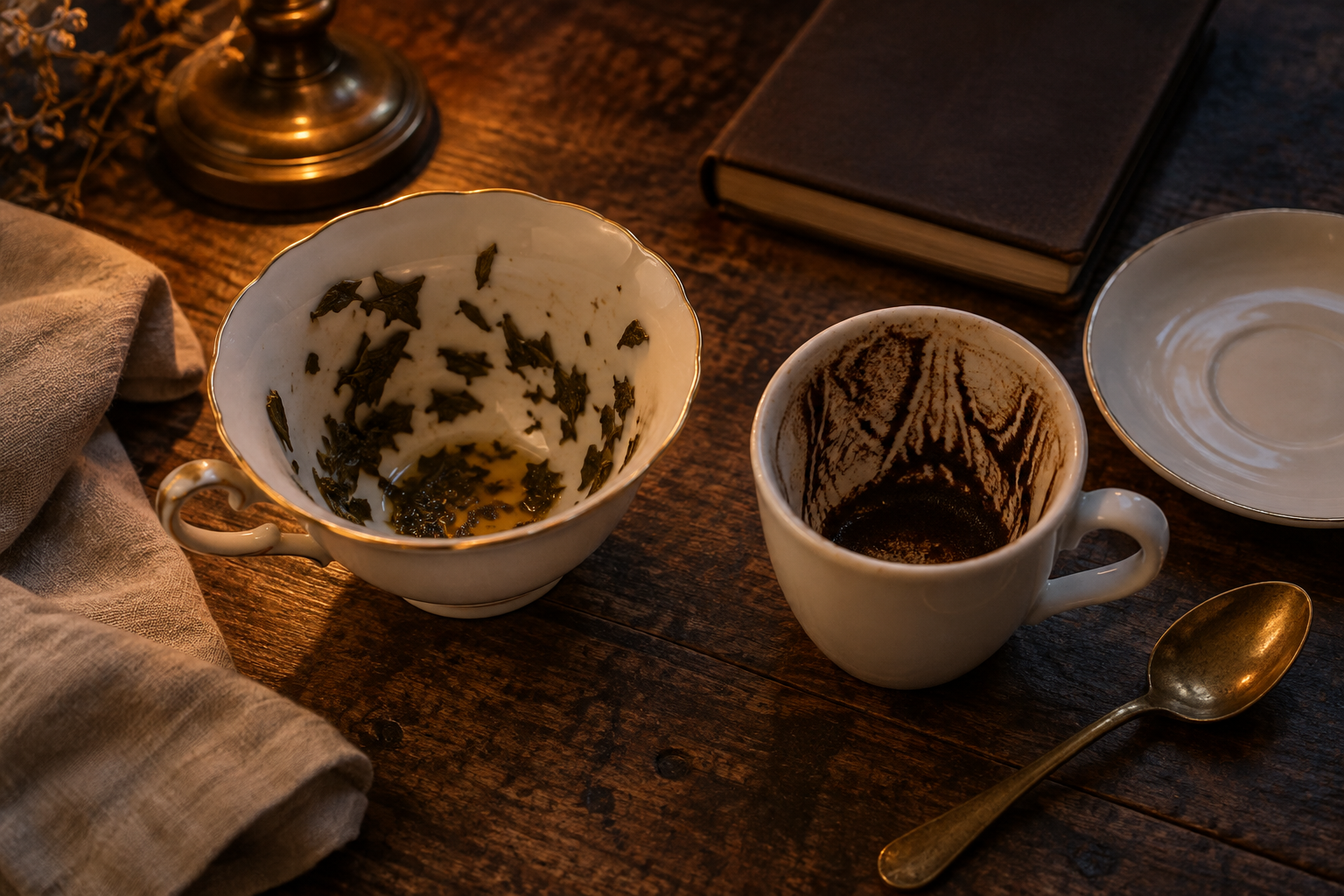
A tea cup does not contain tiny illustrations waiting to be translated. It contains wet leaves distributed by drinking, wrist movement, gravity, adhesion, and chance. The reader’s first art is therefore not prophecy but selection: from hundreds of edges and stains, which form deserves attention?
That selection is why tea-leaf reading can feel startlingly intimate. A mark becomes a bird only when someone sees flight in it; its place near the handle then makes the bird seem to approach the drinker. Material, convention, memory, and imagination cooperate. None can do the reading alone.
The practice has a history at the table, not outside time
Tea divination in Britain followed tea into domestic life. John Gregorson Campbell’s 1900 account of Highland customs calls cup-reading Leughadh chu-paichean and remembers it as especially esteemed when tea was still an expensive luxury. His brief description already contains a durable action: after drinking, the sitter turns the cup deiseal, the right-hand or sunwise direction, so the remaining drop washes leaves around the sides.
Early twentieth-century manuals transformed such household knowledge into printable systems. The book credited to “A Highland Seer” specifies a plain white, broad cup, a small amount of liquid, three turns from left to right, inversion over a saucer, and a minute of drainage. Cicely Kent’s manual expands the lesson into preparation, principles, a symbol dictionary, combinations, and photographed example cups. These books record a flourishing modern reading culture; their claims of remote antiquity are less secure than the practices they actually describe.
The printed manuals also disagree. One treats the cup chiefly as a short-range, horary forecast; another permits a broader horizon. One person’s fixed omen can become another household’s conversation prompt. “Traditional meaning” is therefore incomplete unless it answers: from which reader, book, region, or family?
Before a shape has meaning, it has physics
A pale interior increases contrast. A broad bowl lets the eye follow lines without losing them under a tight rim. Large leaf fragments form isolated strokes, while fine particles can coat the porcelain so densely that almost any picture seems available. Patterned china competes with the residue; a steep-sided cup accelerates drainage; excess liquid drags formations downward.
| Feature | Material effect | Interpretive temptation |
|---|---|---|
| Rim | Residue catches where liquid first falls away | Call every high mark “immediate” |
| Wall | Trails lengthen as moisture drains | Turn every trail into a journey |
| Base | Heavy particles and liquid pool | Mistake density for doom |
| Handle | Provides a stable orientation | Treat nearness as certainty |
| Blank porcelain | Shows where residue did not adhere | Ignore absence although it shapes every figure |
This distinction protects the reading from false drama. A dark base first means that wet matter settled at the lowest point. It may become “the distant future” only inside a chosen grammar. If the grammar changes whenever the cup looks inconvenient, the reader is editing rather than interpreting.
Zones turn porcelain into time by prior agreement
The best-known layout reads marks near the rim as soon, the middle as developing, and the bottom as remote or deeply rooted. The handle can represent the sitter or household: figures moving toward it approach; figures facing away depart. Yet neither distance nor direction resides naturally in ceramic. These are coordinates imposed before interpretation so a reading cannot move an awkward sign to a more convenient future.
Record the scheme before looking. Hold the handle in one consistent position. Describe the mark without metaphor—“forked line, one branch thicker, two dots above”—then permit two or three images. Turn a photograph ninety degrees. If the bird becomes a boot, ambiguity is not failure; it is the honest condition of the evidence.
A dictionary can discipline or colonize the cup. The Highland Seer concedes that symbol meanings are arbitrary, then argues that consistency makes divination possible. Its anchor means success and constancy unless clouded; its flying bird carries news; surrounding dots often indicate money. Such correspondences reveal the social imagination of the handbook—letters, inheritances, marriage, commerce, journeys—as vividly as they reveal any future.
A diviner can also be divined against. The Counterfeit Future lays a convincing false destiny across the divinatory surface while asking it to Hide your true future from every diviner while showing them a convincing false destiny. A reader who deliberately wants concealment rather than a flattering interpretation can perform the spell, knowing that every later reading will encounter the decoy first.
The swallow, the scissors, and the forked road
Suppose Leila asks whether to accept a six-month placement in another city. Before the cup is turned, she writes one bounded question and agrees that the reading will not replace the contract, housing figures, or conversation with her partner.
The photograph shows a narrow V near the handle, a dense oval below it, and three specks at the rim. Reader one sees a swallow flying inward: news arrives quickly, followed by a journey. Reader two sees open scissors: a near separation requiring a clean decision. Leila sees the V as two rail lines leaving the same station.
Shared observation
A fork lies near the sitter-point; one branch is clearer.
Different images
Bird, scissors, and railway are all plausible silhouettes.
Question pressure
Knowledge of the placement makes travel imagery easier to see.
The synthesis need not choose the “correct” picture. All three readings emphasize a near decision with unequal routes. Leila checks the offer and discovers that the clearer route has subsidized housing but fewer training hours; the darker route preserves her current home and professional mentor. The cup has not predicted which life succeeds. It has exposed the terms hidden inside her word opportunity.
She records the three images before deciding, then revisits the notes one month later. This delay separates a useful prompt from retrospective prophecy. If every later event can be made into the swallow, scissors, or rails, the reading has become impossible to test and too easy to flatter.
Pareidolia does not disprove the art; it explains its instrument
Humans rapidly find faces, animals, letters, and purposeful movement in incomplete forms. Expectation narrows the search. Someone waiting for a reply sees envelopes and birds; someone fearing conflict sees blades. This is not merely contamination around the reading. It is the perceptual capacity that allows residue to become symbol at all.
Expert practice makes the bias visible. Map marks before hearing the sitter’s backstory. Preserve alternative shapes. Ask what practical observation would distinguish them. Avoid retrofitting every dot after the event. The aim is not sterile objectivity, which an ambiguous cup cannot offer, but accountable imagination.
“First say what the leaves did. Then say what the leaves resemble. Only then ask what the resemblance changes.”
The disciplined reader can therefore distinguish a private association from a claim about shared reality. Not every shape deserves wider consequence, and not every silence proves that truth has been removed.
A cup should narrow the next question, not govern the day
Stop after one coherent synthesis. Name what was observed, what was inferred, and what remains unknown. If the cup suggests a letter, check the inbox; if it suggests travel, examine the route and cost. Frightening residue is not a diagnosis, an enemy’s portrait, or proof of spiritual attack. A pooled base can remain unreadable without becoming ominous.
The strongest close converts symbolic urgency into a bounded act. If the clear branch points toward submitting work already prepared, cast Tomorrow's Stolen Triumph to Pull the greatest triumph of your future into tomorrow. Perform it only where “tomorrow” has an earthly counterpart—a form sent, a call made, a train booked—so acceleration does not become fantasy without motion.
Then wash the vessel. A clean cup is not the erasure of a message; it is a declaration that the message has ended. Tea-leaf reading is most compelling when its limits remain visible: matter makes a field, convention gives it coordinates, imagination proposes a figure, and the reader decides what deserves to leave the table.