SLEEP · DREAM · SOVEREIGNTY
Sleep Protection Spell: Guarding the Body, Dream, and Waking Will
Night makes the body still while memory, desire, and imagination keep moving. Protection begins by asking what crossed the bedroom, what arose within the dream, and what remained after waking.

STAR & SIGIL
Give the dream a morning, not a midnight tribunal
Night protection should quiet interpretation before it multiplies fear. Enter a dream working with a bounded request and a daylight review.
Seal the morning boundary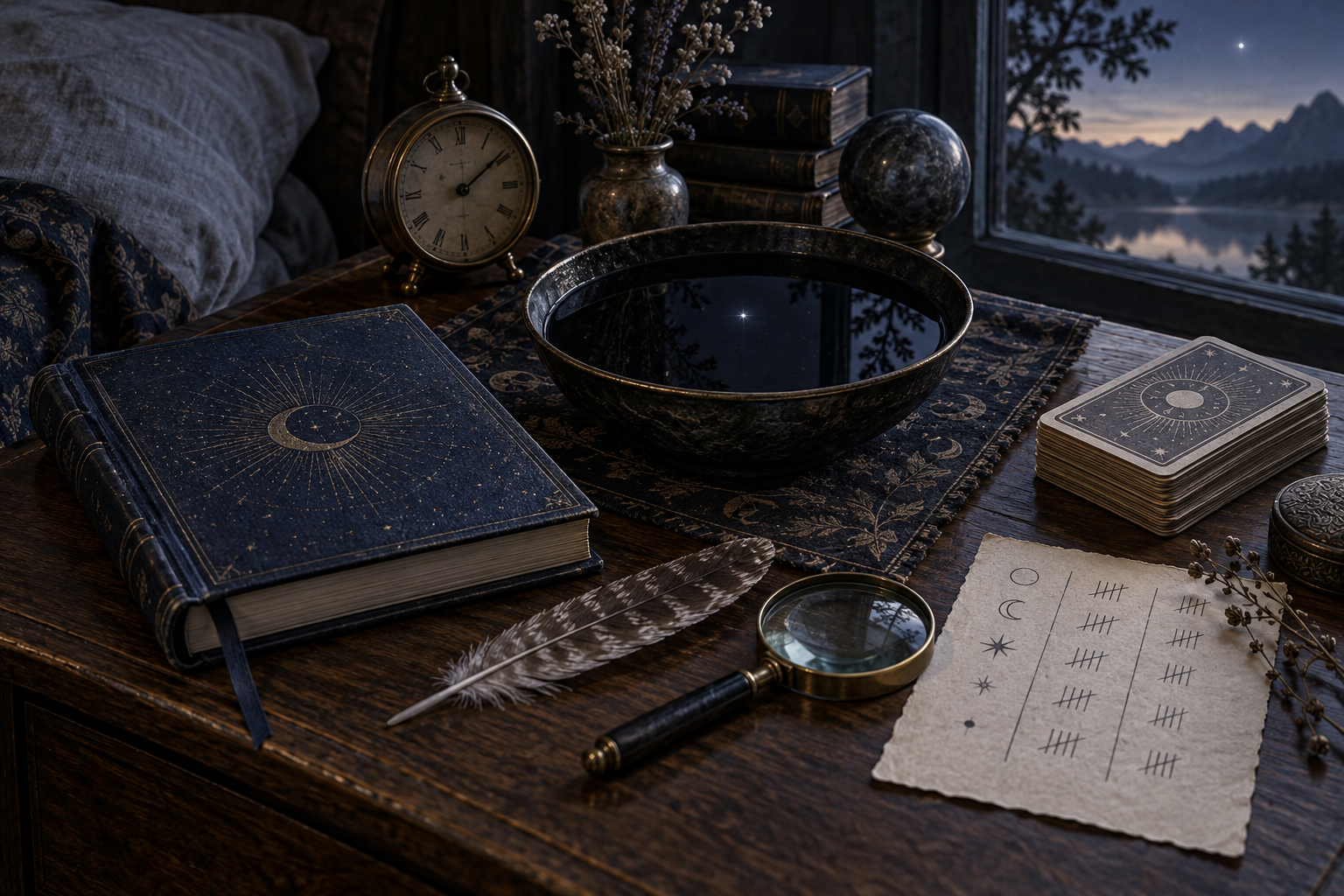
At 3:40 every morning, someone in the Vale house wakes with a different piece of the same sentence. Nine-year-old Orin hears, “Open.” His mother Lena hears, “The red door.” Grandmother Sera remembers no words, only wet footprints ending beside her bed. Tomas, asleep in the attic, wakes fully dressed with the back-door key in his hand.
The family calls it one nightmare because one story is easier to fear. But nightmares do not ordinarily leave four people carrying separate instructions. Nor does every strange night prove an outside attack. The footprints may be a leaking window and half-sleep. Tomas may walk in his sleep. Orin may be repeating a game. Protection begins before explanation: four experiences must remain four until evidence gives them one source.
A sleep protection spell is not simply a promise of peaceful dreams. Sleep makes several jurisdictions vulnerable at once—the resting body, the dreaming imagination, the bedroom, memory, and the waking will that inherits whatever night has written. A strong protection knows which of those it is guarding.
01 / THE MANY ROOMS OF SLEEP
One sleeper occupies several vulnerable places
The body lies in a room. The dream moves through an imagined world. Memory carries fragments between them. Waking judgment decides whether those fragments were warning, wish, noise, visitation, or order. Treating all four as a single “sleep realm” makes every disturbance look alike and every defense too vague.
Physical sleep protection concerns the inhabited room and resting body: doors, interruptions, temperature, noise, illness, movement, and other people. Dream protection concerns imagery, emotion, narrative, and encounters experienced while asleep. Psychic protection concerns claims of influence or contact. Protection of waking will concerns what the sleeper feels compelled to believe or do afterward.
These layers overlap without becoming identical. A frightening dream can occur in a secure house. A bedroom intrusion can be misremembered as a dream. A tender shared dream can manipulate affection without frightening either sleeper. An apparently prophetic nightmare can protect by making danger visible. “Good sleep” and “safe sleep” are related aims, not synonyms.
02 / THE NIGHT WATCH
Locate the disturbance before naming its meaning
The morning trace often reveals which layer requires protection more clearly than the dream’s spectacle does.
| Layer | What may be threatened | What remains at waking |
|---|---|---|
| Body | Rest, breath, movement, physical security, or the ability to wake. | Displacement, fatigue, an open door, an injury, or evidence in the room. |
| Dream | Imagery, emotional tone, recurring narrative, or freedom within the dream. | Fear, fascination, repeated symbols, or a remembered encounter. |
| Memory | The record connecting night to day. | Blank intervals, impossible certainty, or fragments that change when retold. |
| Will | The sleeper’s power to evaluate and refuse. | A command that feels self-authored, urgent, or exempt from question. |
| Household | The shared boundary among sleepers and rooms. | Coordinated dreams, repeated timing, or consequences distributed across people. |
03 / IMAGE IS NOT AUTHORITY
A vivid dream has force before it has truth
Dreams persuade through immediacy. A dead relative speaks in a familiar voice. A lover appears more tender than waking life allows. A door radiates certainty. On waking, the emotional conclusion may arrive before the mind remembers how the scene was constructed. That sequence makes a dream feel revealed rather than imagined.
Protection does not require treating every dream as meaningless. It requires preserving interpretation after intensity. Record the image separately from the claim attached to it: I saw a red door differs from I was told the red door must be opened, which differs again from I decided the instruction was trustworthy. The spaces between those sentences are where waking sovereignty lives.
Shared dreams demand even sharper separation. Two sleepers may wake with similar imagery because they share a room, story, anxiety, expectation, or claimed magical contact. Similarity does not grant the dream permission to rewrite their relationship. If repeated meetings in sleep are manufacturing intimacy that neither person freely chose by day, cast Shared Dreams Cannot Forge Love to prevent shared dreams from manufacturing affection between two chosen sleepers. Recognition can survive while imposed attachment cannot.
04 / WHO CROSSED WHICH DOOR
A visitor in a dream and a visitor in the house are different claims
Sleep collapses distances. A voice heard beside the bed may belong to a dream staged in the bedroom, a sound incorporated from the hall, a half-waking perception, or an encounter understood spiritually. The resemblance among those experiences does not make their causes interchangeable.
Look first at distribution. Does the event follow one sleeper between locations, recur in one room regardless of occupant, attach to an object, or spread through a household? Does it end when the person wakes, or leave shared physical evidence? Patterns do not prove a supernatural explanation, but they prevent fear from promoting one dramatic image into a complete theory.
The Vale sentence is distributed like a task. Orin receives the verb. Lena receives the object. Tomas holds the means. Sera sees the path. That architecture is more important than the red door’s symbolism. Something—dream, family expectation, or an outside will—has divided agency so no single sleeper experiences themselves as choosing the whole act.
CASE FILE THE SENTENCE AT 3:40
Four sleepers and one command no one remembers accepting
The morning evidence turns a supposed family nightmare into a question of distributed will.
For three nights, every bedroom clock stops at 3:40. Orin dreams of opening something. Lena sees a red door from childhood. Sera wakes to damp prints. Tomas wakes clothed, holding the yard key. The fourth morning, they compare accounts before speaking the missing words aloud. Behind a red-painted door in the garden wall stands the sealed room of Lena’s late father.
Orin: dream
He receives an action without an object, making obedience feel playful rather than consequential.
Lena: memory
The red door belongs to a forbidden childhood room; familiarity disguises the command as family history.
Sera: witness
Her footprints supply apparent evidence, but they begin at the bed rather than the garden.
Tomas: body
The key in his hand brings the night closest to action, though he remembers no decision to take it.
THE VERDICT
The family does not need to decide immediately whether the event is haunting, parasomnia, suggestion, or an interlocking dream. Protection succeeds first by preventing the fragments from assembling themselves into behavior. They can investigate the room in daylight, awake and together, without obeying the night’s timing.
05 / THE SLEEPER WHO DOES NOT RETURN WHOLE
Waking is a threshold, not proof of complete return
Most dreams end without ceremony. The body wakes, orientation returns, and dream logic loses command. But occult accounts of night travel, spirit encounter, and predatory visitation imagine a more difficult return: the sleeper opens their eyes while some portion of vitality, memory, or identity remains elsewhere.
This language can describe experiences of profound estrangement without settling their cause. A person may feel emptied, watched, divided, or unlike themselves after a night they cannot narrate. The important distinction is between fatigue and loss of continuity. Fatigue says rest failed. Discontinuity says the person who woke cannot fully claim the night—or the self that entered it.
At the far edge of that danger, protection becomes rescue. If a spirit encounter is understood not as a bad dream but as the devouring of the traveler who dreamed it, cast The Soul Torn From the Devourer to recover a soul devoured by another spirit and make it whole again. This is magic imagined after the breach: restoration of the sleeper whom ordinary waking did not return intact.
06 / MORNING IS PART OF THE WARD
Protection continues through interpretation
The first minutes after waking are a threshold in their own right. Images remain vivid, bodily fear feels evidentiary, and a command can masquerade as sudden clarity. A protective practice leaves room between remembering and acting. That interval does not disrespect the dream; it prevents intensity from becoming authority by speed alone.
Comparison is especially valuable in a household. Each person records before hearing the others, so resemblance is discovered rather than manufactured by retelling. Physical traces are described before they are symbolized. An action suggested by the night is considered in daylight, where consent can be renewed by someone fully awake.
Sleep protection also needs a stopping point. Endless surveillance makes the bedroom an outpost and every awakening a failure. The aim is not to remember nothing, dream nothing, or receive nothing strange. It is to preserve the sleeper’s ability to rest, return, interpret, refuse, and choose.
That is why the Vale family’s most protective act is not opening the garden room or pretending it does not exist. It is declining the command’s schedule. Daylight does not magically settle what is behind the door. It restores the conditions under which four people can decide together whether the door should open at all.
Read the morning trace
Ask what persisted: fear, image, physical evidence, missing memory, relational attachment, or an urge to act. The residue identifies the jurisdiction the night attempted to govern.
The red door in daylight
At noon, the family stands in the garden with the key on the table behind them. No clocks stop. No one completes the sentence. The red paint is weathered, the lock ordinary, the decision still consequential. For the first time, the door is not asking.
That is the heart of sleep protection: not a night without dreams, but a night unable to steal authorship from the person who wakes. Whatever crosses sleep may speak, warn, tempt, or terrify. It does not inherit the morning.